


You were acquitted of a criminal case five years ago. The charges were false, filed by a disgruntled business partner. The court cleared your name completely. But when someone Googles you today, the first result is still a news article about those charges. Not the acquittal. The charges.
This is exactly the situation the Right to Be Forgotten is meant to address. And in India, this right is gaining stronger legal backing every year.
The Right to Be Forgotten (RTBF) in India is the right of an individual to request that personal information, especially outdated, irrelevant, or prejudicial data, be removed from search engine results and digital platforms. While India doesn’t have a standalone RTBF statute, the right derives from the fundamental Right to Privacy under Article 21 of the Constitution, reinforced by the Supreme Court’s landmark Puttaswamy judgment and increasingly supported by provisions of the Digital Personal Data Protection (DPDP) Act 2023.
This guide isn’t a legal theory explainer. Those already exist by the dozens. This is the practical, step-by-step process for actually getting your information delisted from Google and other platforms in India. The forms to fill, the arguments to make, the escalation paths when you get rejected.
The Legal Foundation: Why RTBF Works in India
Before you file anything, you need to understand the legal ground you’re standing on. The strength of your RTBF request depends on which legal argument applies to your situation.
Justice K.S. Puttaswamy v. Union of India (2017)
This is the foundation. In August 2017, a nine-judge Supreme Court bench unanimously declared that the Right to Privacy is a fundamental right under Article 21 of the Constitution. Justice Sanjay Kishan Kaul, in his concurring opinion, specifically recognized the Right to Be Forgotten as part of this privacy right.
This means RTBF isn’t just a nice idea in India. It has constitutional backing from the highest court.
Key Cases That Built the RTBF Framework
Sri Vasunathan v. The Registrar General (Karnataka HC, 2017): The first Indian court to explicitly recognize the Right to Be Forgotten. The Karnataka High Court directed that a woman’s name should be removed from a case record involving her daughter’s marriage, to protect the daughter’s privacy.
Jorawer Singh Mundy v. Union of India (Delhi HC, 2021): A US citizen of Indian origin successfully petitioned the Delhi High Court to direct Google and Indian Kanoon to remove a 2013 court judgment in which he was acquitted. The court held that since he was acquitted, the continued availability of the judgment online was violating his right to privacy.
Ashutosh Kaushik (Delhi HC, 2021): The former Bigg Boss and MTV Roadies winner petitioned to have an MMS video and related content removed from search engines and YouTube. The Delhi High Court recognized his Right to Be Forgotten and directed removal.
Karthick Theodore v. Registrar General, Madras High Court: Theodore requested that a Madras High Court judgment mentioning him be masked. The Madras HC recognized the RTBF claim, leading to a dispute with Indian Kanoon (which hosts the judgments). This case is now pending before the Supreme Court as Ikanoon Software Pvt. Ltd. v. Karthick Theodore, which will define the RTBF’s scope for judicial records in India.
Zulfiqar Ahman Khan v. Quintillion Business Media (Delhi HC, 2019): Khan successfully obtained an order restraining Quintillion (The Quint) from publishing articles about #MeToo allegations against him, on privacy and RTBF grounds.
The DPDP Act 2023 Connection
The Digital Personal Data Protection Act 2023 strengthens RTBF through several provisions:
Right to erasure: Section 12(3) allows data principals (individuals) to request erasure of their personal data when it is no longer necessary for the purpose for which it was collected and retention is not required by law.
Right to correction: You can request that data fiduciaries correct inaccurate personal data about you.
Consent withdrawal: If your data was collected based on consent, you can withdraw that consent, requiring the data fiduciary to erase the data.
While the DPDP Act doesn’t explicitly use the phrase “Right to Be Forgotten,” its erasure and correction provisions provide a statutory framework that complements the judicial RTBF precedents.
When Can You Invoke the Right to Be Forgotten?
RTBF is not absolute. You can’t use it to erase all mentions of yourself from the internet. Indian courts have consistently held that RTBF must be balanced against the public interest, freedom of expression, and the right to information.
Here are the situations where RTBF claims are strongest:
Strong RTBF Cases (High Chance of Success)
Acquittal in a criminal case. If you were charged with a crime and later acquitted, you have a strong case for delisting the charge-related content. The Jorawer Singh Mundy case is your direct precedent. The logic: the criminal justice system found you not guilty, so the continued online presence of the charges is prejudicial and irrelevant.
Old cases that are spent or dismissed. Cases that were withdrawn, dismissed, or where charges were quashed are similar to acquittals. The information is no longer relevant to your current situation.
Non-consensual intimate content. Images, videos, or content of an intimate nature shared without your consent. The Ashutosh Kaushik precedent applies. This also triggers IT Act provisions (Sections 66E, 67, 67A) and DPDP Act consent withdrawal rights.
Personal information that’s outdated and prejudicial. Old debt records, business failures, addresses, phone numbers, or other personal data that’s no longer accurate and causes ongoing harm.
Medical or health information. Health conditions, treatment records, or other medical data that was published without consent.
Weak RTBF Cases (Lower Chance of Success)
Ongoing criminal proceedings. The Kerala HC ruled in 2023 that RTBF cannot apply to ongoing court proceedings. If your case is still active, RTBF likely won’t work.
Matters of genuine public interest. If you’re a public official, politician, or public figure, and the information relates to your public role, RTBF claims are harder. Courts balance your privacy against the public’s right to know.
Information that’s factually accurate and currently relevant. If someone published a truthful review about your business last month, RTBF is not the right tool. You’d need to use other remedies (defamation, consumer protection) if the content is false.
Information published under legal obligation. Court orders, regulatory filings, and information published because the law requires it (like company registrations) are harder to delist.
Step-by-Step: How to Get Information Delisted from Google in India
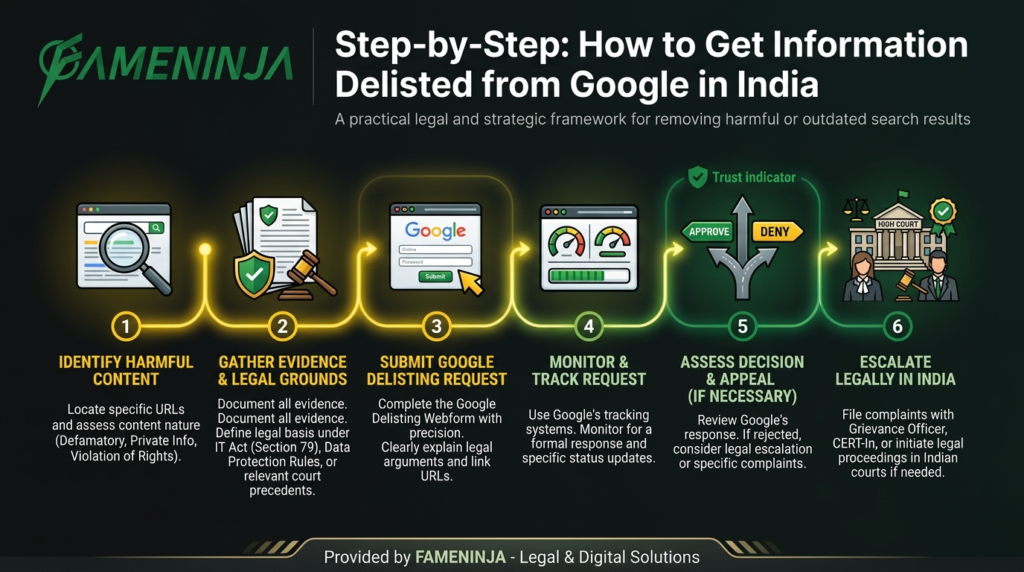
Route 1: Google’s Own Removal Process (Fastest)
Google has specific removal request forms that you can use without any court order. This is the fastest route and should be your first attempt.
Step 1: Identify the right removal form.
Google offers several removal tools:
Personal information removal: For removing personal contact information, identification numbers, financial information, or confidential medical records. Use the Google personal information removal request form.
Outdated content removal: For content that has been updated or removed from the source website but still appears in Google search results. Use the Google outdated content removal tool.
Legal removal request: For content that violates Indian law. Use Google’s legal removal request form.
Step 2: Fill out the form with specific details.
For each URL you want delisted, provide:
- The exact URL (not just the website)
- Why the content should be removed (tie it to a specific legal ground)
- Your relationship to the information (you are the person depicted/mentioned)
- Any court orders or legal notices you have
Step 3: Reference Indian legal precedents.
In the “additional information” field, cite:
- Justice K.S. Puttaswamy v. Union of India (2017) for Right to Privacy
- The specific case most relevant to your situation (Jorawer Singh Mundy for acquittals, etc.)
- DPDP Act 2023, Section 12(3) for erasure rights
- Any court order you have
Step 4: Follow up.
Google typically responds within 10-30 days. If you don’t hear back, follow up through the same form. If rejected, move to Route 2.
Route 2: Intermediary Grievance Officer (IT Rules 2021)
Under the IT (Intermediary Guidelines) Rules 2021, every significant social media intermediary and search engine operating in India must appoint a Grievance Officer. You can file a complaint directly.
For Google India:
Send a detailed complaint to Google’s India Grievance Officer. Include:
- Your identification (Aadhaar is not required, but government ID helps)
- The specific URLs you want delisted
- Your legal arguments (privacy, RTBF, DPDP Act)
- Evidence supporting your claim (acquittal order, court dismissal, etc.)
- A clear request for delisting within the stipulated timeframe
The Grievance Officer must acknowledge your complaint within 24 hours and resolve it within 15 days (or 72 hours for certain categories including privacy violations).
If the Grievance Officer doesn’t resolve it:
Escalate to the Grievance Appellate Committee at gac.gov.in. File your appeal within 30 days of the Grievance Officer’s decision (or non-decision). The Committee must dispose of your appeal within 30 days.
Route 3: Court Order (Most Authoritative)
If Google and the intermediary grievance process don’t work, a court order is the definitive solution. Here’s how:
Which court to approach:
File a writ petition in the High Court of your state. RTBF petitions are typically filed under Article 226 (High Court writ jurisdiction) or Article 21 (fundamental rights).
What to include in your petition:
- A description of the information you want delisted
- How the information violates your right to privacy
- That the information is outdated, irrelevant, or prejudicial
- Reference to Puttaswamy and the relevant RTBF case law
- DPDP Act 2023 provisions
- The specific URLs and platforms involved
- Your prior attempts at resolution (Google forms, Grievance Officer)
What to expect:
The court will balance your privacy interest against the public interest. If your case is strong (acquittal, outdated charges, personal information), courts have been increasingly sympathetic to RTBF claims.
Cost and timeline:
A writ petition in a High Court typically costs Rs. 25,000 to Rs. 2,00,000 in legal fees depending on the complexity and the lawyer. Timeline varies by court, but interim orders can be obtained within weeks if there’s urgency. The Jorawer Singh Mundy order was passed relatively quickly given the clear acquittal.
Route 4: Removing Content from Specific Platforms
Beyond Google, you may need to address the original source:
Indian Kanoon: Indian Kanoon publishes court judgments and doesn’t typically remove them. However, courts can order Indian Kanoon to mask or redact personal details (the Karthick Theodore route). If you have a court order directing masking, Indian Kanoon is obligated to comply.
Casemine: Similar to Indian Kanoon, Casemine hosts case law databases. Court orders for redaction apply here too.
News websites: For news articles, contact the publication’s editorial team first, requesting removal or anonymization. If they refuse, file a complaint with their Grievance Officer under IT Rules 2021. For defamatory content, a legal notice under BNS 2023 Section 79 (defamation) creates additional pressure.
For detailed strategies on deindexing court cases, see our dedicated guide on deindexing court cases from Google.
For removing negative news articles specifically, our guide on deindexing negative news from Google covers the process in detail.
Common Mistakes That Get RTBF Requests Rejected
After helping clients through dozens of RTBF processes, here are the mistakes we see most often:
Not providing specific URLs. “Remove all mentions of me from the internet” will be rejected. You need to provide the exact URL of each piece of content you want removed. Be specific.
Claiming RTBF for content that’s currently relevant. If the article is about something that happened last month and is still newsworthy, RTBF is the wrong tool. RTBF works best for outdated information that’s no longer relevant.
Not mentioning the legal basis. Just saying “I want this removed” isn’t enough. Reference specific legal provisions: Article 21, Puttaswamy, the relevant case precedent, and DPDP Act sections. Google and courts respond to legal arguments, not emotional appeals.
Filing in the wrong jurisdiction. If the content was published by a Delhi-based news site, the Delhi High Court is the appropriate forum. Filing in another state’s High Court can lead to jurisdictional challenges.
Ignoring the source while only targeting Google. Deindexing from Google hides the content from search results, but the content still exists on the original website. For complete removal, you need to address both the source and the search engines.
Not preserving evidence of prior attempts. Courts want to see that you tried the intermediary grievance process before approaching them. Save all complaint numbers, email responses, and rejection notices.
What the DPDP Act Changes for RTBF Going Forward
The DPDP Act 2023 is still being operationalized (the final rules are being drafted). But when fully implemented, it will provide stronger statutory support for RTBF-like requests:
Data erasure rights become enforceable. Currently, RTBF depends on court interpretation. Under DPDP, you’ll have a statutory right to request erasure of personal data that’s no longer needed.
Data Protection Board as an adjudicator. Instead of going to court for every RTBF claim, you’ll be able to approach the Data Protection Board of India for faster resolution.
Penalties for non-compliance. Data fiduciaries (including search engines and websites) that fail to comply with valid erasure requests will face penalties under DPDP.
This doesn’t replace court remedies. You’ll still be able to petition courts for RTBF, and the judicial precedents will remain relevant. DPDP adds another avenue, not a replacement.
How FameNinja Handles RTBF Cases

At FameNinja, delisting court cases and negative news from Google is one of our core services. Here’s our typical process for RTBF cases:
Assessment. We evaluate the client’s situation to determine which legal route is most appropriate. Not every case needs a court order. Many can be resolved through Google’s removal tools or intermediary grievance processes.
Documentation. We help the client compile the necessary documentation: acquittal orders, case dismissal certificates, and evidence of prejudice caused by the continued availability of the information.
Multi-route filing. We typically file through Google’s removal process and the intermediary grievance process simultaneously. If both fail, we coordinate with the client’s legal counsel for court proceedings.
Monitoring and follow-up. After removal, we monitor search results to ensure the content stays delisted. Sometimes Google re-indexes content if it appears on new URLs or if the source website republishes. Ongoing monitoring catches these issues early.
Integration with broader ORM. RTBF is often one part of a larger personal online reputation management strategy. While we work on delisting negative content, we simultaneously build positive content that dominates search results for the client’s name.
RTBF for Different Situations: Quick Reference
You were acquitted of a criminal charge: Best route: Google legal removal form + cite Jorawer Singh Mundy precedent. If rejected, High Court writ petition. Success rate: high.
Your old court case appears on Indian Kanoon: Best route: Court order directing masking/redaction + Google deindexing request. Reference Karthick Theodore case. See our full guide on court case deindexing.
Old news article still ranking for your name: Best route: Contact the publication’s editor requesting removal or anonymization + Google outdated content tool. If refused, Grievance Officer complaint + legal notice. See our guide on deindexing negative news.
Non-consensual intimate images/videos: Best route: cybercrime.gov.in complaint + platform removal request + Google removal + legal action under IT Act Sections 66E/67. Also covered by the 3-hour deepfake removal rule if AI-generated.
Old social media posts resurfacing: Best route: Platform deletion + Google outdated content tool. For more, see our guide on deindexing negative social posts.
Personal information (address, phone, Aadhaar) published without consent: Best route: Google personal information removal tool. This has a high success rate for contact information and identification numbers. DPDP Act strengthens this claim.
FAQ
Is the Right to Be Forgotten a law in India?
Not as a standalone statute, but it has strong legal backing. The Supreme Court in Puttaswamy (2017) recognized the Right to Privacy as a fundamental right under Article 21, with RTBF as a component. Multiple High Courts have granted RTBF relief. The DPDP Act 2023 provides statutory support through data erasure provisions, though it doesn’t use the phrase “Right to Be Forgotten” explicitly. For practical purposes, RTBF is an enforceable right in India through court orders and DPDP provisions.
How long does it take to get information delisted from Google in India?
Through Google’s own removal forms: 10-30 days for a response, with removal happening within days if approved. Through the Intermediary Grievance Officer: 15 days for resolution (72 hours for privacy violations). Through court: varies widely, but interim orders can be obtained within 2-4 weeks for urgent cases. Full disposition may take months. The fastest route is Google’s direct removal tools when the case is straightforward (personal information, acquittals).
Can I remove my court case from Indian Kanoon?
You cannot directly request removal from Indian Kanoon. Indian Kanoon considers court judgments to be public records and typically resists removal requests. However, courts can order Indian Kanoon to mask or redact personal details from judgments. The Karthick Theodore case established this precedent at the Madras HC level, and the Supreme Court is currently deciding the broader scope in Ikanoon Software Pvt. Ltd. v. Karthick Theodore. In the meantime, you can request Google to deindex the Indian Kanoon page from search results even if the page itself remains live.
Does RTBF apply to social media posts?
Yes, though the mechanism differs by platform. You can request social media platforms to remove posts containing your personal information or outdated content under the IT Rules 2021 Grievance Officer process. If the platform refuses, you can escalate to the Grievance Appellate Committee or court. For search engine results showing cached social media content, Google’s removal tools apply. The DPDP Act’s consent withdrawal and erasure provisions also apply to social media platforms operating in India.
Can public figures use the Right to Be Forgotten?
Public figures have a harder time with RTBF claims because courts balance their privacy against the public’s right to information. However, RTBF is not completely unavailable. If the information is personal (not related to their public role), outdated, and prejudicial, public figures can still succeed. The Zulfiqar Ahman Khan case (involving #MeToo allegations) showed that even public figures can obtain RTBF-type relief in certain circumstances. The key factor is whether the information relates to their public duties or personal life.
How much does it cost to exercise RTBF in India?
Filing through Google’s removal tools and the intermediary grievance process is free. Filing with the Grievance Appellate Committee is also free. Court proceedings are the expensive option: legal fees for a High Court writ petition typically range from Rs. 25,000 to Rs. 2,00,000 depending on complexity and the lawyer. If the DPDP Act’s Data Protection Board becomes operational, filing complaints there is expected to be free or low-cost. For an ORM firm to handle the process end-to-end (documentation, filing, monitoring), costs vary by case complexity.
What’s the difference between delisting and deletion?
Delisting means the content is removed from search engine results but still exists on the original website. Deletion means the content is removed from the source entirely. Most RTBF cases in India result in delisting (Google removes it from search results) rather than deletion (the website takes it down). For complete removal, you need to address both the search engine and the source website separately. Court orders can direct both delisting and deletion.
Will the Supreme Court’s ruling in Ikanoon v. Theodore affect my RTBF rights?
Yes, this pending Supreme Court case will significantly clarify RTBF in India, specifically regarding judicial records. If the court rules broadly in favor of RTBF for judicial records, it will strengthen all RTBF claims involving court cases. If it rules narrowly (limiting RTBF for public court records), it may make it harder to get court judgments delisted, though other types of personal information would still be covered. Regardless of the outcome, the Puttaswamy privacy right and DPDP Act provisions will continue to support RTBF for non-judicial personal information.