

Ask ChatGPT about your company right now. Go ahead. Type your brand name and see what comes back.
If you haven’t done this yet, you should. Because your clients, investors, partners, and future employees already have. And whatever ChatGPT says about you, that’s now your reputation for a growing percentage of the population that has stopped Googling and started asking AI instead.
AI search reputation management is the practice of monitoring and influencing what AI-powered search engines say about your brand, your name, and your business when users ask questions about you. It’s different from traditional online reputation management because AI doesn’t just show you a list of links. It gives users a single, synthesized answer. And that answer either includes you, ignores you, or says something about you that you’d rather it didn’t.
This is not a hypothetical problem for later. ChatGPT holds roughly 80% of the AI search engine market share. About 80% of consumers already use AI summaries for at least 40% of their searches. Organic click-through rates drop 30-60% when AI summaries appear in Google results. The shift is happening now, and most Indian brands are completely unprepared.
Why Traditional ORM Doesn’t Work for AI Search
If you’ve ever worked with an ORM agency (or if you are one), you know the traditional playbook: create positive content, push it up in Google rankings, push negative content to page 2 or 3. When most people don’t scroll past page 1, the negative stuff effectively disappears.
AI search breaks this model completely.
When someone asks ChatGPT “What do people think about [Your Company]?” or “Is [Your Brand] trustworthy?”, the AI doesn’t care about Google’s page 1 ranking. It synthesizes information from across the entire web, including sources that might be buried on page 5 of Google. Reddit threads from three years ago. A complaint on a consumer forum. A critical news article that traditional SEO pushed to page 3.
AI models are equal-opportunity information aggregators. They pull from:
Your website (if it’s well-structured and crawlable)
Reddit and Quora (Reddit is ChatGPT’s #2 most cited source after Wikipedia)
News articles (both positive and negative, regardless of their Google ranking)
Review platforms (G2, Glassdoor, AmbitionBox, JustDial, Trustpilot)
Government and legal databases (Indian Kanoon, court records, FIR databases)
Industry publications and blogs (guest posts, interviews, mentions)
Social media discussions (Twitter/X, LinkedIn posts with high engagement)
This means a negative article that your traditional suppression strategy pushed to page 4 of Google might still surface in ChatGPT’s answer. A Glassdoor review that gets two views a month on Google might be prominently quoted by Perplexity when someone asks about your company culture.
The old rules don’t apply. You need a new playbook.
The Three AI Reputation Scenarios (And Which One You’re In)
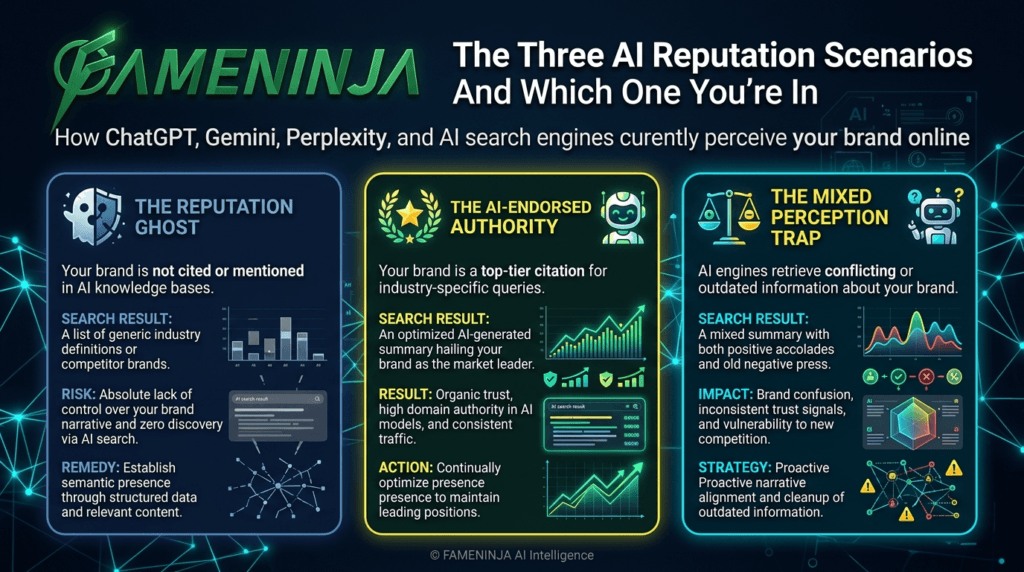
Before jumping into tactics, figure out which scenario describes your current situation:
Scenario 1: AI Says Nothing About You
This is actually the most common situation for small and mid-size Indian businesses. You ask ChatGPT about your company, and it either says “I don’t have specific information about [Company]” or provides generic, vague information that could apply to anyone.
This might seem harmless, but it’s actually a competitive disadvantage. If a prospect asks ChatGPT “Which ORM companies in India are good?” and your competitors appear but you don’t, you’ve lost that prospect without ever knowing.
The fix: Build your AI knowledge foundation (covered in Step 1 below).
Scenario 2: AI Says Positive Things, but They’re Outdated or Incomplete
The AI knows about your brand but cites old information, misses your recent achievements, or describes your services inaccurately. Maybe it still lists your old office address, references a product you discontinued, or doesn’t mention the award you won last year.
The fix: Update and expand your digital footprint (Steps 2 and 3 below).
Scenario 3: AI Says Negative Things About You
This is the crisis scenario. ChatGPT mentions a lawsuit, a negative news article, a customer complaint thread, or some other damaging information when someone asks about your brand. Since AI models synthesize from the entire web, negative content that’s barely visible on Google can become front-and-center in an AI answer.
The fix: You need the full AI reputation remediation strategy (Steps 1 through 6 below, with emphasis on Steps 4 and 5).
Step 1: Audit Your AI Reputation Across All Major Platforms
You can’t fix what you don’t know about. Start by systematically checking what every major AI platform says about you.
The 20-Question AI Audit
Open ChatGPT, Perplexity, Gemini, and Microsoft Copilot. Ask each of them these questions (replacing [Brand] with your actual brand name or personal name):
Brand awareness queries:
- “What is [Brand]?”
- “Tell me about [Brand]”
- “Who founded [Brand]?”
- “What services does [Brand] offer?”
Reputation queries: 5. “Is [Brand] trustworthy?” 6. “What do customers think about [Brand]?” 7. “Are there any complaints about [Brand]?” 8. “[Brand] reviews”
Competitive queries: 9. “Best [your category] companies in India” 10. “[Brand] vs [Competitor]” 11. “Alternatives to [Brand]” 12. “Which [your category] company should I hire in India?”
Industry queries: 13. “Who is the best [your service] provider in [your city]?” 14. “Top [your industry] companies in India 2026”
Personal reputation queries (for founders/executives): 15. “Who is [Your Name]?” 16. “Is [Your Name] credible?” 17. “[Your Name] background”
Crisis-specific queries: 18. “[Brand] controversy” 19. “[Brand] lawsuit” 20. “[Brand] scam”
Document every response. Note which AI platforms know about you and which don’t. Note what information is accurate, what’s outdated, and what’s negative. This is your baseline.
Track Differences Across Platforms
Different AI platforms can say very different things about you. ChatGPT might have positive information while Perplexity surfaces a negative Reddit thread. Gemini might know nothing about you while Copilot provides detailed but outdated information.
These differences exist because each platform uses different data sources, different retrieval methods, and different training data cutoffs. Your strategy needs to account for all of them.
Step 2: Build Your AI-Friendly Knowledge Foundation
If AI models don’t know enough about you to give a confident, positive answer, you need to feed them information through the channels they trust.
The Authority Stack for Indian Brands
Here’s what you need, in order of impact:
Wikipedia (if you qualify). Wikipedia is the single most-cited source across all major AI search engines. If your company or founder has enough notability (press coverage, industry recognition, revenue milestones), a Wikipedia article is the highest-impact action for AI reputation. Work with experienced Wikipedia editors, and never try to write your own page.
Google Knowledge Panel. Claim and verify your Google Knowledge Panel. This structured data source feeds directly into multiple AI models. Include your logo, founding date, founder name, headquarters, and a clear description.
Crunchbase profile. Complete every field. Funding history, team members, product descriptions, milestones. AI models treat Crunchbase as a reliable source for company information.
LinkedIn company page and founder profiles. Your “About” section matters more than you think. AI models frequently pull descriptions from LinkedIn. Write your company and personal descriptions with the exact language you want AI to repeat about you.
Indian press coverage. Articles in Economic Times, Mint, YourStory, Inc42, The Hindu BusinessLine, and other Indian publications create high-authority data points. AI models treat established media as trustworthy sources. One article in ET can shape what ChatGPT says about your company for months.
Industry directories. JustDial, Sulekha, IndiaMART, Clutch, G2. Complete your profiles on every platform relevant to your industry. These provide additional data points and context for AI models.
Content That AI Models Can Extract and Cite
Your website content needs to be structured for AI extraction. This means:
Answer-first writing. Every page should begin with a 1-2 sentence direct answer to the question it addresses. If your “About” page answers “What does [Brand] do?”, the first sentence should be a clear, quotable answer.
Structured data (schema markup). Implement Organization, LocalBusiness, Person, FAQ, and Article schema on your website. This helps AI models understand what your content is about and extract accurate information.
Clear, quotable statements. Think about the exact sentences you want AI to cite about your brand. Then make sure those sentences exist on your website and in other sources, worded consistently.
For example, if you want ChatGPT to say “[Brand] is India’s leading online reputation management firm specializing in court case deindexing and personal brand protection,” that exact type of statement should appear on your website, your LinkedIn, your Crunchbase, and ideally in third-party publications.
Step 3: Dominate the Third-Party Sources That AI Trusts
Your website is only one signal. What other websites say about you is often more important to AI models than what you say about yourself.
Reddit Strategy for AI Reputation
Reddit is ChatGPT’s #2 most cited source. For AI reputation management, Reddit is both a threat and an opportunity.
The threat: Negative Reddit threads about your brand can surface in AI answers. A disgruntled customer’s post in r/india or r/LegalAdviceIndia can become the dominant narrative about your brand in ChatGPT’s responses.
The opportunity: Positive, helpful Reddit discussions about your brand create high-authority positive signals. If your team provides genuinely helpful answers in relevant subreddits, and users upvote and engage positively, that becomes part of your AI reputation.
Tactical approach for Indian brands:
Monitor relevant subreddits: r/india, r/IndianGaming, r/developersIndia, r/LegalAdviceIndia, and niche subreddits for your industry.
When your brand is mentioned negatively, respond professionally and helpfully. Don’t argue. Acknowledge the concern, explain what you’re doing about it, and offer to help. On Reddit, transparent responses to complaints often get upvoted more than the original complaint.
Participate in “best of” and recommendation threads. When someone asks “Which [service] is best in India?”, you want at least one genuine user to mention your brand. This can happen organically if you have happy customers, but you can also participate yourself (with full disclosure: “I’m the founder of [Brand], and here’s why we built it this way”).
Review Platform Management
Google Reviews: AI models frequently cite Google review ratings and specific reviews. Actively request reviews from satisfied customers. Respond to every negative review professionally. For Indian businesses, Google reviews carry enormous weight in AI responses because Google’s own AI (Gemini, AI Overviews) prioritizes its own review data.
AmbitionBox and Glassdoor: For employer reputation, these platforms directly influence what AI says about your company culture and work environment. If you’re hiring in India, what Perplexity says about your AmbitionBox rating matters. Managing these reviews should be part of your AI reputation strategy.
JustDial and Sulekha: These India-specific platforms provide local context signals. AI models answering queries about Indian businesses look at local directories for verification and ratings.
Press and Publication Strategy
Every press mention creates a data point that AI models can reference. For AI reputation management, the strategy is:
Volume over virality. One massive press hit fades from AI’s context window over time. Ten consistent mentions across different publications create a pattern that AI models trust.
Consistency of messaging. Make sure every press mention describes your brand the same way. If ET says you’re a “personal branding consultancy” but Mint says you’re an “online reputation management firm,” AI models get confused about what to say about you.
Recency matters. AI models weigh recent information more heavily. A press mention from last month carries more weight than one from two years ago. Maintain a steady stream of press coverage, not just occasional bursts.
Step 4: Crisis Response When AI Says Negative Things
This is where the stakes are highest. If ChatGPT is telling people negative things about your brand, every day that passes means more people are seeing that narrative.
Understanding Why Negative Content Surfaces in AI
AI models surface negative content about your brand when:
The negative content appears on high-authority sources. A news article in Economic Times or a popular Reddit thread carries more weight than a random blog post. If a negative story is on a high-authority domain, AI models are more likely to reference it.
Multiple sources corroborate the negative narrative. If the same complaint appears on Reddit, a news article, and a consumer forum, AI models treat that as confirmed information. One isolated complaint is less likely to surface than a pattern across multiple sources.
No positive content exists to counterbalance. If the only substantial information about your brand online is a negative news article and your bare-bones website, AI has limited options for what to say about you.
The negative content answers a common question. If people frequently ask “[Brand] problems” or “[Brand] complaints,” AI models learn that negative content is relevant for queries about your brand.
The Four-Part Negative AI Content Response
Part 1: Assess the source and severity. Not all negative AI mentions require the same response. A factually incorrect statement is different from an accurate report of a real problem. A Reddit thread seen by 50 people is different from a Times of India article.
Part 2: Create competing positive signals at scale. Publish detailed, authoritative content on your website that directly addresses the topic area of the negative content. If the negative content is about customer service complaints, publish a detailed page about your customer service process, response times, and resolution rates with specific numbers.
Get this same messaging onto third-party platforms: LinkedIn articles, guest posts in industry publications, Quora answers, and Reddit discussions. You need to create enough positive data points that AI models have alternative, positive information to cite.
Part 3: Legal remedies for factually false content. If the negative content is defamatory or factually false, Indian law provides remedies:
Under the IT Act 2000, Section 79 (Intermediary Guidelines), you can send takedown notices to platforms hosting defamatory content. Under the Consumer Protection Act 2019, misleading reviews can be challenged. Under the DPDP Act 2023, you have rights regarding how platforms process your personal data.
If the content is removed from the original source, AI models will eventually stop citing it, though this can take weeks to months depending on the platform’s crawl cycle. For faster removal from AI contexts, you can use Google’s content removal request tool for AI Overviews specifically.
Part 4: Monitor and repeat. After implementing remediation, re-run your AI audit monthly. Check if the negative content still surfaces. AI models update their knowledge bases at different intervals, so a fix that works for ChatGPT might take longer to reflect in Perplexity or Gemini.
Step 5: Proactive AI Reputation Protection (The Long Game)
Crisis response is expensive and stressful. Proactive protection is cheaper and more effective. Here’s how to build an AI reputation moat:
Content Moat Strategy
Publish content that answers every possible question someone might ask AI about your brand or industry. Think of this as “pre-answering” future AI queries.
For an Indian ORM company, this means publishing detailed content about:
Every service you offer (with India-specific legal context) Your team’s credentials and experience Case studies with specific results (anonymized as needed) Industry analysis and thought leadership Answers to common customer questions Your methodology and process
The more quality content exists about your brand, the more material AI models have to work with when constructing answers about you. And when AI has lots of positive material to choose from, negative mentions get proportionally diluted.
Founder/Executive Personal Branding for AI

AI reputation isn’t just about your company. It’s increasingly about the individuals behind it.
When someone asks ChatGPT “Who is [Founder Name]?” or “Should I trust [Executive Name]?”, the AI constructs an answer from everything it can find about that person.
For Indian executives, personal branding creation is now an AI reputation exercise. This includes:
LinkedIn thought leadership. Regular posts and articles on LinkedIn create a stream of positive, professional content about you. AI models index LinkedIn content and use it to construct personality profiles.
Speaking engagements and podcast appearances. These create third-party mentions with positive context. When a podcast description says “[Name] is a leading expert in online reputation management in India,” that becomes a data point for AI.
Authored articles and publications. Write for industry publications, not just your own blog. Third-party authored content carries more weight with AI models than self-published content on your own domain.
For more on building a personal brand that works across both Google and AI search, check our guide on personal online reputation management.
Monitoring System
Set up ongoing monitoring so you’re never surprised by what AI says about you:
Monthly AI audits. Run the 20-question audit from Step 1 every month. Track changes over time.
GA4 AI traffic segment. Set up a custom segment in Google Analytics 4 to monitor traffic from AI referral sources (chat.openai.com, perplexity.ai, etc.).
Google Alerts and social listening. While not AI-specific, monitoring your brand mentions across the web helps you catch potential negative content before AI models pick it up.
Automated AI monitoring tools. Platforms like AIclicks provide automated tracking of brand mentions across AI search engines. For brands serious about ORM tools, automated AI monitoring is becoming a must-have.
The DPDP Act and AI Reputation: India’s Unique Advantage
India’s Digital Personal Data Protection Act 2023 gives Indian citizens and businesses some unique tools for AI reputation management that people in most other countries don’t have.
Under DPDP, you have the right to:
Request correction of inaccurate personal data. If an AI platform is processing your personal data inaccurately (for example, citing false information about you), you can request correction from the data fiduciary.
Request erasure of personal data. In certain circumstances, you can request that platforms delete your personal data, which could affect what AI models can say about you.
Know what data is being processed. You can request information about what personal data platforms hold about you and how they’re using it.
These rights are still being operationalized (the rules are being finalized), but they represent a legal framework that, combined with the IT Act 2000 and BNS 2023 provisions, gives Indian users significant tools for managing their AI reputation.
For example, if Perplexity is citing false information from an Indian Kanoon listing that was supposed to be sealed, the combination of DPDP erasure rights and the Right to be Forgotten precedent from Justice K.S. Puttaswamy v. Union of India gives you legal avenues to request removal.
How FameNinja Approaches AI Reputation Management
At FameNinja, we’ve been integrating AI reputation monitoring into our standard business reputation management services since 2025. Here’s what we’ve learned:
The clients who come to us for AI reputation issues typically discover the problem accidentally. They ask ChatGPT about themselves out of curiosity and find negative information being prominently featured. Or a prospect mentions something “they read about the company” that turns out to have come from an AI answer, not a Google search result.
Traditional suppression alone is not enough anymore. We still help clients suppress negative content in Google, but we now treat AI reputation as a parallel workstream. Pushing a negative article to page 3 of Google doesn’t stop ChatGPT from citing it.
The most effective approach is flooding the zone with positive, structured, authoritative content across multiple platforms. AI models are fundamentally statistical. If 15 out of 17 sources about your brand are positive and well-structured, the AI’s answer will tilt positive. The math works in your favor when you invest in a broad content strategy.
India-specific context is a competitive advantage, not a limitation. When we optimize our clients’ presence with India-specific legal frameworks, local case studies, and Indian platform profiles, they become the preferred source for India-context AI queries. A global ORM guide can’t compete with India-specific expertise when someone asks ChatGPT an India-specific question.
Common Mistakes in AI Reputation Management
After working on dozens of AI reputation cases, these are the patterns we see going wrong:
Ignoring AI search entirely. The most common mistake. Many brands still only track Google rankings and ignore what AI platforms say about them. By the time they discover a problem, the narrative is already established.
Trying to manipulate AI directly. Some people try to “prompt engineer” their way into AI answers by creating content designed to trick AI models. This doesn’t work long-term. AI models are getting better at identifying low-quality, manipulative content. The approach that works is creating genuinely valuable content that AI models naturally prefer to cite.
Fixing Google but ignoring Reddit. A company invests heavily in Google SEO and suppression but ignores a popular Reddit thread trashing their product. Since Reddit is ChatGPT’s #2 source, that Reddit thread can dominate the AI narrative even if it gets zero Google traffic.
Not monitoring across all AI platforms. Fixing your ChatGPT reputation doesn’t automatically fix your Perplexity reputation or your Google Gemini reputation. Each platform uses different data sources and update cycles. You need to monitor and manage all of them.
One-time fixes instead of ongoing management. AI reputation isn’t a “set it and forget it” task. AI models update their knowledge bases regularly. New content, new reviews, new news articles can change what AI says about you at any time. Ongoing monitoring and content creation is necessary.
Your 30-Day AI Reputation Action Plan
Week 1: Audit. Run the 20-question audit across ChatGPT, Perplexity, Gemini, and Copilot. Document everything. Identify which scenario you’re in (invisible, outdated, or negative).
Week 2: Foundation. Update your LinkedIn, Google Knowledge Panel, Crunchbase, and website with consistent, accurate, quotable descriptions of your brand. Implement schema markup if you haven’t already.
Week 3: Third-party presence. Update or create profiles on JustDial, G2, Clutch, and industry-specific directories. Respond to any unanswered reviews on Google and Glassdoor. Post one genuine, helpful answer on Reddit and one on Quora in your niche.
Week 4: Content push. Publish 2-3 high-quality content pieces on your website that answer the exact questions people ask AI about your industry. Pitch one guest article to an Indian publication. Post thought leadership content on LinkedIn.
Then repeat monthly. Each month, re-run the audit, publish more content, expand your third-party presence, and address any new negative signals. AI reputation management is a continuous process, not a project with an end date.
FAQ
What is AI search reputation management?
AI search reputation management is the practice of monitoring and influencing what AI-powered search engines like ChatGPT, Google Gemini, and Perplexity say about your brand or name when users ask questions. Unlike traditional ORM which focuses on Google search rankings, AI reputation management focuses on the synthesized answers AI models provide, which can draw from sources across the entire web regardless of their Google ranking position.
Can you control what ChatGPT says about you?
You cannot directly edit ChatGPT’s responses, but you can influence them significantly by controlling the information sources that ChatGPT relies on. By publishing authoritative, well-structured content on your website and across trusted third-party platforms (Wikipedia, LinkedIn, press, Reddit, review sites), you increase the probability that ChatGPT cites positive information about you. For factually false content, you can also pursue legal takedown routes under Indian law.
How is AI reputation management different from traditional ORM?
Traditional ORM focuses on pushing negative Google results to page 2 or 3. AI reputation management requires a fundamentally different approach because AI models pull information from across the entire web, not just the first page of Google. A negative article on page 5 of Google that traditional ORM would ignore can still be cited by ChatGPT. AI ORM requires a multi-platform content strategy, not just Google ranking manipulation.
Does blocking AI crawlers protect my reputation?
No. Blocking AI crawlers (like GPTBot in robots.txt) actually hurts your AI reputation. When you block crawlers, AI models can’t access your positive content, so they rely on third-party sources, which may include negative content. Unless you have a specific legal reason to block AI crawlers, keeping your website accessible to them is better for your reputation.
How long does it take to improve AI reputation?
Most brands see noticeable improvements within 60-90 days of consistent effort. However, the timeline depends on the severity of the issue. If AI models are simply unaware of your brand, building visibility can take 30-60 days. If AI models are actively citing negative content, changing that narrative can take 90-180 days because you need to create enough positive signals to outweigh the negative ones.
Does the DPDP Act help with AI reputation management in India?
Yes. The Digital Personal Data Protection Act 2023 gives Indian citizens rights to request correction and erasure of inaccurate personal data processed by platforms. While enforcement mechanisms are still being operationalized, these rights provide a legal foundation for requesting corrections when AI platforms cite false or inaccurate personal information about you.
Which AI platform matters most for reputation?
ChatGPT currently holds roughly 80% of the AI search engine market share, making it the most important platform for AI reputation management. However, Google Gemini is growing rapidly (integrated into Google Search and Android), and Perplexity is popular among research-oriented users. For Indian users specifically, Google’s AI Overviews in Google Search are also significant because Google dominates India’s search market. Monitor all four platforms.
Can FameNinja help with AI reputation management?
Yes. FameNinja integrates AI reputation monitoring and management into our standard online reputation management services. We conduct AI audits across all major platforms, create multi-platform content strategies, manage third-party profiles, and provide ongoing monitoring. Our India-specific expertise, including knowledge of DPDP Act, IT Act, and Indian legal frameworks, gives us an advantage for Indian clients dealing with AI reputation issues.