

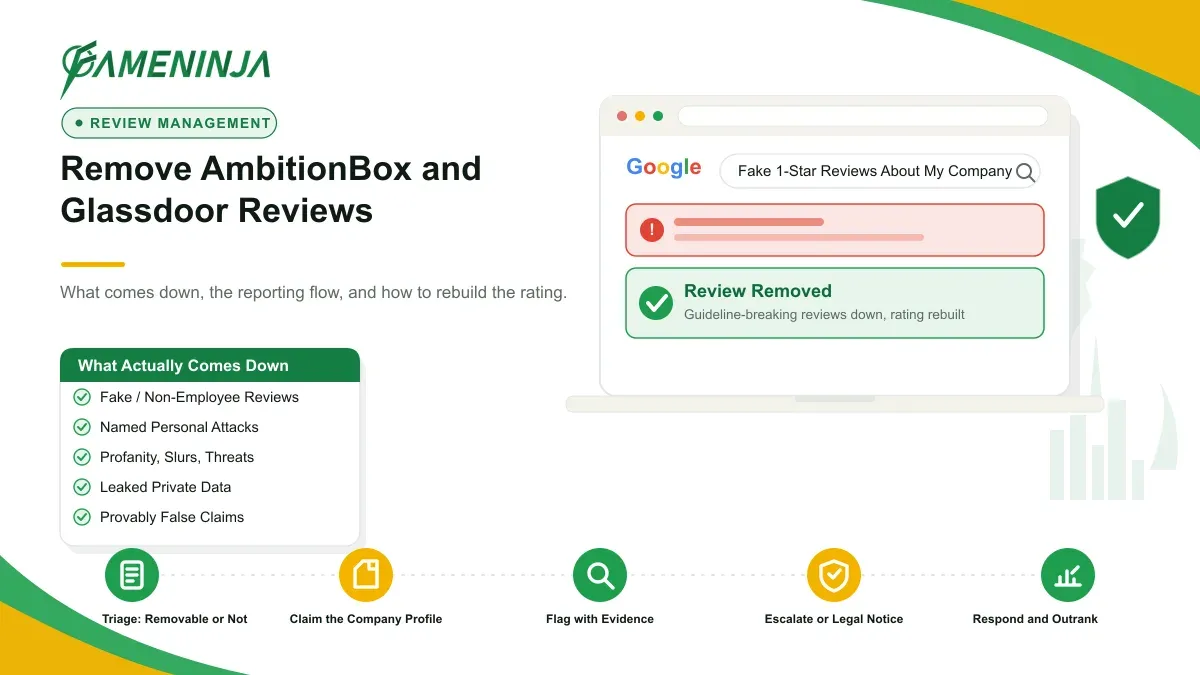
What actually comes down, how to force it, and an honest read on what you can only manage and outrank.
One anonymous review can undo months of hiring. A candidate you were about to close reads a one-star rating calling your company a toxic sweatshop that delays salaries. A client googles your brand and lands on a bitter thread. Suddenly you are explaining a stranger's claim you never got the chance to answer.
If you need to remove negative AmbitionBox and Glassdoor reviews right now, you do not need a lecture on company culture. You need to know what comes down, how to force it, and what to do about the ones that will not move. This guide covers the reporting flow on each platform, the legal route for genuinely defamatory posts, the employer reputation management work that handles the rest, and the part most agencies skip: honest criticism is protected, and pretending otherwise wastes your money.
Discover our latest blog: How to Remove a Deepfake in India: The 2026 Takedown Playbook
Quick answer
You cannot delete a genuine negative review because it stings. AmbitionBox and Glassdoor remove only content that breaks their community guidelines: fake reviews from people who never worked there, personal attacks naming an individual, profanity or threats, leaked private or confidential data, and provably false statements of fact. Report the review through the platform's flagging flow with specific, guideline-referenced evidence, escalate in writing if it stalls, and use a legal notice or court order for defamatory anonymous posts. For honest criticism you cannot remove, the working fix is a measured public reply plus a steady flow of real reviews that moves the average.
Why do AmbitionBox and Glassdoor reviews hit hiring so hard?
Because they rank for your own company name, and a searcher sees them before they see you.
AmbitionBox, owned by Info Edge, the group behind Naukri, is the default employer-review site for Indian jobseekers. Glassdoor is its global equivalent. Both rank strongly on Google for "your company name reviews" and "your company name salaries". A candidate weighing your offer, a client running diligence, and an investor doing a background check all land on the same aggregate star rating, often above your own careers page.
That visibility cuts both ways. A cluster of angry reviews on page one shapes offers, closes, and diligence outcomes. But the rating is an average of many voices, which means it moves. A handful of removed guideline violations plus a genuine flow of fresh reviews can change the number a searcher sees inside a few weeks. This is why employer reviews are better treated as a standing reputation asset than a one-off cleanup, and why a broader online reputation management plan fixes the underlying signal instead of chasing individual reviews forever.
Which reviews can actually be removed, and which cannot?
Here is the part a "guaranteed removal" pitch will never tell you. Neither platform deletes a review because the employer disputes it. Both remove content that violates their guidelines, and both defend a real employee's right to describe their experience anonymously. Telling those two apart is the first real skill in this work, and getting it wrong is how employers waste months.
| What you report | AmbitionBox | Glassdoor | Realistic outcome |
|---|---|---|---|
| Fake review from a non-employee | Removable | Removable | Strongest case. Bring proof the person never worked there |
| Names and attacks an individual | Removable | Removable | Usually actioned quickly. Both ban targeting named people |
| Profanity, slurs, threats | Removable | Removable | Clear guideline breach, low argument |
| Leaked confidential or private data | Removable | Removable | Salary tied to a named person, client names under NDA, personal contact details |
| Duplicate or wrong-company posting | Removable | Removable | Mechanical fix, usually fast |
| Provably false statement of fact | Removable, evidence-heavy | Removable, evidence-heavy | Needs documentation. May need a takedown notice |
| Harsh but genuine opinion | Not removable | Not removable | Respond and outrank. No amount of reporting or money moves it |
| Ex-employee is still angry | Not removable | Not removable | Not a violation. Anger is not a guideline breach |
| Review you simply disagree with | Not removable | Not removable | Mass-reporting these can get the employer flagged |
The last three rows are where most employer-review budgets get burned. "Long hours, weak management, poor work-life balance" is precisely the speech both platforms exist to carry. Trying to force it down tends to backfire, because both publish anti-manipulation policies and can penalise employers who mass-report legitimate reviews. For that bucket the play is response and suppression, covered further down.
How do you report a review on AmbitionBox and Glassdoor?
Through the employer account, citing the exact guideline breached, with evidence attached. A precise report gets reviewed far faster than a general complaint.
AmbitionBox
Step 1: Claim your company profile
Verify ownership so you can respond publicly and raise issues as the official employer rather than an anonymous flag. Unclaimed profiles have almost no leverage.
Step 2: Flag the specific review
Use the report option on the review itself and select the exact violation: fake, abusive, confidential data, wrong company. Do not write "this is false" and stop there. Name the guideline.
Step 3: Send a written grievance with evidence
If flagging stalls, contact support in writing. Attach proof that the reviewer was never an employee, that a claim is factually checkable and false, or that private data is exposed. Cite the specific clause the review breaks.
Step 4: Respond publicly while you wait
A calm, factual employer reply neutralises much of the damage even while the report is pending, and it signals to every future reader that you engage rather than hide.
AmbitionBox handles large volumes of personal data about named individuals, so a review exposing a named person's private details or salary can be challenged as a privacy matter, not only as a guideline breach. The DPDP Act 2023 gives individuals rights over their personal data, which can strengthen a takedown request where a named employee's details have been published without consent.
If a cluster of reviews looks coordinated, treat it as a pattern rather than a set of individual complaints, and document the timing, the phrasing overlap, and the account behaviour. That documented history is what a review management specialist or a lawyer uses to escalate.
Glassdoor
Step 1: Flag through the employer account
Select the precise guideline it violates. Glassdoor removes content that is not a genuine first-hand experience, names individuals, contains slurs or threats, or leaks confidential information.
Step 2: Give specific, checkable grounds
"We disagree" is rejected. "This person was never employed here, and here is the payroll record showing it" gets traction. So does "this states a false, checkable fact, and here is the document that checks it".
Step 3: Escalate defamation through legal channels
Glassdoor will not usually unmask an anonymous reviewer on request. For a genuinely defamatory post that means a court order: a suit against the unknown author, then a John Doe subpoena compelling the platform to disclose whatever identifying data it holds. Courts weigh this against free-speech protections, so the underlying claim has to be real.
Step 4: Reply as the employer, every time
Every review lets you post an official response. Use it. A measured reply often does more for the next reader than a removal you may never win.
An honest note on timelines
We do not publish removal timelines, because they depend on the platform's queue, the strength of your evidence, and whether the review is contested. What we can say plainly: a clear guideline violation with documentary proof moves fastest, a contested factual dispute takes materially longer, and genuine opinion is not on a timeline at all because it is not coming down.
When does a negative review become defamation in India?
When it states a false fact as fact, not when it states an opinion you dislike. That distinction decides whether the legal route is available at all.
Defamation in India is addressed under the Bharatiya Nyaya Sanhita, 2023, which replaced the Indian Penal Code, and online publication also engages the Information Technology Act, 2000 together with the IT Rules 2021 made under it.
The practical difference looks like this. "Management was poor and I burned out" is an opinion, and it is protected however much it costs you. "This company withholds statutory provident fund contributions" is a statement of fact that is either true or false, checkable against records, and actionable if false.
There is also a route many employers do not know about. Under the intermediary rules, platforms must publish a Grievance Officer contact and respond to complaints within a defined window, with a further appeal available to a Grievance Appellate Committee if the platform's decision is unsatisfactory. That is a documented escalation path sitting between a flag and a lawsuit, and it costs nothing but a well-drafted complaint.
Two more things worth saying out loud. Most reviews are anonymous, so a defamation case typically starts against an unknown defendant with a court application to compel disclosure. And winning removal at the source does not automatically clear the Google result. If the review or the coverage around it is ranking for your brand, deindexing the search result is a separate track, which our work on removing negative articles and content covers.
This is general information, not legal advice. A wrong or overbroad legal threat can backfire badly, including a Streisand effect that amplifies the review to an audience that would never have found it. Have someone who does this regularly assess the case before you send anything.
What do you do about genuine negative reviews you cannot remove?
You answer them once, fix what caused them, and outrank what remains. Most reviews that hurt are real, and that is not a dead end. It is where the actual reputation work happens.
Respond professionally, publicly, once. Thank the reviewer, acknowledge the specific issue without getting defensive, reveal nobody's identity, and state what changed. You are writing for the next thousand readers, not to win an argument with one.
Fix the root cause. If three reviews mention delayed salaries or one bad manager, the durable fix is the payroll process and the manager. Reputation follows reality. No suppression holds against a genuine, ongoing problem, and anyone who tells you otherwise is selling you a treadmill.
Suppress what stays. Strengthen the assets that rank for your brand: your careers page, leadership profiles, credible press coverage, and a healthier review profile, so the damaging thread drops below the fold where most people never look. That combined rebuild is what reputation repair and ongoing online business reputation management are built to do.
If you are dealing with a live situation and want a straight read on which of your reviews are actually removable, message us on WhatsApp and we will tell you honestly, including when the answer is that a review is not coming down.
How to earn authentic positive reviews without breaking platform rules
The most effective way to fix an employer rating is to make the honest average better. Done cleanly this is legitimate and durable. Done with fakes it is the fastest way to get flagged.
- Ask at the right moment. Prompt employees after a genuine positive milestone: an appraisal, a project win, a work anniversary. Feeling drives honest reviews.
- Make it easy, never scripted. Share the AmbitionBox and Glassdoor links and invite honest feedback. Do not dictate wording, do not offer money or perks, and never post reviews yourself. Both platforms detect incentivised and fake reviews, remove them, and flag the employer who solicited them.
- Widen the sample. A rating built on five angry leavers is fragile. Fifty honest voices, good and bad, is a truer and steadier number, and it dilutes any single hostile review without anyone bending a rule.
- Keep it running. A one-off review drive fades. A quarterly rhythm holds the average where you want it.
The same discipline applies to customer reviews, not only employee ones. Our guidance on increasing positive reviews on Google and on removing negative reviews across platforms goes deeper on doing this without crossing into fake-review territory.
How FameNinja handles employer-review cleanup
We start by triaging every review into two buckets: removable, meaning a genuine guideline or legal violation we can push, and not removable, meaning real opinion we manage and outrank. That triage is free and it is the honest part, because it usually tells an employer that fewer reviews are removable than they hoped.
For the removable bucket we prepare precise, evidence-backed reports against the specific guideline, escalate in writing through the platform's grievance route when flagging stalls, and coordinate legal escalation where a post is genuinely defamatory. For the rest we run response and suppression, and we help you build a compliant flow of authentic reviews so the rating recovers at the source rather than being propped up.
What we never do is promise to erase every negative review, post fake ones, or guarantee that a platform will act. None of that is real, and all of it can make your situation worse than it is today.
If you are dealing with this right now
A hostile employer review feels like it defines you to every candidate and client. It does not have to. The fake and rule-breaking ones can come down, the defamatory ones have a legal route, and the honest ones can be answered and outranked while you fix what caused them.
What we offer first is a straight assessment: which of your AmbitionBox and Glassdoor reviews are actually removable, which need a legal push, and what it realistically takes to rebuild the rating with real voices. No guarantee, because nobody honest can give one.
Book a confidential consultation for the fastest reply. Everything you share stays between us.