

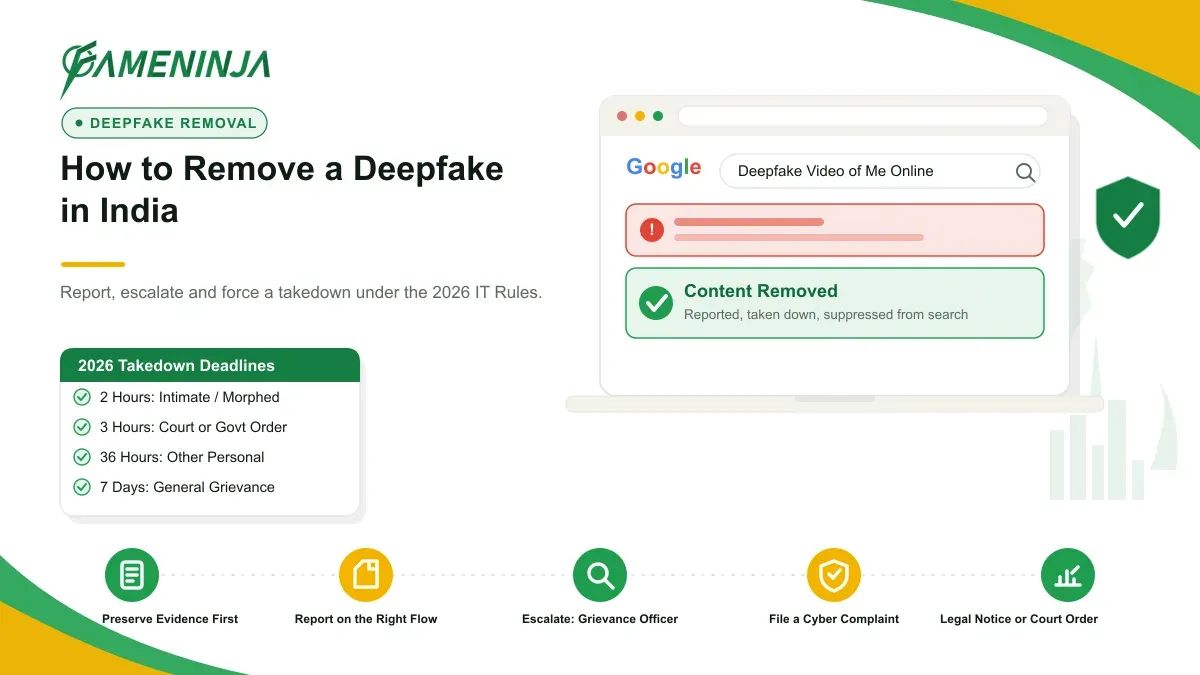
The new takedown clocks, the exact steps to force a removal, and an honest read on what gets deleted and what only gets suppressed.
A morphed video of you is sitting on someone's WhatsApp. A fake, explicit image with your face has appeared on an Instagram account you have never seen. A cloned voice note is asking your staff to transfer money. If any of that is happening right now, you do not need a lecture on artificial intelligence. You need to know how to remove a deepfake in India, who is legally obliged to act, and how fast. And if the clip has already started showing up in your search results, that is a second job running in parallel with the first.
This guide walks through the 2026 takedown rules, the exact steps to force a removal, and the legal routes when a platform stalls. It is written for the person in the middle of it, and for the founder or professional watching a fake clip that threatens years of trust. We will also be honest about the parts nobody else tells you: what gets deleted, what only gets suppressed, and where a court order becomes unavoidable.
Quick answer
To remove a deepfake in India, report it to the hosting platform under its grievance process, file a complaint on cybercrime.gov.in, and preserve every URL and screenshot as evidence. Under the amended 2026 IT Rules, platforms must act on non-consensual intimate or morphed content within roughly two hours of a valid report, and within about three hours of a court or government order. Persistent cases need a lawyer and a takedown order.
What counts as a deepfake under Indian law in 2026
A deepfake is synthetic media, an image, video or audio clip, generated or altered by AI to show a real person saying or doing something they never did. Indian law does not treat "deepfake" as a single named offence. It treats the harm the fake causes: impersonation, obscenity, privacy violation, forgery or defamation.
That distinction decides your route. It depends on what the fake does to you, not on the technology that made it. A cloned voice used to authorise a payment is handled differently from a morphed intimate image, even though both are deepfakes and both are illegal.
In February 2026, the Ministry of Electronics and Information Technology amended the Information Technology (Intermediary Guidelines and Digital Media Ethics Code) Rules to deal with what it calls synthetically generated information, or SGI. The amendment does two things. It requires platforms to label AI-generated content and keep traceable metadata that users cannot casually strip out. And it forces them to act on complaints far faster than before.
(Note: Source: Ministry of Electronics and Information Technology, Information Technology (Intermediary Guidelines and Digital Media Ethics Code) Amendment Rules, 2026, notified 10 February 2026, in force 20 February 2026. meity.gov.in)
The 2026 IT Rules amendment: your new takedown deadlines
The headline change is speed. The older framework gave platforms 24 to 36 hours for most things. The amended rules cut that sharply for the categories that do the most damage.
The new clocks, effective 20 February 2026
- Around 2 hours for high-risk content: nudity or sexual acts, non-consensual intimate imagery, impersonation, and artificially morphed images.
- Around 3 hours for content flagged by a court order or a lawful government direction, down from 36 hours.
- Around 36 hours for other complaints about content concerning a specific individual.
- Around 7 days for general user grievances.
(Note: Source: Freshfields, "India targets deepfakes and AI-generated content: key changes under MeitY's 2026 amendments to the IT Rules", 2026.)
Worth correcting a myth that has already spread. Impersonation sits in the two-hour bucket, not the 36-hour one. If someone has built a fake profile of you and is posting synthetic clips from it, you are entitled to demand action in hours, not days.
These clocks only start when the platform receives a valid, well-documented complaint through the correct channel. A vague report emailed to the wrong address starts nothing. This is the single most common reason a deepfake takedown in India drags on for weeks. The content was reportable the whole time. The complaint was never filed the way the rule requires.
The 2026 amendment also ties non-compliance to the platform's safe harbour. Under the framework built on the IT Act and these Rules, an intermediary that ignores a valid takedown request can lose the legal protection that normally shields it from liability for user content. That is what gives your request teeth. A platform is not doing you a favour by acting. It is protecting itself.
One honest caveat. Senior lawyers have publicly called the two and three hour windows very hard to meet in practice, and enforcement is still settling. Treat the deadlines as your right to demand, not as a guarantee the content vanishes on schedule.
How to remove a deepfake in India, step by step
Speed and evidence decide these cases. Work through the steps in order, and do the first one before you touch anything else.
1. Preserve evidence first
Before you report anything, capture the profile URL, the post or video URL, the direct media link, timestamps and full-page screenshots. Save a copy offline. A successful removal erases the content and your proof along with it, so document before you flag. Skip this step and you will regret it at exactly the moment a lawyer asks for it.
2. Report through the platform's impersonation or intimate-image flow
Every major platform has a dedicated report path. Use the one that matches the harm, not the generic "report post" button. On Meta platforms, the impersonation and non-consensual image flows are separate from a normal post report, and choosing the right one changes whether a human reviews it in minutes or a classifier sits on it for days. YouTube, X and Telegram each run their own equivalent.
3. Escalate to the grievance officer
Under the IT Rules, every platform operating in India must publish a grievance officer and an India contact. If the in-app report stalls, send a written complaint to that officer citing the specific rule and the deadline. This is where most self-filed cases finally move. If the officer also goes quiet, the Grievance Appellate Committee sits above them.
4. File on the National Cyber Crime Reporting Portal
Lodge a complaint at cybercrime.gov.in, run by the Indian Cyber Crime Coordination Centre, which has a dedicated flow for women and children and for obscene content. For financial fraud through a cloned voice or video call, ring the 1930 helpline first and file second. Money moves faster than paperwork.
5. Use StopNCII for intimate images
StopNCII.org lets an adult create a digital hash of an intimate image so participating platforms can block matching uploads before they appear. It works on the hash, not the image itself, so the picture never leaves your device. For repeat-upload cases this does more than any single takedown.
6. Send a legal notice, or seek a court order
If the content sits on a stubborn host, or keeps returning, a lawyer's notice changes the temperature. A takedown order changes the outcome.
If the fake is also indexed by search engines, removal from the source and removal from Google are two separate jobs. Taking down the original post does not always clear the cached result. Our guide on how to remove content from Google covers the search side, and the remove negative articles and content service covers persistent hosts.
The legal routes when a platform ignores you
When reporting fails, Indian law gives you real teeth. The right section depends on the harm.
- Section 66E, IT Act covers violation of privacy through capturing or publishing private images.
- Sections 67 and 67A, IT Act cover publishing or transmitting obscene and sexually explicit material online. Any case involving a minor must be reported immediately and handled with extreme care.
- Section 66D, IT Act covers cheating by personation using a computer resource, which fits many cloned-voice and fake-profile frauds.
- The Bharatiya Nyaya Sanhita, 2023, which replaced the old Indian Penal Code, carries the current provisions for forgery and defamation, so a malicious morphed clip can attract criminal liability there.
(Note: Source: Information Technology Act, 2000, and the Bharatiya Nyaya Sanhita, 2023. Section text available via India Code, indiacode.nic.in)
The practical path usually runs like this. File the cybercrime complaint and, where the harm is serious, an FIR with your local cyber cell. Get a lawyer to issue a takedown notice to the platform and the host. If the content still stands, move for a court order directing removal or deindexing. Google and most platforms will act on non-consensual intimate imagery voluntarily, but for a contested clip, one where the uploader claims satire or public interest, they often want a court direction before they deindex. The official rule text and updates are published by the Ministry of Electronics and IT at meity.gov.in, and the government summarised the 2026 changes in a Press Information Bureau release.
This is general legal information, not legal advice. The right remedy is case-specific, and a wrong or overbroad request can be refused. Before you send a notice, have someone who does this regularly read it.
What is realistically possible: suppression versus deletion
Here is the part most agencies skip. Removal and suppression are two different promises, and confusing them is what most people get wrong.
Deletion means the content is gone from the source: the account is disabled, the video is taken down, the page is removed. It is achievable when the content clearly breaks a platform rule or the law, which is often true for non-consensual intimate deepfakes. Deletion is the goal, and for the worst content it is realistic.
Suppression means the content still exists somewhere, but you push it off the first page of search results and out of easy reach by strengthening the genuine, positive content about you. You suppress when deletion is not available: the host is offshore and unresponsive, the clip has been mirrored across a dozen sites, or a court order is still pending.
An honest reading of a deepfake removal in India case usually mixes both. You delete what you can force down, and you suppress what refuses to die. Anyone promising to erase every copy of a viral clip permanently, on a fixed date, is not being straight with you. Re-uploads happen. The realistic objective is to remove the source, block re-uploads with hashing, clear the search results, and rebuild the first page so a searcher finds the real you. That combined work is what reputation repair and a broader online reputation management plan are for.
How deepfakes about you surface in AI search
Search is no longer only ten blue links. When someone asks ChatGPT, Perplexity or Google's AI answers about you or your company, the assistant writes a short summary built from whatever it finds across the web. If a sensational fake, or the coverage around it, is the loudest signal, that framing can leak into the AI answer even after the original post is gone.
This changes the job. Getting a deepfake deleted protects the search results. Correcting the record in AI answers needs a second layer: accurate, well-structured content on sources these systems trust, so the model has a truthful version to cite. Clear, factual pages about you, consistent details across profiles, and credible third-party coverage are what an AI engine pulls from.
Fix the search page and ignore the AI answer, and half the problem is still sitting there.
A note on dignity, and one real pattern we see
For anyone dealing with a morphed intimate image or an MMS-style leak, the fear is not abstract. It is the dread of a family member seeing it. Treat yourself with the same care you would give a friend in this position. Report, preserve, and get help. Do not negotiate with a blackmailer, and do not pay, because payment rarely ends it.
Without naming anyone, the pattern we see most often looks like this. A professional discovers a fake account using their photo, panics, and spends two days arguing in the app's report tool while the clip spreads. By the time they preserve evidence, some of it is already deleted.
The cases that resolve fastest are the boring, methodical ones. Evidence saved on day zero. The right report flow used. The grievance officer emailed with the exact rule cited. A cyber complaint filed in parallel. Method beats panic, every time. Our dedicated guidance on MMS and intimate-image removal in India goes deeper on the sensitive cases.
If you are dealing with this now
A deepfake feels like it controls the story. It does not have to. The content is removable in most clear cases, the 2026 rules are on your side, and the steps above work when they are done in order and done fast.
What we can offer is a private, confidential assessment by someone who handles these cases regularly: an honest read on what will come down, what will need suppressing, and what will take a court. No public case studies, no names on a website.
Book a confidential consultation, or message us on WhatsApp for the fastest reply.