

A US customer leaves a one-star review on your Better Business Bureau profile, or worse, someone who never bought from you does, and that page starts surfacing the moment buyers check whether your business is real. For an Indian company selling into North America, the BBB profile is often the first "is this legit" signal a customer sees. One harsh paragraph, or an F rating sitting next to an unanswered complaint, can quietly cost you deals you never knew were close. This guide covers how to remove a negative or fake BBB review the only way that actually works, by reporting it against BBB policy, and if the problem runs wider than one platform, our fake review removal guide for Indian businesses picks up from there.
Here is the calm version of the truth. You cannot simply delete a BBB review because you dislike it. You can report a review to BBB when it breaks BBB's own policy, you can respond to a complaint through BBB's resolution process, and you can out-weigh honest criticism by earning genuine reviews. This guide covers how to remove a BBB review that actually qualifies, how to handle the ones that do not, and how to run all of it from India.
Quick answer: how to remove a BBB review
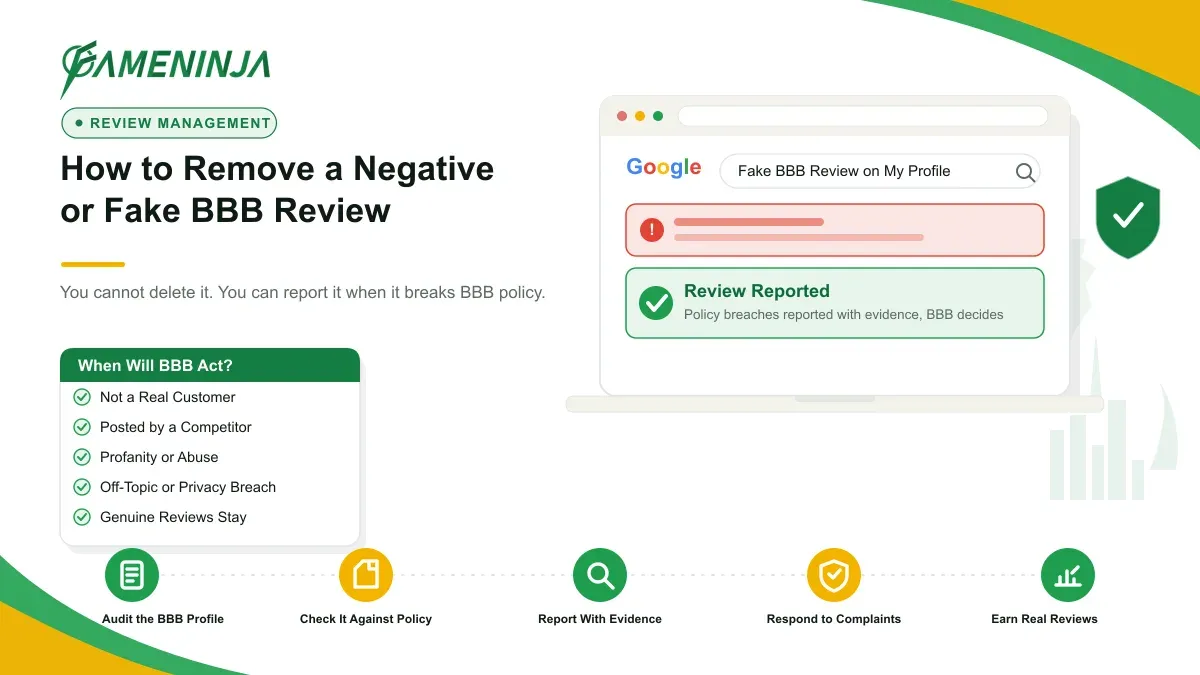
You cannot delete a BBB review yourself. You can report a review to BBB when it breaks BBB policy, for example a fake reviewer, a competitor, profanity, an off-topic post, or a privacy breach, and BBB decides after checking. Genuine negative reviews stay. For a formal complaint, respond through BBB's resolution flow, then earn real reviews to out-weigh the rest.
BBB reviews and BBB complaints are two different things
Most business owners lump them together, but BBB treats a customer review and a complaint as separate objects with separate handling. Getting this distinction right decides which lever you pull.
A BBB customer review is an opinion. A person rates your business, usually on a one-to-five scale, and writes about their experience. BBB asks the reviewer to verify their identity and confirm they had a genuine interaction with your business before it publishes. Reviews sit on your profile as commentary, and BBB has stated that customer reviews are displayed separately from the BBB letter rating. You can respond to a review publicly, and you can report one that breaks the rules.
A BBB complaint is a formal dispute. A customer files it because they want a specific outcome, such as a refund, a repair, or a corrected bill. BBB forwards the complaint to your business, asks you to respond within a set window, relays your reply to the customer, and records how it was resolved. Complaints stay on your profile for a period, commonly reported as up to three years, and they do factor into the BBB rating. You can read how BBB frames both flows on its process of complaints and reviews page.
The practical point is simple. A review is answered or reported. A complaint is worked and resolved. Confusing the two is how businesses waste weeks arguing with the wrong process. The same reporting-not-deleting logic applies elsewhere too, which is why deleting a Google review in India follows a similar report-and-respond path rather than a delete button.
What BBB will and will not remove
Start with the honest headline. BBB does not remove a review for being negative, and it should not. A trust body that scrubbed criticism on request would be worthless to the buyers it serves. What BBB does remove is content that breaks its published Customer Reviews policy.
Based on BBB's stated standards for what it will and will not publish, a review is a candidate for removal when it shows signs like these:
- It is not from a genuine customer, meaning the person had no real marketplace interaction with your business.
- It appears to come from a competitor, an employee, or someone with a conflict of interest rather than an actual buyer.
- It contains profanity, abusive language, or a personal attack rather than a description of a service experience.
- It is off-topic, meaning it is not about a marketplace transaction with your business at all.
- It breaches privacy by revealing confidential details, account numbers, or personal information about an individual.
- It reads as a complaint or dispute that belongs in the complaint process, not the review section.
- It is spam, a duplicate, or otherwise clearly not a good-faith review.
You can check BBB's own framing of what qualifies on its customer reviews information page before you report anything. Reading the actual policy matters, because your report is far stronger when you point to the specific rule a review breaks.
What most people get wrong is treating the BBB profile like a review site to be scrubbed clean. It is really a dispute-resolution record. A genuine one-star review from a real customer who had a bad experience is not a policy violation, and no amount of reporting will move it. If several reviews say the same true thing, that is feedback about your business, not an attack to be deleted. The reporting route is for the fakes and the rule-breakers, nothing more.
How to report or dispute a BBB review: step by step
When a review genuinely breaks BBB policy, here is the disciplined way to report it. BBB customer reviews are handled by the local BBB that serves your business area, so your report goes to that office for evaluation.
- Open the review on your BBB Business Profile and copy the exact profile URL, the reviewer's display name, the date, and the star rating. Take a dated screenshot.
- Read BBB's Customer Reviews policy and pinpoint the exact rule the review breaks. "This is unfair" is not a reason. "This person was never a customer" is.
- Gather evidence that BBB cannot see on its own. Order records or a CRM export showing no transaction, proof of a competitor link, or the passage that reveals private information.
- Use the report option on the review, or contact the local BBB that services your profile, and submit a short, factual dispute that names the policy and attaches the evidence.
- Keep the tone unemotional. Moderators handle a high volume of disputes, and a tidy, specific report gets a fairer read than an angry one.
- Wait for BBB's decision and follow up through the same local BBB if you hear nothing. Keep your reference details handy.
Here is the honest limitation, stated plainly. Even with a policy-based report and solid evidence, BBB reviews each dispute at its own discretion, and there is no guaranteed removal and no fixed timeline. It may agree and remove the review, it may ask the reviewer to verify again, or it may leave it up. Anyone promising you guaranteed deletion of a specific BBB review, by a specific date, for a fee, is selling something they cannot reliably deliver.
If the fake review sits alongside other planted content across platforms, that wider pattern is a different job, and our fake review removal guide for Indian businesses covers the cross-platform version of this work.
How to respond to a BBB complaint the right way
A complaint is not something you report away. It is something you work. And your response is public, so it is read by the next buyer doing due diligence, not just by the person who filed it.
When a complaint arrives, BBB forwards it to your business and asks you to respond. BBB's published process describes a response window of roughly 14 calendar days, with a follow-up request if you miss the first one. You can see how consumers are told to file on BBB's file a complaint page, which helps you understand what the other side went through. Work the complaint like this:
- Respond inside the window. A silent business looks worse to a reader than a business that shows up and explains itself.
- Answer the specific dispute, not the emotion. State the facts, the timeline, and what you are offering to resolve it.
- Offer a real resolution where one is fair. A refund, a fix, or a clear explanation moves the complaint toward a resolved status.
- Stay calm and professional. Never reveal private details about the customer, and never sound like a lawyer wrote the reply.
- Let BBB relay your response. The customer can accept it or push back, and BBB records the outcome on your profile.
A resolved complaint reads very differently from an ignored one. Two businesses can each have a complaint on file, and the one that responded and resolved it looks trustworthy, while the silent one looks evasive. Responding is the single highest-value move on a BBB profile, because it feeds both the rating and the human reading the page.
For a genuinely false and damaging review that crosses into defamation, a legal route may exist in the relevant jurisdiction, and a qualified lawyer where the content or reviewer sits can advise on a notice or takedown demand. This is general information, not legal advice. In most day-to-day cases, the report-and-respond path does more, faster, than litigation against an anonymous reviewer.
The India angle: handling a BBB profile from India
BBB operates across the United States and Canada, and there is no BBB in India. So an Indian business shows up on BBB only when it sells to North American customers, runs a US entity or subsidiary, or lists a US address and phone number. If that is you, you are managing a North American trust profile remotely, and a few realities come with that.
Claim the profile first. Many BBB profiles start as unclaimed listings that BBB built from public data. Claiming your BBB Business Profile lets you respond to reviews and complaints, and it usually requires verification tied to the US listing, such as the business phone number or address on file. Sort out who on your side can complete that verification before you need it in a hurry.
Plan around the clock. Local BBB offices and accredited-business support run on North American business hours. From Mumbai or Bangalore, that means late evenings and nights for a live conversation, so build in a buffer and do not expect same-hour replies. The complaint response window still runs on calendar days, so a nine-and-a-half-hour time difference eats into your working time if you wait.
Keep your public details consistent. Buyers and search engines both cross-check your name, address, and phone across your website, Google, and BBB. Mismatched entity details weaken trust and confuse the AI systems that now read these pages. If reputation across your whole footprint is the real issue, that is an online business reputation management question, and the BBB profile is one piece of it.
How your BBB profile feeds AI answers
Search is no longer only ten blue links. Buyers now ask ChatGPT, Perplexity, Gemini, and Google's AI Overviews questions like "Is this company legit?" or "Should I trust this vendor?" When they do, these systems pull from public sources they treat as authoritative, and BBB profiles are exactly that kind of source.
This raises the stakes on a neglected profile. An AI assistant does not hand the reader a page to weigh for themselves. It writes one summarised verdict. If your BBB profile shows a low rating, unanswered complaints, and a couple of harsh reviews with no reply, the AI can restate that as a plain fact: this business has unresolved complaints. The reader may never click through to see your side, the dates, or the resolution you actually offered.
Two things follow. First, an answered, resolved, and professionally managed BBB profile gives these systems something fair to summarise. Your complaint responses, your review replies, and accurate business information all feed the model. Second, a fake or defamatory review is now more damaging than before, because an AI can repeat it without the caution a human reader might apply. That raises the value of reporting genuinely rule-breaking content and of keeping every complaint answered. You are not gaming the model. You are making sure the true version of your business is the easiest one for it to cite.
The durable fix: respond, earn real reviews, and out-weigh
Reporting handles the reviews that should not exist. Everything else is won by making the honest picture of your business louder than the loudest complaint. This is where suppression and deletion part ways, and the difference is the whole game.
Deletion means the review is gone, which only happens when BBB agrees it broke policy or a court orders it. Suppression means the review still exists, but it is no longer the first or loudest thing people see, because fresher, genuine, positive signals sit above and around it. Fake and rule-breaking reviews are candidates for deletion. Genuine negative reviews are candidates for suppression through response and volume, not removal. Most profiles are a mix of both, so the honest strategy is a mix too.
Do three things, in order. Respond to every review and every complaint, including the fair ones, because a calm reply that acknowledges the concern and states what changed reassures the next reader more than a deleted review ever could. Then fix the root cause, because if three complaints name the same problem, solving it stops the fourth one before it is written. Finally, invite genuine reviews from real, satisfied customers.
That last step needs a warning. BBB asks reviewers to verify, and it is built to catch fake or incentivised reviews, so a coordinated campaign of invented five-star posts is both against the rules and easy to detect. Ask real customers, at the right moment, and let honest feedback shift the average over time. A steady flow of true reviews reflects your business more fairly than a snapshot taken during one bad month. For more on this approach, our ORM blog has related guides on doing it honestly.
An anonymized example from our work
A pattern we see often, described here without names, numbers, or rates, to protect the business. An India-based company selling software to US customers came to us after its BBB profile turned into a problem. A cluster of low-star reviews had appeared, one complaint sat unanswered because nobody on the team knew BBB had even forwarded it, and the profile was reading worse than the actual business deserved.
We started with the boring, high-value work. The team claimed and verified the profile, then answered the open complaint inside the next window, offering a fair and specific resolution. For the reviews, we sorted them honestly. A couple looked like they came from people with no record of ever being customers, so we helped structure policy-based reports to the local BBB, pointing to the exact rule and attaching the records that contradicted the claims. Others were simply unhappy real customers, and we said so plainly, because those were not removable.
BBB actioned some of the reported reviews after its own review, and left others in place, which we expected and had told the team to expect. The lasting change came from the rest of the plan. The company responded professionally to every remaining review, fixed a genuine onboarding gap that two honest reviews had flagged, and invited real customers to share their experience. Over the following months, the profile read as a fairer reflection of the business. No guaranteed outcome, no invented success rate, just disciplined reporting where justified and rebuilding where it counted.
If you would like a similarly honest read on your own BBB profile, you can ask us for a free ORM report, a quick, discreet first conversation with a real person.
A calm next step
You do not have to accept a false or rule-breaking BBB review as permanent, and you do not have to believe anyone who promises to make every negative review vanish. The real work is a sorting job. Report what genuinely breaks BBB policy, respond to and resolve every complaint, and rebuild the honest picture of your business so it speaks louder than one bad paragraph.
If you want a straight, no-drama assessment of your BBB profile, and a clear view of what is realistically actionable, request a free ORM report. You will get an honest read from a real expert who has done this work for Indian businesses selling into North America.
Written by the FameNinja ORM team, drawing on hands-on reputation work with Indian businesses that serve US and Canadian customers. This article is general information, not legal advice. For any legal step, consult a qualified lawyer in the relevant jurisdiction.