
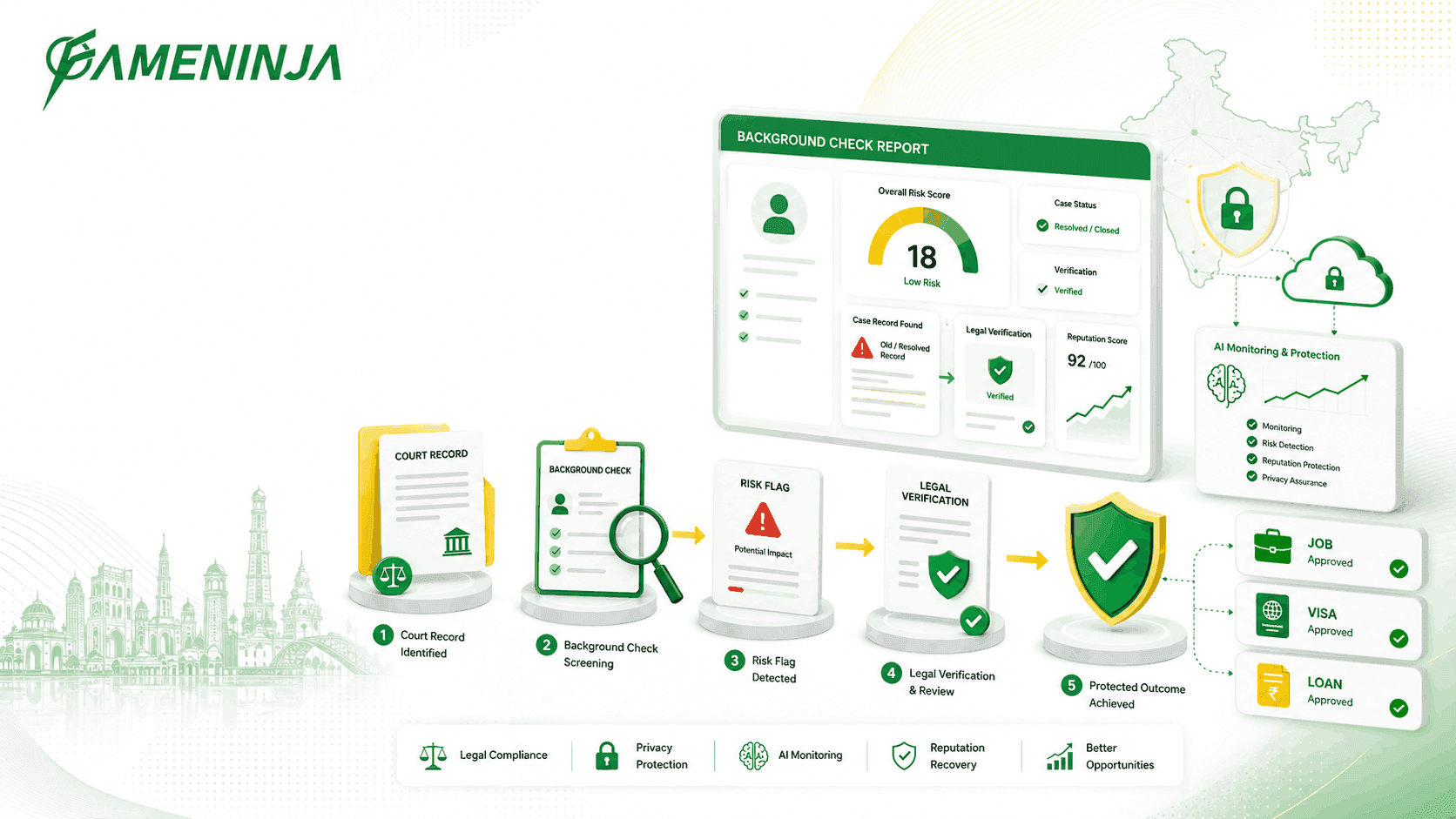
The job offer was almost signed. Then the background check came back, the recruiter went quiet, and a week later the role was “no longer available.” You never got a reason, but you know what they found. A single court case, sitting in Google results, quietly deciding outcomes you never get to argue.
Court records do their real damage at exactly these moments: an employment verification, a visa interview, a loan application, a partnership due diligence. The page itself is old and static. The consequence is fresh and expensive. This guide explains how court records feed into background checks in India, what you can actually do to stop one case from sinking your job, visa, or loan, and how to handle the situation honestly when removal takes time.
For the full removal playbook, start with our pillar guide on deindexing court cases from Google. This article is about the consequence side: the checks, the screenings, and protecting the opportunities that hang on them.
Quick answer
Most background checks in India pull from a mix of public records and a plain Google search of your name. A court case that surfaces in search can trigger questions or quiet rejections even when it was minor, settled, or resolved in your favour. You reduce the harm by de-indexing the case from your name where the law allows, suppressing it with accurate content, and preparing a calm, documented explanation for screeners who still find it.
How court records actually reach a background check
Background screening in India is less centralised than people assume. There is no single national database a verifier queries for everyone. Instead, an employment background check typically combines identity and address verification, education and employment confirmation, and, increasingly, a criminal and litigation check. That last part is where court records enter.
Two routes matter. The formal route is a court-record search, where a verification agency or its court runner checks for cases against your name in relevant jurisdictions. The informal route, and the one most people underestimate, is a simple Google search of your name by the recruiter, the visa officer, or the loan manager. Even where a formal check finds nothing, a case ranking on the first page of Google can do the damage on its own.
This is why search visibility matters so much. A verifier following due process distinguishes a closed case from an open one. A busy recruiter glancing at Google often does not. The opinion worth saying directly: in practice, your Google results are a background check, run by everyone, all the time, whether or not a formal screening ever happens.
Where court cases hurt you most
Different decisions weigh a court record differently, and knowing which you are facing helps you respond.
Employment and empanelment screenings are the most common. Corporate roles, banking and finance positions, healthcare empanelment, and senior hires almost always include verification, and a litigation hit can stall an offer. Visa and immigration processes ask directly about legal history and may run their own checks; a visible case invites scrutiny even when it is irrelevant to the application. Loan, credit, and insurance underwriting can factor reputation and litigation into risk, especially for high-value or business lending. Business partnerships, board appointments, and investment due diligence involve people searching your name deliberately and reading whatever Google shows first.
In each of these, the case is rarely the whole story, but it arrives without context and lands at the worst possible moment.
What you can and cannot control
Be clear-eyed about the two layers, because they behave differently.
You have real influence over what appears in search results. Through de-indexing where the law supports it, and through suppression with accurate content, you can change what a recruiter or officer sees when they type your name. That is the layer this work targets.
You have far less control over a formal court-record search conducted with your consent during official verification. If a licensed agency runs a jurisdictional check, the case may show in their report regardless of your search results, because they are reading court systems, not Google. De-indexing from Google does not erase the underlying record or alter your legal history. Anyone who tells you otherwise is misleading you.
So the honest framing is this: you can strongly shape the informal, search-driven judgments, and you can prepare for the formal ones, but you cannot make a real court record vanish from the legal system. The strategy below works with that reality rather than against it.
Step by step: protecting your opportunities
Step 1: Run your own background check first
Before any employer does, search your own name the way a screener would. Use your name with “court,” “case,” “FIR,” your city, and your profession. Note exactly what appears, where it ranks, and which platforms host it. You cannot fix what you have not seen, and being surprised in front of a recruiter is the worst outcome.
Step 2: De-index where the law allows
If the case was resolved in your favour, settled, quashed, or you were acquitted or discharged, you have a strong basis to ask Google and legal databases to de-index your name. Indian rulings in 2026 have favoured exactly these cleared cases. The process and the documents you need are covered in our guide to removing an acquittal or dismissed case from Google, and the remove from Google service handles the heavy lifting. De-indexing the case from your name is the single most effective way to neutralise the informal, search-driven rejection.
Step 3: Suppress what cannot be removed
When a case is active or cannot be removed, the answer is to push it down with accurate, authoritative content about you. A name search that leads with your professional profile, your work, and your achievements changes the impression a screener forms in the first five seconds. Suppression takes months, not days, so start early, and treat it as ongoing rather than a one-time fix. Our content suppression service is built precisely for this.
Step 4: Prepare a calm, documented explanation
For formal verifications where the case will show regardless, prepare a short, factual explanation backed by documents: the resolution order, the acquittal, the settlement, or proof the matter was minor or misattributed. Screeners and HR teams handle disclosed, documented facts far better than discoveries they make themselves. Honesty plus paperwork beats silence plus surprise. Where the legal position is delicate, take advice before you disclose. [LEGAL REVIEW]
Step 5: Fix misattribution fast
A surprising share of background-check damage comes from mistaken identity, a case belonging to someone with the same or a similar name. If that is your situation, gather identity proof showing you were never a party, and present it to the platform and the verifier. Misidentification is one of the few grounds on which legal databases redact readily.
Step 6: Build a durable clean footprint
The lasting protection is a strong, accurate online presence that consistently outranks any stray record and gives every future screener the right first impression. This is ongoing reputation repair and personal reputation management, and it is what keeps a single old case from resurfacing as a recurring problem at every new opportunity.
How AI background checks change the picture in 2026
Screening is quietly shifting. Some verification tools and many individual screeners now ask an AI assistant about a candidate, and AI answers do not behave like a Google results page. When a recruiter asks ChatGPT, Perplexity, or Gemini “is there anything concerning about [your name],” the model may summarise an old news article or a cached record, sometimes without the context that the matter was closed or that you were cleared.
That creates two risks and one opportunity. The risks: an AI can repeat a stale allegation, and it can do so without showing its source, so you never get to rebut it. The opportunity: if the accurate version of your story, the resolution, the acquittal, your current work, is well-documented and indexed, the same systems are far more likely to surface that instead. Managing your presence in AI answers is now part of protecting yourself in any screening, which is why modern reputation work covers both search engines and AI assistants together.
FameNinja example: an offer saved before the check came back
A senior candidate came to us mid-process. An offer was on the table, formal verification was days away, and an old, resolved matter still ranked for his name. He had assumed the case was buried; it was not.
We mapped exactly what a screener would see, moved to de-index the resolved matter from his name, and began building accurate professional content so his search results led with his career rather than the case. In parallel, we helped him prepare a short, documented explanation he could share if the formal check surfaced the matter. The lesson here is the sequence, not any invented result: act before the check, not after the rejection. The candidates who come to us while an opportunity is still open have far more options than those who arrive after a quiet “no.”
Frequently asked questions
Do background checks in India include court cases?
Many do. Formal verification can include a criminal and litigation search of court records, and almost every screener also runs an informal Google search of your name. A case visible in search can affect a decision even when a formal check finds nothing material.
Can I remove a court case so it never shows in a background check?
You can de-index it from your name in Google where the law allows, and suppress it with accurate content, which addresses informal, search-driven checks. You cannot erase the underlying court record, so a formal jurisdictional search may still find it. [LEGAL REVIEW]
Will de-indexing from Google affect a formal verification report?
Not directly. De-indexing changes what appears in Google search; it does not alter court systems. A licensed agency running a court-record search reads those systems, not your search results.
Should I disclose a resolved case before a background check?
Often yes, with documents. Screeners handle disclosed, documented facts better than surprises. Where the legal position is sensitive, take advice on what and when to disclose before doing so. [LEGAL REVIEW]
What if the case is someone else with my name?
Misidentification is one of the strongest grounds for redaction. Gather identity proof showing you were never a party, and present it to the hosting platform and the verifier promptly.
How long before a background check should I start cleaning my results?
As early as possible. De-indexing requests take weeks, and suppression takes months. Starting only when an offer is on the table leaves little time. If you anticipate screening, begin now.
Does a court case affect visa or loan applications too?
It can. Visa processes ask about legal history and may run checks, and lenders may factor litigation into risk for high-value or business borrowing. The same de-index, suppress, and document approach applies.
Can FameNinja guarantee my case will be gone before the check?
No, and be wary of anyone who guarantees that. Removal depends on the case status and the platforms, and timelines vary. What we can do is pursue removal where it is possible, suppress aggressively, and prepare you for any formal check, which materially improves your odds.
The bottom line
A court case rarely tells your whole story, but it arrives at the moment a job, visa, or loan is being decided, and it arrives without context. You cannot erase a real court record, but you can strongly shape the search-driven judgments that decide most of these moments. De-index the case from your name where the law allows, suppress it with accurate content, fix any misidentification, and prepare a calm, documented explanation for formal checks. Above all, act while the opportunity is still open, not after the quiet rejection.
If you have a screening coming and a case in your results, time matters. Chat with us on WhatsApp or book a free, confidential consultation, and we will give you an honest assessment of what can be done before your next check.