

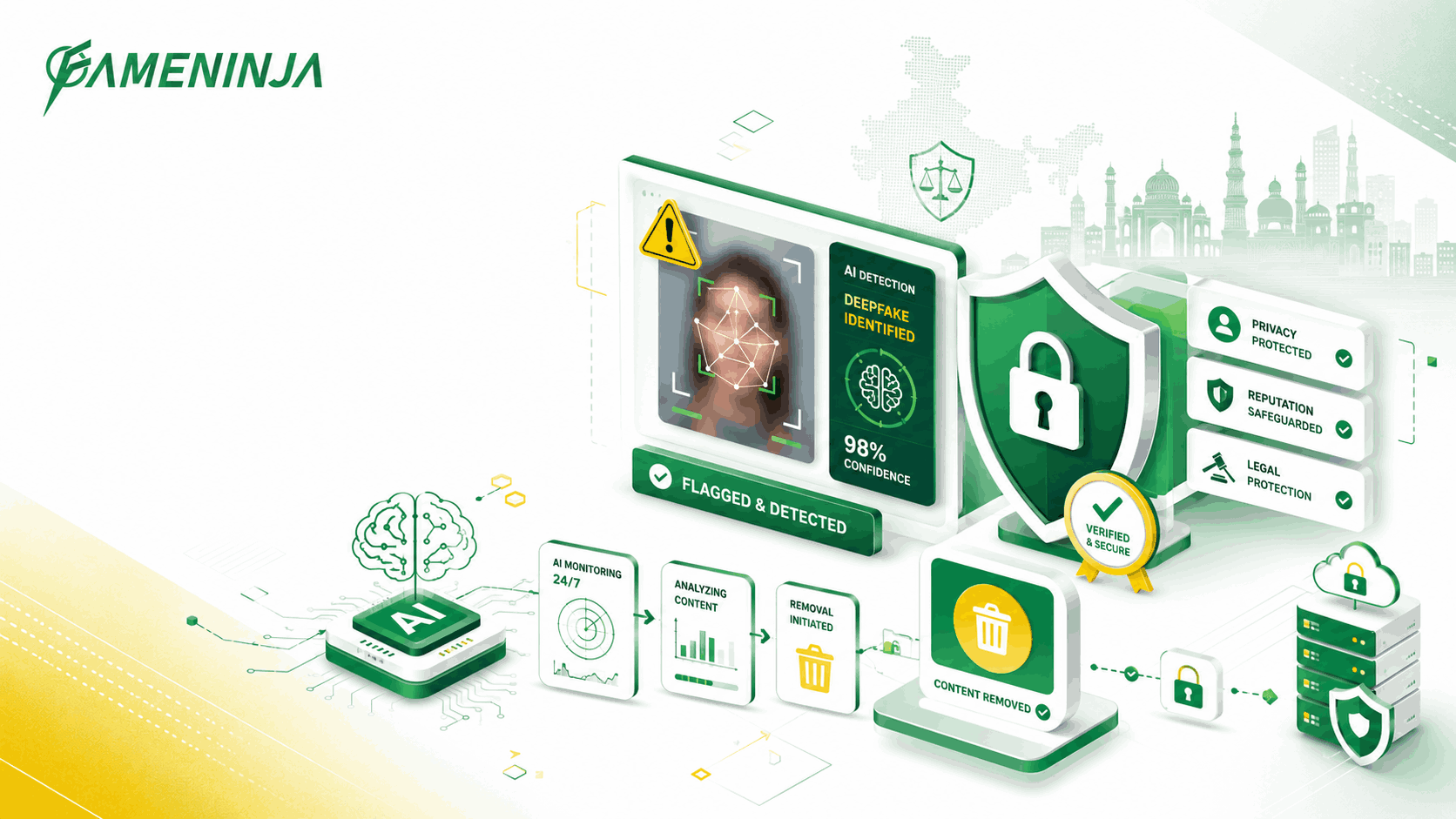
If you are a victim of deepfake pornography, help is available. ICALL (9152987821), Vandrevala Foundation (1860-2662-345), and NCW helpline (7827-170-170) provide free, confidential support. You are not alone, and this is not your fault.
AI-generated deepfake pornography, where someone uses artificial intelligence to create fake nude or sexually explicit images or videos using your face, is one of the most harmful forms of digital abuse. In India, you now have strong legal tools to fight it, including the February 2026 IT Rules amendment that requires platforms to remove deepfake content within 3 hours of a valid complaint.
This guide covers the complete removal process, the legal provisions available to Indian victims, and what to do when standard reporting doesn’t work. It builds on our India’s 3-hour deepfake removal rule guide with specific focus on sexually explicit deepfakes.
How Deepfake Pornography Differs From Other Intimate Content Leaks
Deepfake pornography involves AI-generated content. The victim never actually appeared in any intimate image or video. The AI took their face (from social media photos, professional headshots, or any public image) and grafted it onto explicit content.
This creates unique legal and emotional dynamics:
There is no “original” intimate content. Unlike MMS leaks where actual intimate content was captured, deepfake pornography is entirely fabricated. The victim never posed for, consented to, or was present during the creation of any intimate content. This is important for both legal arguments and emotional processing.
Detection is harder. Modern deepfakes can be extremely convincing. Viewers may not realize the content is fake, which means the reputational damage is just as real as if the content were genuine.
Creation tools are widely accessible. Unlike a few years ago, creating deepfakes no longer requires technical expertise. Several AI tools (many of which are illegal to use this way) can generate deepfakes from a single photo in minutes.
The legal framework is stronger for deepfakes than for real leaked content. The February 2026 IT Rules amendment specifically targets AI-generated content, providing a 3-hour removal window that doesn’t exist for non-AI content.
Your Legal Arsenal Against Deepfake Pornography
The 3-Hour Removal Rule (IT Rules 2021, Amended Feb 2026)
When you report AI-generated sexually explicit deepfake content, significant social media intermediaries must remove it within 3 hours. This is the fastest legal removal mechanism available in India for any type of content.
For the full step-by-step process for invoking the 3-hour rule, see our detailed guide on India’s 3-hour deepfake removal rule. The key requirement: your complaint must explicitly state that the content is AI-generated/digitally manipulated and invoke the February 2026 amendment provisions.
Section 67A IT Act (Sexually Explicit Material)
Deepfake pornography is sexually explicit material published in electronic form. First conviction: up to 5 years and up to Rs. 10 lakhs fine. Subsequent: up to 7 years and up to Rs. 10 lakhs fine.
The person who created the deepfake, the person who distributed it, and anyone who knowingly forwarded it can all be prosecuted under this section.
Section 66E IT Act (Privacy Violation)
Even though the content is AI-generated, using someone’s face/likeness without consent in intimate imagery violates their privacy. Up to 3 years imprisonment and/or up to Rs. 2 lakhs fine.
Section 67 IT Act (Obscene Material)
For deepfakes that are obscene but may not meet the “sexually explicit” threshold of 67A. Up to 3 years and Rs. 5 lakhs (first conviction).
BNS 2023 Provisions
Section 77 (Voyeurism): Creating or distributing intimate images without consent. 1-3 years (first offense), 3-7 years (repeat).
Section 79 (Defamation): Deepfake pornography defames the victim. Up to 2 years imprisonment.
Section 78 (Criminal Intimidation): If the deepfake is used as a threat or for extortion.
DPDP Act 2023
Your face, likeness, and biometric data (facial features) are personal data. Creating a deepfake using your personal data without consent violates the DPDP Act. This provides additional grounds for removal requests and legal action.
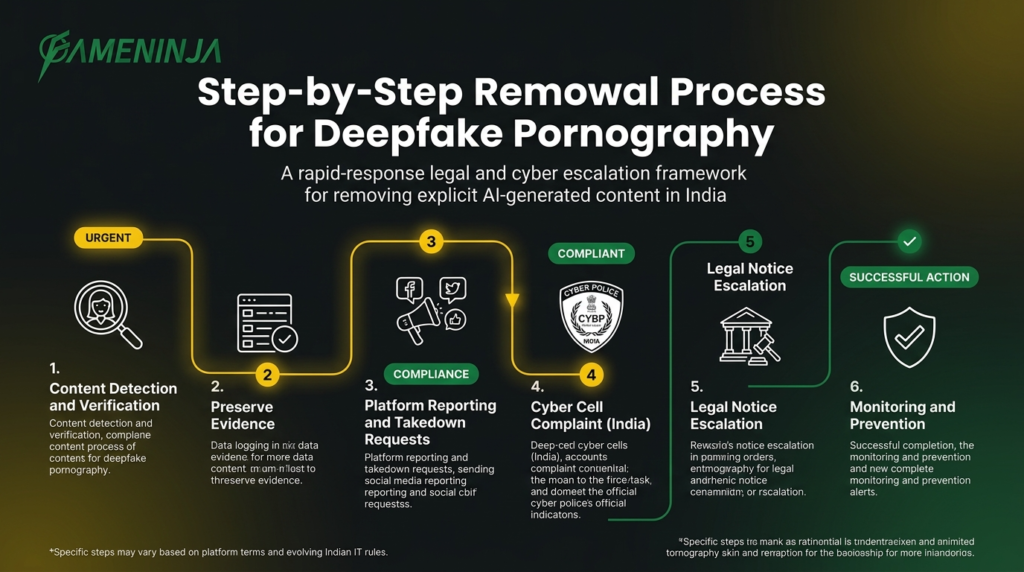
Step-by-Step Removal Process for Deepfake Pornography
Immediate Actions (First 30 Minutes)
1. Document the content. Screenshot the URL, posting account, and platform. Record the time you discovered it. If it’s a video, note the duration and platform.
2. File platform reports. On every platform where the content appears, report it using the platform’s specific mechanism for non-consensual intimate images or AI-generated manipulated media.
3. Invoke the 3-hour rule. In your platform complaint, explicitly state: “This is AI-generated deepfake content depicting me without my consent. I am invoking the 3-hour removal provision under the IT (Intermediary Guidelines) Rules 2021, as amended in February 2026.”
Within the First Hour
4. File on cybercrime.gov.in. Go to cybercrime.gov.in. Select “Report Cyber Crime Related to Women/Children.” Category: Social Media Related Crime. Provide all documentation. Save the complaint number.
5. Email the platform’s India Grievance Officer. Send a formal complaint referencing the IT Rules, your platform report, and your cybercrime complaint number.
Within 3 Hours
6. Check for removal. If the content has been removed, document the removal (screenshot showing content is gone). If not removed within 3 hours, the platform is in violation.
7. If not removed: send legal notice. Have a lawyer send a legal notice to the platform’s Grievance Officer, Nodal Contact Person, and India legal team, citing the expired 3-hour deadline, your cybercrime complaint, and the platform’s loss of safe harbor protection under Section 79 IT Act.
Within 24 Hours
8. Google deindexing. File a Google removal request for any cached versions, thumbnails, or indexed copies of the content. Use Google’s non-consensual intimate images removal form.
9. Reverse image/video search. Search for copies of the deepfake on other platforms using reverse image search tools. File removal requests for every instance found.
10. FIR filing. File an FIR at the cyber cell citing Sections 66E, 67A IT Act, Section 77 BNS 2023, and any other applicable provisions.
Ongoing
11. Monitor for re-uploads. Check weekly for the first 3 months, then monthly. Re-uploads can be addressed through the same 3-hour rule each time.
12. Pursue criminal prosecution. Work with the police and your lawyer to identify and prosecute the creator.
13. Court order. If needed, seek a John Doe order covering all platforms to prevent future distribution.
The Emotional and Psychological Impact
Deepfake pornography is a form of image-based sexual abuse. Victims frequently experience:
Intense shame and embarrassment, even though the content is entirely fabricated Anxiety about who has seen the content and whether it will resurface Depression, social withdrawal, and difficulty maintaining personal relationships Professional consequences if the content reaches colleagues or clients Trust issues around sharing any photos or videos online
It’s essential to understand: this is not your fault. You did nothing wrong by having photos online. The person who created the deepfake committed a crime. The availability of your photos on social media does not justify or excuse the creation of deepfake pornography.
Professional support is important. Even if you feel you’re coping well, speaking with a counselor who understands digital abuse can help process the experience. ICALL (9152987821), Vandrevala Foundation (1860-2662-345), and iCall (022-25521111) are free and confidential. The Cyber Peace Foundation also provides guidance specific to technology-facilitated abuse.
You don’t have to tell everyone. You get to decide who knows about the deepfake and when. There’s no obligation to explain the situation to anyone except those directly involved in the removal and legal process. Handle this at your own pace.
When the Creator Uses Anonymous Platforms
Deepfake pornography is often distributed through anonymous channels: Telegram groups, anonymous websites, or accounts with no real identity. This makes identification harder but not impossible.
Digital forensics. The police cyber cell can trace account creation through IP addresses, email registrations, and payment records (if the creator sold the content).
Platform cooperation. Under Indian law, platforms must cooperate with law enforcement investigations. Court orders can direct platforms to disclose account holder information.
Metadata analysis. AI-generated content often contains metadata that can help identify the creation tool and potentially the creator.
Anonymous reporting channels. If someone tips you off about the content through an anonymous message, preserve that message too. It may contain clues about the creator’s identity.
The Legal Landscape for AI-Generated Content in India (2026)
India’s legal framework for deepfakes is evolving rapidly. Here’s where things stand:
The Deepfake Prevention and Criminalisation Bill, 2023 was introduced as a private member’s bill but has not yet been enacted. If passed, it would create a standalone deepfake law with specific penalties for creation, distribution, and possession of deepfake content. Until then, victims rely on existing IT Act and BNS provisions.
The February 2026 IT Rules amendment is the most significant recent development. By creating a 3-hour removal obligation for AI-generated content, it gives victims a concrete, enforceable timeline that didn’t exist before.
MeitY’s AI advisory (March 2024) required AI platforms deploying in India to seek government approval before launch and to label AI-generated content. While enforcement has been inconsistent, this advisory establishes the principle that AI-generated content carries disclosure obligations.
The DPDP Act’s data processing requirements apply to AI tools that use personal data (like facial images) for training or generation. An AI tool that creates deepfakes using someone’s face without consent is processing personal data in violation of the Act.
Court precedents are building. The Delhi HC’s personality rights orders in celebrity deepfake cases, combined with the Bhuvan Bam ruling (April 2026), are establishing judicial precedent for swift action against deepfake content. These precedents strengthen any victim’s case, not just celebrity cases.
For Indian victims, the combination of IT Act criminal provisions, the 3-hour removal rule, DPDP Act data protection rights, and emerging court precedents creates one of the stronger legal frameworks globally for fighting deepfake pornography, despite the absence of a standalone deepfake law.
Protecting Yourself Proactively

Limit high-resolution photos online. Deepfake AI needs source images. The fewer high-quality face photos you have publicly available, the harder it is to create convincing deepfakes.
Use profile privacy settings. Set social media profiles to private where possible. Limit who can see your tagged photos.
Monitor your digital footprint. Regular Google searches of your name, reverse image searches of your profile photos, and alerts for your name help catch deepfakes early.
Content authentication. As C2PA (Content Credentials) technology matures, authenticated content will be distinguishable from deepfakes. Follow developments in content authentication standards.
For broader strategies on protecting your online presence, see our guides on personal branding creation and ORM tools for personal brand monitoring.
How FameNinja Handles Deepfake Pornography Cases
These are among the most sensitive cases we handle at FameNinja. Our approach:
Strict confidentiality. Maximum two team members per case. Encrypted evidence handling. All case materials deleted after resolution.
Speed-first protocol. We aim to file the first removal report within 30 minutes of engagement. The 3-hour rule gives us a clear deadline, and we work backwards from it.
Multi-platform, simultaneous filing. We file on every platform, cybercrime.gov.in, and with Grievance Officers in parallel. We don’t wait for one channel to respond before trying the next.
Legal coordination. We work alongside the client’s legal counsel to ensure that the removal evidence trail supports criminal prosecution. If the client doesn’t have a lawyer, we can recommend experienced cyber law practitioners.
Emotional support awareness. We’re not counselors, but we recognize the trauma these cases cause. We connect clients with professional support services and conduct all communications with sensitivity and respect.
This work is part of our broader personal online reputation management services, with the highest confidentiality and urgency classification.
FAQ
Is creating deepfake pornography illegal in India?
Yes. Creating deepfake pornography violates multiple Indian laws: Section 66E IT Act (privacy violation), Section 67A IT Act (sexually explicit material), Section 77 BNS 2023 (voyeurism), and the DPDP Act 2023 (processing personal data without consent). While India doesn’t have a standalone deepfake law yet (the Deepfake Prevention and Criminalisation Bill 2023 is still pending), existing laws provide strong criminal penalties ranging from 3 to 7 years imprisonment.
How fast can deepfake pornography be removed under the 3-hour rule?
The February 2026 IT Rules amendment requires platforms to remove AI-generated deepfake content within 3 hours of receiving a valid complaint. In practice, we’ve seen removals happen within 1-2 hours when the complaint is properly formatted, explicitly invokes the 3-hour provision, and includes a cybercrime complaint number.
What if the deepfake is on Telegram where enforcement is harder?
Telegram is generally slower to respond to removal requests than Meta or Google platforms. File through [email protected], your Grievance Officer complaint, and the cybercrime portal simultaneously. For persistent Telegram channels, a court order directing ISPs to block access to the specific channel URL is often more effective than waiting for Telegram to act.
Can I take action if I don’t know who created the deepfake?
Yes. You don’t need to know the creator’s identity to get content removed. File platform reports, cybercrime complaints, and Grievance Officer complaints without identifying the creator. For criminal prosecution, the police can investigate and identify the creator through digital forensics. A court can order platforms to disclose creator information.
Does the deepfake need to be “convincing” for legal action?
No. Indian law doesn’t require the deepfake to be convincing or realistic. Even poorly made deepfakes that use your face in explicit content are covered by Section 66E, 67A IT Act, and Section 77 BNS 2023. The harm is in the creation and distribution of the content, not in how realistic it looks.
Can I sue the AI tool/platform that was used to create the deepfake?
This is an evolving area of law in India. Currently, the strongest legal action is against the person who created and distributed the deepfake. However, if the AI tool explicitly markets itself for creating non-consensual intimate content, it may be liable as an intermediary that facilitates illegal activity. The DPDP Act and IT Act’s intermediary liability provisions could apply. This is likely to be clarified by courts in coming years.
What compensation can I claim for deepfake pornography?
Through civil proceedings, you can claim compensation for emotional distress, reputational harm, lost income or opportunities, counseling expenses, and legal costs. While Indian courts haven’t established standard amounts for deepfake cases specifically, privacy violation damages in comparable cases have ranged from Rs. 1 lakh to Rs. 25 lakhs depending on the extent of distribution and harm.
How do I explain to my employer/family that the content is fake?
If the deepfake has been seen by people you know, a straightforward approach works best: explain that the content is AI-generated fake material, that you’ve filed a police complaint and legal action is underway, and that the content has been or is being removed. Having your FIR number and cybercrime complaint number adds credibility. Many victims find that once people understand deepfake technology, they’re supportive.