

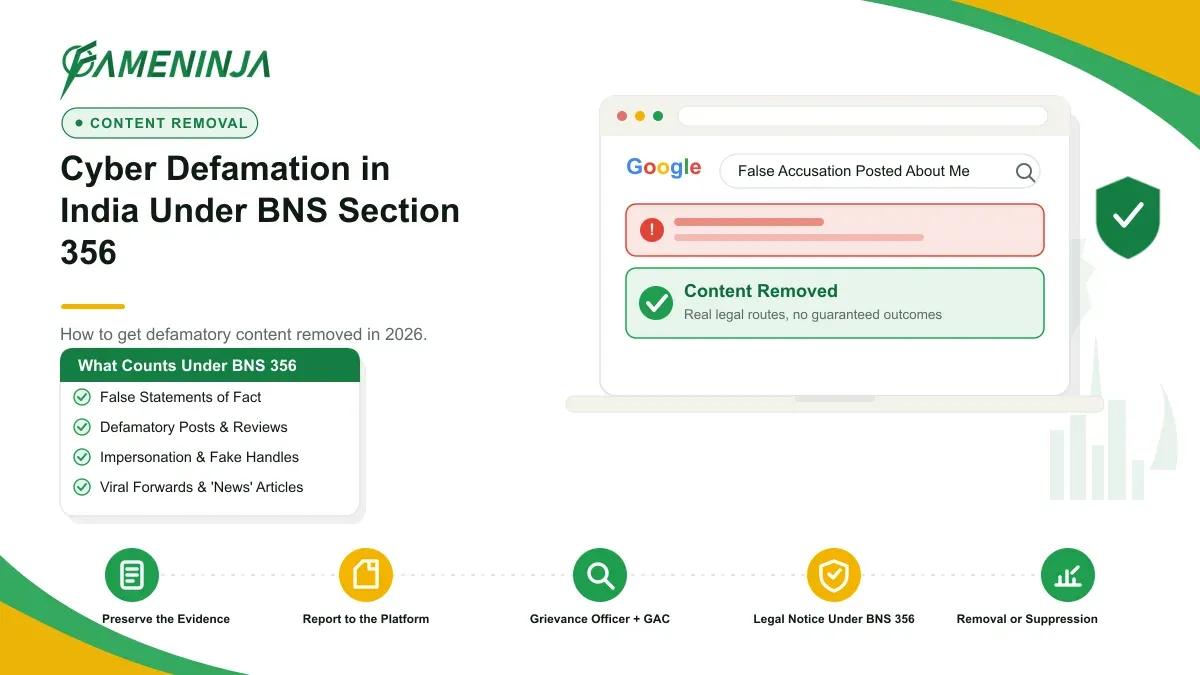
Someone posted a false accusation about you. Maybe it is an anonymous blog, a review that reads like a personal attack, a viral tweet, or a WhatsApp forward that mutated into a "news" article.
Someone posted a false accusation about you. Indian law has a name for it, cyber defamation, punishable under BNS Section 356, and real routes to fight it, including a government content removal appeal. Maybe it is an anonymous blog, a review that reads like a personal attack, a viral tweet, or a WhatsApp forward that mutated into a "news" article. It ranks on Google now. Clients see it. Family sees it. And the person who wrote it is hiding behind a fake handle.
Cyber defamation in India sits under BNS Section 356, the defamation provision that replaced the old Indian Penal Code sections in 2024. Knowing the law is one thing. Getting the content actually removed is a separate fight, and the two are often confused. Filing a criminal complaint does not pull the post down. A takedown request to the platform does not punish the author. You usually need both moving together, plus a clear-eyed view of what the internet will and will not let you erase.
This guide explains the law in plain terms, the three routes that actually get content down, and the honest limits. This is general information, not legal advice.
Quick answer
Cyber defamation in India is a punishable offence under BNS Section 356 (which replaced IPC Sections 499 and 500). To get defamatory content removed, you combine three routes: a legal notice to the platform under the IT Rules 2021, a grievance complaint to the platform's officer, and, where needed, a civil injunction or court order.
What counts as cyber defamation under BNS Section 356 in India
Cyber defamation is defamation that happens online: a false statement, published to at least one other person, that harms your reputation. The "cyber" part only means the medium is a website, an app, a social platform, a review page, or a messaging forward. The legal test is the same one Indian courts have used for decades.
Under BNS Section 356, defamation means making or publishing an imputation about a person, intending to harm, or knowing it will harm, that person's reputation. The provision carries the same ten exceptions that existed under the old IPC Section 499, so not every unflattering statement is defamation.
Here is the line that matters most. Truth, said for the public good, is a defence. Honest opinion and fair comment on a matter of public interest are protected. A one-star review that says "the food was cold and the staff were rude" is opinion. A review that invents a crime you never committed is not. What most people get wrong is assuming that anything negative or embarrassing is automatically defamatory. It is not. If the statement is true, or is clearly opinion rather than a false statement of fact, a removal claim built purely on defamation will struggle.
So before you act, sort the content into three buckets:
- False statement of fact presented as true. This is the strongest defamation ground.
- Opinion or fair comment, even if harsh. Weak on defamation, though it may breach a platform's own rules.
- Private or unlawful content (leaked images, a doctored photo, an ID leak). This may fall under other laws, such as IT Act Sections 66E or 67, and often moves faster than a defamation claim.
Getting this sorting right early saves months. A defamation notice against genuine opinion tends to fail, and sometimes invites a counter-claim.
BNS 356 vs IPC 499 and 500: what changed in 2024
The Bharatiya Nyaya Sanhita, 2023 came into force on 1 July 2024 and replaced the Indian Penal Code. For defamation, this is mostly a renumbering with one meaningful addition.
Under the old code, IPC Section 499 defined defamation and IPC Section 500 set the punishment. Under the new code, both are folded into BNS Section 356. The substance is largely carried over, including the ten exceptions and the definition. The headline change is the penalty menu. BNS Section 356 keeps imprisonment of up to two years, or a fine, or both, and adds community service as a sentencing option.
For a reputation victim, the practical takeaways are simple:
- If you are drafting a complaint or a legal notice in 2026, cite BNS Section 356, not IPC 499 or 500. Using the repealed sections signals that the drafting is dated.
- Older cases, articles, and even some lawyers still reference IPC 499/500. The principles they discuss usually still apply, but the citation has moved.
- Criminal defamation remains a compoundable, largely complainant-driven offence in most situations, which means the process typically starts with you (or your counsel), not the police station.
None of this, on its own, removes a single URL. The criminal track punishes; it rarely deletes. That is why the removal work runs on a parallel set of rails.
How to get defamatory content removed in India: the three routes
This is the part law firms often skip and platforms rarely explain. Getting a case on file is not the same as getting the content down. Removal usually comes from one of three routes, and the strongest results come from running them together.
Route 1: A legal notice and complaint to the platform
Almost every platform, from Google and Meta to Indian review sites like JustDial, X, and employer-review pages, has a grievance process under the IT (Intermediary Guidelines and Digital Media Ethics Code) Rules 2021. Intermediaries operating in India must appoint a Grievance Officer and publish a way to reach them.
Under these rules, the Grievance Officer is expected to acknowledge a complaint within 24 hours and resolve it within about 15 days, with faster timelines for certain categories such as non-consensual intimate imagery. A well-built complaint does three things: it identifies the exact URLs, it states precisely why the content is unlawful (false statement of fact, defamation under BNS Section 356, or a specific policy breach), and it attaches proof that the claim is false.
A legal notice adds weight. Sent to the platform, and where possible to the author, it puts the content creator and the intermediary on formal notice. Sometimes the post disappears at this stage, because the author does not want a legal fight. Sometimes it does not, and you escalate.
Route 2: The Grievance Appellate route and cyber-crime reporting
If the platform rejects or ignores the complaint, the IT Rules 2021 created a Grievance Appellate Committee mechanism to appeal that decision. In parallel, if the content involves harassment, impersonation, or intimate images, you can and should report it on the National Cyber Crime Reporting Portal at cybercrime.gov.in, which has dedicated flows for these categories.
Note the 2025 tightening. The IT Amendment Rules 2025, which took effect in late 2025, require government takedown intimations to intermediaries to come from a senior officer (broadly, Joint Secretary rank or, in law enforcement, a Deputy Inspector General or above), and to specify the legal basis and the exact link. For a private victim, the message is clear: vague, sloppy notices are easier for platforms to reject now. Precision wins.
Route 3: A civil injunction or court order
When the author is anonymous, when the platform will not act without a court's word, or when the content keeps re-appearing, you move to a civil suit for defamation and ask the court for an interim injunction. An injunction can direct the author to take the content down and can direct intermediaries to disable specific URLs.
Indian courts have been active here. Through 2025 and 2026, Delhi High Court and trial courts passed several interim orders directing platforms to remove specified defamatory URLs, and in some matters extended orders to newly identified links carrying the same content. These orders show the pattern that works: a court identifies specific unlawful content, and intermediaries are directed to disable it. This is the route that most reliably forces removal when a platform is resisting, though it takes time and legal cost.
The honest summary: the platform complaint is fast and cheap but discretionary; the court order is slower and costlier but carries force. Serious cases use both.
When a court order is needed for Google de-indexing
People often ask us to "remove it from Google". Two very different things hide inside that request, and mixing them up wastes weeks.
Removing the source page means the website that hosts the content takes it down, or a court directs it to. Once the page is gone, Google's index catches up, and you can use Google's own Refresh Outdated Content tool to speed that along.
De-indexing means Google stops showing a URL in results even though the page still exists. Google will de-index on limited grounds on its own, such as certain personal data or clear policy violations. For defamatory content that a court has ruled unlawful, a court order directing removal or de-indexing is usually what moves Google to act. Google is an intermediary; absent a legal basis, it generally will not delete a news article or a critical post simply because you dispute it.
A related trap is "similar content". Some court orders have tried to require platforms to also block future posts that resemble the original. Intermediaries have pushed back, arguing they should not have to judge whether new content is "similar" enough to fall under an old order. The realistic expectation: orders that name exact URLs get actioned cleanly; broad "block anything like this" orders are contested and slower.
One more piece of history worth knowing. IT Act Section 66A, once used to police "offensive" online speech, was struck down as unconstitutional by the Supreme Court in Shreya Singhal v Union of India in 2015. So a removal strategy cannot rest on 66A. The live tools today are BNS Section 356, the civil law of defamation, and the IT Rules 2021.
What is realistically possible: suppression vs deletion, and filing a case vs getting content down
This is the section most guides leave out, so read it twice.
Suppression is not deletion. Deletion means the content is gone: the page is removed or the URL is de-indexed. Suppression means the content still exists, but it is pushed down and off the first page by stronger, positive results, so almost nobody sees it. Deletion is the goal when the law clearly supports it. Suppression is the honest fallback when the content is opinion, is hosted on a stubborn platform, or is protected speech that no court will order down. Good reputation repair work uses both, and says plainly which one applies to your case.
Filing a case is not getting content down. A criminal complaint under BNS Section 356 can punish an author, eventually. It does not, by itself, remove the post. Removal comes from the platform complaint or the civil injunction, which is why we run those in parallel rather than waiting for a criminal case to conclude.
Now the honest limitation. No one can promise that a specific piece of content will be deleted, and anyone who does is selling you certainty that the internet does not offer. Whether a post comes down depends on the platform's cooperation, the strength of your evidence, and, in contested matters, a court's decision. A case can be filed and a notice can be sent, and the content can still stay up while the process runs. What we can do is build the strongest lawful route for your facts, pursue removal and suppression together, and tell you honestly which outcome is realistic before you spend a rupee.
If you want a plain reading of your own situation, our team offers a Free ORM Report that maps which route fits your case. You can also chat with us on WhatsApp (the button above) for a quiet, discreet first conversation.
How cyber defamation surfaces in AI search (ChatGPT, Perplexity, Gemini)
Google is no longer the only place your reputation is decided. When someone types your name into ChatGPT, Perplexity, or Google's AI Overviews, the assistant summarises whatever it finds, including that defamatory post, and states it as if it were settled fact. Worse, the AI often drops the "allegedly" and the context, compressing a disputed claim into a flat sentence.
This matters for removal in two ways. First, taking the source page down or getting it de-indexed also starves the AI models of that material over time, because they read the open web. Second, publishing accurate, well-structured content about yourself gives these engines a truthful source to cite instead. That is why an online reputation management plan in 2026 treats AI answers as a distinct surface, not an afterthought.
If you are checking your own exposure, ask the assistant directly: "What do you know about [your name]?" and "Is [your name] involved in any controversy?" Note every source it cites. Those cited URLs are your removal and suppression priority list. Clear the source, and the AI answer changes at the root.
A real pattern we see (anonymized)
Consider a common case, with identifying details removed. A founder in a Tier-1 city discovered an anonymous blog post accusing him of fraud, tied to a business dispute that had already been settled privately. The post ranked on the first page for his name, and an AI assistant repeated the claim when investors searched him.
The approach followed the routes above. First, we sorted the content: this was a false statement of fact, not opinion, which made it a genuine BNS Section 356 matter. Second, a grievance complaint and a legal notice went to the blogging platform with the specific URL and the evidence that the dispute was settled. Third, because the author was anonymous and hiding behind privacy tools, counsel prepared for a civil injunction to compel disclosure and removal. In parallel, we built accurate, authoritative content so that even during the legal process, the defamatory post lost its grip on page one.
We do not publish outcome figures or timelines here, because they vary case by case and promising a number would be dishonest. The point of the example is the method: sort the content, pursue removal and suppression together, and keep the legal and the reputational tracks moving at once. For content like this, our remove negative articles and content and remove content from Google work sit alongside the legal notice, not instead of it.
A calmer next step
A defamatory post feels urgent, and it should be handled quickly. It does not need to be handled in a panic. The strongest cases move on two rails at once: the legal route under BNS Section 356 and the IT Rules 2021, and the reputation route that suppresses what cannot be deleted and rebuilds what should be seen.
If you want an honest assessment of your situation, without a guaranteed-removal sales pitch, request a Free ORM Report or chat with us on WhatsApp (the button above). You can also read more India-legal reputation guides on the FameNinja blog. We will tell you what the law allows, what suppression can do, and which one applies to you.
This is general information, not legal advice. For your specific facts, consult a qualified advocate.
Sources and further reading
- Bharatiya Nyaya Sanhita, 2023, official text: India Code
- IT (Intermediary Guidelines) Rules 2021: Ministry of Electronics and Information Technology
- Report cyber-crime, harassment, and intimate-image content: National Cyber Crime Reporting Portal
- Current defamation and intermediary rulings: LiveLaw