

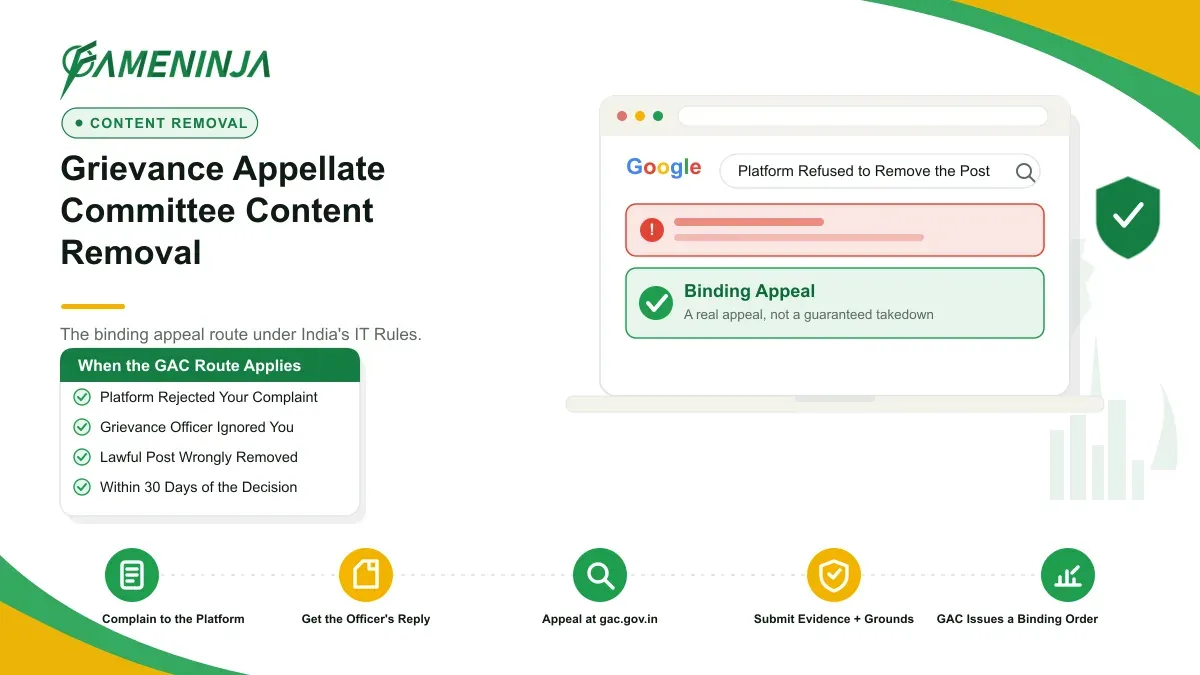
The platform said no. You reported a defamatory post, a fake profile, or a false claim about you, the Grievance Officer replied with a templated line, and the content is still live.
The platform said no, and grievance appellate committee content removal is the appeal route built for exactly that moment. You reported a defamatory post, a fake profile, or a false claim about you, the Grievance Officer replied with a templated line, and the content is still live. Or the opposite happened: a lawful post of yours was pulled down and nobody will tell you why. Most people stop there, because the reply reads final. It is not.
India built a government appeal that sits above the platform's own grievance desk. The grievance appellate committee content removal route, run at gac.gov.in, lets you challenge that decision for free, entirely online. It was created under the IT Rules 2021 precisely because too many complaints were being closed without a real answer. This guide explains when the route fits, how to file, and, just as honestly, what it will not do. We will separate suppression from deletion, and flag every legal point a lawyer should confirm. Read it before you accept the platform's "no" as the end.
Quick answer
The Grievance Appellate Committee (GAC) is a government appeal body under India's IT Rules 2021. If a platform's Grievance Officer refuses to remove content, or wrongly removes yours, you can appeal free at gac.gov.in within the prescribed window, usually 30 days. The GAC can issue a direction the platform must follow. Outcomes are case by case.
What the Grievance Appellate Committee (GAC) is
The Grievance Appellate Committee is a government-appointed appeal body that reviews decisions made by a social media or intermediary platform's Grievance Officer. It was set up under Rule 3A of the Information Technology (Intermediary Guidelines and Digital Media Ethics Code) Rules, 2021. Three such committees were notified in January 2023, and the appeal portal lives at gac.gov.in.
Here is the plain version. Every large platform in India must have a Grievance Officer who handles user complaints. Before the GAC existed, that officer was often the last stop. If the platform closed your complaint, you either lived with it or went to court. The GAC adds a layer in between. It sits above the platform's grievance desk, so a user who is not satisfied has somewhere to go that is neither the platform nor a courtroom.
Each committee has a chairperson and two whole-time members appointed by the central government, drawn from ministries and independent members. The point of the design is independence from the platform. The platform decided first. The GAC reviews that decision on appeal.
Two features matter for a stressed reader. It is free. And it is fully online, from filing the appeal to receiving the decision. You do not need to travel, and you do not pay a court fee to start.
When the GAC content removal route applies to you
The route works in two directions, and this is where people get confused. It is not only for takedowns. It is for any user aggrieved by a Grievance Officer's decision.
Your takedown request was refused. You reported defamatory content, impersonation, a privacy violation, or unlawful material. The platform's Grievance Officer reviewed it and declined, or closed the ticket without acting. You believe the content breaks the rules or the law. You can appeal that refusal to the GAC.
Your lawful content was wrongly removed. You posted something legitimate, a review, a criticism, a factual account, and the platform took it down or suspended your reach after someone else complained. You can appeal the removal and ask for it to be restored. This is the "appeal wrongful content takedown India" side of the same door.
The common thread is a prior decision by a platform Grievance Officer. The GAC reviews that decision. It is an appeal, not a fresh complaint. So the order of operations is fixed: you must first report to the platform and get a decision, then escalate. If you skip the platform and go straight to the GAC, there is no decision to appeal yet.
A quick honesty note before you invest effort. The GAC route fits content-and-account grievances under the IT Rules. It is a strong tool for defamatory posts, impersonation, non-consensual images reported to a platform, and wrongful removals. If your real problem is a news article on a publisher's own website, a court record, or a Google search result with no underlying platform grievance, a different remedy usually applies. We cover those boundaries below, and in our work on removing negative articles and content.
How to file a GAC appeal at gac.gov.in, step by step
The process rewards preparation. A vague appeal gets a vague result. Here is the sequence.
Step 1: Report to the platform first, and keep the record. Use the platform's in-app reporting and its Grievance Officer contact. Save the complaint reference number, the date, and every screenshot. Under the 2026 amendment to the rules, Grievance Officers are expected to resolve complaints faster than before, and to acknowledge quickly. If they do not act, or act wrongly, that failure is what you appeal.
Step 2: Get the Grievance Officer's decision in writing. The appeal clock runs from the communication you receive from the Grievance Officer. A closed ticket, an email, or an in-app notice usually counts. If you got nothing, note the date your complaint should have been resolved by, because inaction is itself a decision you can challenge.
Step 3: Create your appeal at gac.gov.in. The portal is the official channel. You register, identify the platform, and reference the original grievance. File within the prescribed window, generally 30 days from the Grievance Officer's communication. Do not let the window lapse; a late appeal can be rejected on timing alone.
Step 4: State the rule that was broken, not just your feelings. This is the step most people rush. Point to what makes the content unlawful or rule-violating: defamation, impersonation, a privacy breach, obscene material, or a wrongful removal of lawful speech. Attach the URLs, the screenshots, the grievance reference, and a short, factual timeline. Specific beats emotional every time.
Step 5: Wait for the decision and preserve everything. The GAC aims to decide within a defined period, reported as 30 days from receiving the appeal. Keep monitoring the live content and take dated screenshots, because the situation can change while the appeal is pending, and evidence can disappear.
If the volume of URLs is large, or re-uploads keep appearing, this is the point where structured help pays off. Our reputation repair and remove from Google work exists for exactly this stage, when one takedown is not the whole battle.
What the GAC can and cannot do (the honest part)
This is the section to read twice, because it is where hope meets reality.
What the GAC can do. It can review the platform's decision and issue a direction to the platform. Reporting on the mechanism describes that direction as binding on the platform, which is the real value: a body outside the platform can tell it to act. In practice, the GAC has been used to review appeals where content was ordered taken down. When the content clearly violates the rules, the appeal has teeth.
What the GAC cannot do, and here is the honest limitation. A GAC direction is an administrative order, not a court judgment. It does not, on its own, force a search engine to de-index a page worldwide, it does not bind parties outside the IT Rules framework, and it does not guarantee a specific result on your facts. Its constitutional footing has itself been questioned, and whether a GAC order can be appealed further is not fully settled. No honest advisor will promise you a removal or a fixed timeline from this route.
That leads to the distinction that decides most cases: suppression versus deletion.
Deletion means the content is actually taken off the platform. The GAC route aims at deletion, and it can achieve it when the content breaks the rules and the platform is the right respondent.
Suppression means the content still exists, but you push it down in search and crowd it out with stronger, truthful material. When deletion is not available, because the content is lawful opinion, sits on a publisher you cannot compel, or survives the appeal, suppression is the realistic plan. Our online reputation management work is built around that honest split: remove what the rules allow, suppress what they do not, and say plainly which one applies to you.
What most people get wrong is treating the Grievance Officer's first "no" as the ceiling. It is not. It is the trigger for the appeal. The mistake is quitting one step before the tool that was designed for exactly this moment.
GAC vs DPDP erasure, court de-indexing, and account recovery
The GAC route gets confused with three other remedies. Using the wrong one wastes weeks. Keep them separate.
GAC appeal is not DPDP right to erasure. The Digital Personal Data Protection Act 2023 gives you rights over your personal data held by a data fiduciary, including correction and erasure in defined situations. That is a data-protection remedy against a data holder. The GAC appeal is an administrative challenge to a platform's grievance decision about content. Different law, different target, different process. Some cases can involve both, but they are not the same door.
GAC appeal is not court-ordered de-indexing. Removing a result from Google search, or de-indexing a court record, generally needs a legal or policy basis and often a court order, especially for lawful journalism or public records. The GAC directs intermediaries under the IT Rules; it is not the vehicle for compelling a search engine to erase a lawful page globally. For that terrain, see our work on remove from Google.
GAC appeal is not account recovery. If your account was hacked, locked, or lost, that is a security and access problem, handled through the platform's recovery flows and, where a crime occurred, the police. The GAC reviews content and grievance decisions, not password resets.
Knowing which lane you are in is half the work. Pick wrong and you file the right argument in the wrong forum.
The 2026 IT Rules amendments and what changed
The framework did not stand still. India amended the intermediary rules in 2026, and the changes tightened timelines that matter to anyone chasing a takedown.
Reporting on the 2026 amendment describes shorter platform response times: Grievance Officers expected to resolve complaints in a compressed window, faster acknowledgement, quicker action on unlawful content, and a very short window for the most serious material such as non-consensual intimate imagery and child sexual abuse material. The appeal to the GAC continued, with the appeal window and the resolution target reported at 30 days each.
Courts have also pushed on speed. Reporting indicates the Delhi High Court directed the GAC to decide appeals within a bounded period rather than letting them drift. Treat the exact case name and date as something your lawyer should confirm before you rely on it.
Why this matters to you: faster platform timelines mean you should get a Grievance Officer decision sooner, which means your appeal clock starts sooner, which means you should file promptly. The system is being nudged toward decisions, not silence. Use that. For the underlying rules, the Ministry of Electronics and Information Technology publishes the framework at meity.gov.in, and if the content involves a cyber crime, report in parallel at cybercrime.gov.in. Independent legal coverage of the GAC and the amendments is tracked by outlets like LiveLaw.
This section states legal points at a general level. Confirm current timelines and any specific ruling with a lawyer before acting.
How the GAC route shows up in AI search
People no longer only Google their problem. They ask ChatGPT, Perplexity, and Google AI Overviews, "the platform refused to remove content, what can I do in India?" The answer those engines assemble is now part of your reputation, because it shapes what a worried person, a client, or a journalist reads about your situation and your options.
Two things follow. First, if the AI answer is vague or wrong about the GAC, people miss a real remedy, and your problem looks more hopeless than it is. Second, when the content about you is defamatory, an AI assistant can repeat it as if settled. Getting the underlying post removed through the GAC route, where the facts allow, is what stops the AI from parroting it later.
To be surfaced accurately, the useful sources define the term cleanly, name the portal, and state the steps. That is why this article leads with a plain definition, names gac.gov.in, and lists the sequence: AI engines lift clear, self-contained answers. If you want your side of a story to be what these engines cite, the fix is the same as good ORM: publish accurate, structured, verifiable material, and remove the unlawful content at the source. More on that approach across our FameNinja blog.
An anonymized example from our work
A pattern we see often looks like this. A founder in a Tier-1 city finds a post repeating a false, damaging claim about them. They report it through the platform, citing defamation. Weeks later, the Grievance Officer closes the ticket with a generic line that the content does not violate the platform's community standards. The founder assumes that is final and starts panicking about investors reading it.
The change comes from treating that reply as the start, not the end. The record gets organized: the grievance reference, the dated screenshots, the exact URLs, and a short factual note on why the claim is false and why it breaches the rules. That package becomes a GAC appeal at gac.gov.in, filed inside the window, arguing the specific rule violated rather than how upsetting it is.
Here is the honest part, kept honest. Whether the GAC directs the platform to act depends on whether the content actually breaks the rules, and on the facts of that case. We do not promise the outcome, and we do not invent one here. What reliably improves is the quality of the case and the odds of a real review, instead of a second templated "no." Where deletion is not available, the same effort feeds a suppression plan so the damaging result loses its grip in search over time.
Where to start
If a platform refused to remove defamatory content, or pulled down something lawful of yours, the Grievance Officer's decision is not the last word. The GAC route exists for this exact moment, it is free, and it is online. Prepare the record, name the rule that was broken, and file inside the window.
If you would rather have a calm, honest read before you act, we are happy to look at the specifics with you. You will get a straight answer on whether the GAC route, a suppression plan, or both, is the realistic path for your case. You can also request a Free ORM Report. No guarantees, just an honest assessment.
This is general information, not legal advice. Confirm any legal step with a qualified Indian lawyer.