

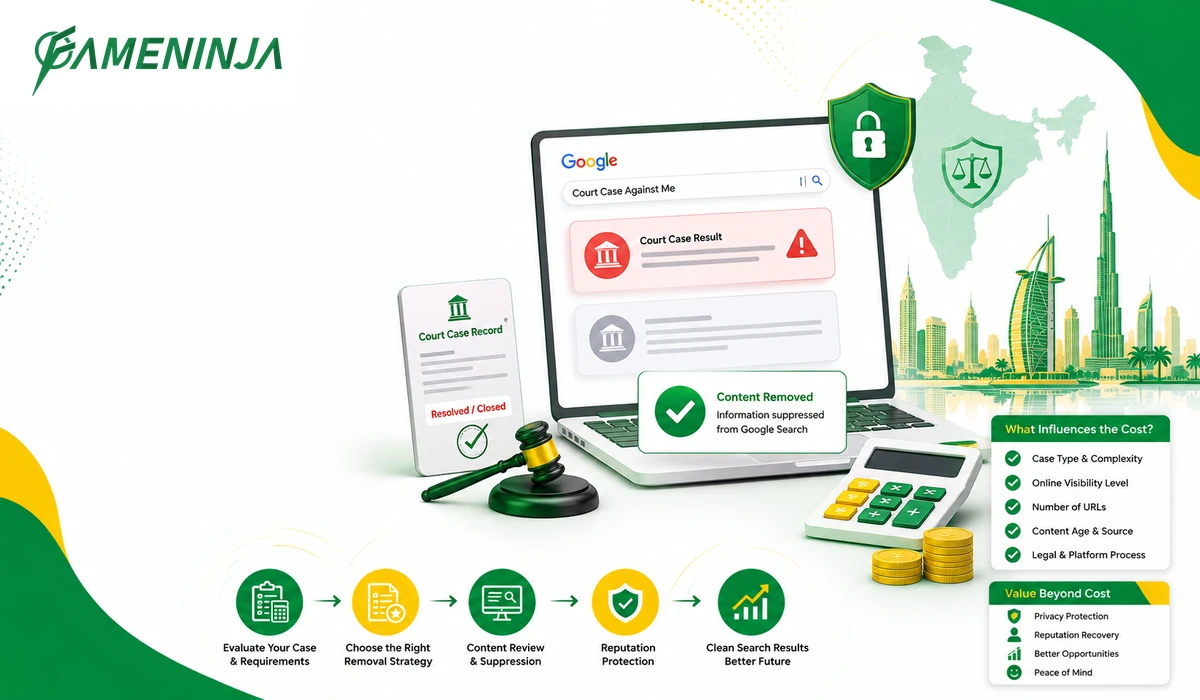
You were discharged, acquitted, or the matter was settled years ago. On paper it is over. But when someone searches your name, an old FIR, a news report, or a judgment still sits near the top, and it is costing you a job, a deal, a loan, or your peace of mind. So you start asking what it would cost to remove a court case from Google, and the answers you get range from a few thousand rupees to several lakhs.
They are all describing different things. There is no single price, because there is no single action called “removal”. This page explains what removing a court case from Google actually involves, prices each route honestly, and is clear about the one thing most vendors will not tell you: a live judgment is rarely deleted. What usually happens is de-indexing or masking, and the cost depends on which route fits your facts.
Quick answer: There is no flat fee. “Removing” a court case from Google usually means de-indexing the result or masking your name in the record, not deleting the judgment. Costs depend on the route: a court petition (advocate fees often reported around Rs 30,000 to Rs 2,00,000 and two to six months), a complaint under the DPDP Act, or ongoing search suppression priced per link, keyword, and geography. Full deletion is the exception, not the rule.
First, what “removing a court case from Google” actually means
This is where most of the confusion and most of the overcharging come from. Four different outcomes get sold under the same word.
Deletion means the judgment or article is taken off the internet entirely. For genuine court records, this is rare. Courts treat judgments as public records needed for legal research and precedent, and they strongly prefer to preserve them.
De-indexing means the specific URL is removed from name-based search results. The page still exists, and the record stays accessible by case number, citation, court, and date, but a casual search of your name no longer surfaces it. This is the realistic mechanism behind most “removals”.
Masking means a court directs that your name in the public version of the judgment be replaced with a neutral reference, while the unredacted record is preserved internally. It addresses the harm at the source rather than just at the search engine.
Suppression means the result stays live and indexed, but stronger positive pages are built to push it off the first page, where most people never look. It is not a legal remedy. It is reputation engineering, used when removal or de-indexing is not available.
Understanding which of these you actually need is the single biggest factor in what you will pay. We break the first two apart in detail in our guide on Court Case Removal vs Court Case Suppression, and the distinction is worth getting right before you spend a rupee.
Why a flat price does not exist
Two people can both want to “remove a court case” and face completely different bills. The cost is driven by your facts, not a menu.
The status of the case matters most. Indian courts have become more willing to protect people whose matters ended in acquittal, discharge, quashing, or settlement, or that were purely private in nature. A clean exoneration is a far stronger basis than an ongoing or unresolved matter.
The number and type of URLs matter next. A single judgment listing is cheaper to address than your name spread across a court database, a legal aggregator, and a dozen news articles. Whether the content is text, or also includes photographs, changes the work too.
Public interest is the hard limit. The Right to be Forgotten in India is not absolute. It is balanced against the public’s right to know, and requests tied to public servants, politicians, or matters of genuine ongoing public interest are routinely refused. No amount of money changes that.
What it costs to remove a court case from Google, route by route
There are three realistic routes, plus suppression for whatever cannot be removed. Each carries a different cost and a different likelihood of success.
The court route: a Right to be Forgotten or masking order
This is the strongest route and, for court records, often the only one that leads to de-indexing. Your advocate files a writ petition, usually under Article 226, asking the High Court to direct search engines to de-index the content and, where appropriate, to mask your name in the record.
This route has real momentum behind it. In a landmark order in June 2026, the Delhi High Court directed Google and other search engines to de-index name-based results, and directed the legal database Indian Kanoon to restrict name-based search, for a batch of petitioners whose cases had ended in acquittal, discharge, quashing, or settlement, or were purely private. The judgments stayed accessible by case number and citation; only the name-based discoverability was restricted.
What it costs: this is a legal expense, not an agency fee. Advocate costs for such a petition have been reported in the range of roughly Rs 30,000 to Rs 2,00,000 depending on the seniority of counsel, with a timeline often cited at two to six months depending on the court’s backlog and whether the platforms contest. Once an order exists, executing it across search engines and databases is the part a reputation firm handles. If your goal is the underlying record rather than the news coverage, our work on how to remove court records from Google walks through what de-indexing a judgment realistically involves.
The DPDP route: a complaint to the Data Protection Board
The Digital Personal Data Protection Act, 2023 gives you a right to seek erasure of personal data from a data fiduciary in defined circumstances, and a path to complain to the Data Protection Board if a legitimate request is refused. For some situations this can be a faster and cheaper alternative to a full writ petition.
What it costs: filing a complaint with the Board is far lighter than litigation, though it still benefits from legal help to frame correctly. The Act also carries significant penalties for non-compliant fiduciaries, which gives a well-founded request real weight. Treat this as an evolving route and take current legal advice on whether it fits your facts.
The platform and source route: acting on a valid order
Where a court has declared content unlawful, search engines will usually act. Google’s own legal removal process accepts a signed court order, the exact URLs, and the specific part of the order that mandates removal, and de-indexes confirmed content, often within days. Google records these actions publicly in its Transparency Report. Without a valid order or a clear policy violation, though, Google treats court records as legitimate public information and will not remove them on request alone.
The same logic applies to the original publisher. If a news site agrees to take down or update an article at the source, the search result follows once the page is recrawled. This is also where photographs come in. If a mugshot or court-step image is part of the coverage, addressing it may be a separate task, which is why people often pair this work with a plan to remove negative image from Google search alongside the text results.
The suppression route: when removal is not available
If your matter does not qualify for de-indexing, or while a petition is in progress, suppression is the realistic play. It does not touch the court record. It builds and strengthens accurate, positive pages so the damaging result drops below the first page over time.
How long it takes depends on how entrenched the result is. A single article on a weak domain can drop in weeks. A judgment, or a story on a strong news site, can take months of consistent work, because you are competing against a high-authority page for your own name. The assets used are real: authoritative profiles, owned properties, interviews, and verified third-party features, all built to outrank the damaging result for your name. This is also why suppression is measured per search engine and per geography. Holding the first page on google.co.in is a different job from holding it on a global search, and each target is costed on its own, which is part of why the figure is only fixed once we have seen the actual search footprint.
What it costs: suppression is priced on a model, not a flat fee, because the work scales with the problem. The usual structure is per link, per target keyword, and per geography or search engine, with the exact figure quoted after a case assessment. It is typically an ongoing effort rather than a one-time charge, because results need to be held in place. The bulk of suppression work targets the news coverage rather than the judgment itself, so if the real problem is a cluster of articles, our approach to Remove negative news from Google is usually where that part of the budget goes.
What you should be cautious of
Here is my honest opinion after seeing how this is sold. The most common trap is a vendor promising guaranteed deletion of a court case for a fixed fee. For a genuine judgment, that promise is almost always either an overstatement or a description of de-indexing dressed up as deletion. The lawful, realistic paths are a court order to de-index or mask, a DPDP complaint where it fits, and suppression for the rest.
And the honest limitation, stated plainly: no one can promise a court will grant a masking or de-indexing order. The outcome depends on your facts, the case status, and the public-interest balance, and a judge makes that call, not an agency and not a law firm. Anyone who guarantees the result is selling you certainty they do not have. The honest version is a realistic assessment of how strong your case is and which route gives the best odds.
How FameNinja approaches it
We are not a law firm, and we do not pretend to be. For the court route, we coordinate with privacy advocates who handle the petition, while we assess the full search footprint, prepare the URL evidence, execute de-indexing submissions once an order exists, and run suppression on whatever cannot be removed. The first step is always an honest read of which route your facts actually support, so you are not paying for a petition that will fail or a suppression campaign you did not need.
The cost picture at a glance
The short version you can keep. There is no single price to remove a court case from Google. The court route, a writ petition for de-indexing or masking, is a legal cost reportedly around Rs 30,000 to Rs 2,00,000 in advocate fees over two to six months, plus execution. The DPDP complaint route is lighter and may fit acquittal-based erasure requests. The platform route works only with a valid court order or a clear policy violation. Suppression is priced per link, keyword, and geography, quoted after assessment, and is ongoing. What you pay depends on your case status, the number and type of URLs, and whether the matter carries public interest.
An illustrative example
A composite, to show how the routes combine. An entrepreneur was discharged in a criminal matter years ago, but an old judgment, an Indian Kanoon listing, and several news articles still rank for his name, and a banking partner raised it during diligence. His advocate pursues a de-indexing and masking order on the strength of the discharge. Once granted, the search results and the database listing are addressed through that order, while the remaining news coverage, which the order did not cover, is suppressed over the following months. Three different routes, one outcome. The cost was not a single number; it was a legal fee, an execution effort, and an ongoing suppression budget. (This example is illustrative and not a specific client.)
FAQ
Can you actually remove a court case from Google?
Usually not by deleting it. Indian courts treat judgments as public records and prefer to preserve them. What is realistic is de-indexing the result from name-based search or masking your name in the record, typically through a court order, and suppressing whatever cannot be removed.
How much does it cost to remove a court case from Google?
There is no flat fee. The court route is a legal expense, with advocate fees reported in the range of roughly Rs 30,000 to Rs 2,00,000 and a two to six month timeline, plus execution. Suppression is priced per link, keyword, and geography. The total depends entirely on your facts.
Is de-indexing the same as deleting the judgment?
No. De-indexing removes the URL from name-based search results, but the judgment still exists and stays accessible by case number, citation, court, and date. It reduces the harm of a casual name search without erasing the legal record.
Does the Right to be Forgotten apply in India?
It is recognised through court rulings as part of the right to privacy under Article 21, and it interacts with the erasure right under the DPDP Act, but it is not fully codified and it is not absolute. It is balanced against public interest, so it does not apply automatically.
Which cases are most likely to be de-indexed?
Matters that ended in acquittal, discharge, quashing, or settlement, or that are purely private, have a far stronger basis than ongoing matters. Cases involving public servants, politicians, or genuine ongoing public interest are routinely refused.
What if my case cannot be removed?
Suppression is the fallback. It does not touch the court record, but it builds stronger positive pages so the damaging result drops below the first page over time. It is priced on an ongoing per-link, per-keyword, per-geography model.
Should I use a lawyer or a reputation agency?
Often both. The court order itself requires an advocate. Assessing the full search footprint, executing de-indexing once an order exists, and suppressing what remains is reputation work. The two roles are complementary, not interchangeable.
Get an honest assessment first
Before you spend anything, the smart move is a clear read on which route your case actually supports, and an honest answer on what is realistic. We will tell you whether you have a strong basis for de-indexing, where a DPDP complaint might fit, and what suppression would involve for anything that stays. No promises of deletion, no pressure.
Message us on WhatsApp or book a confidential consultation, and we will give you a straight read.