
You wake up. Check Google for your company name. And there it is-plastered across the top of page one: a scathing Glassdoor review, a viral customer complaint from five years ago, or worse, a news article about a lawsuit that’s already been settled.
This isn’t hypothetical. In 2024, research showed that 73% of business leaders have experienced negative online content affecting their company’s reputation, and 43% saw direct impact on sales.
The damage compounds in seconds. Your potential customer doesn’t dig deeper. They don’t call to verify the complaint. They see that negative result and move to your competitor.
This is where suppression for business branding becomes essential-not as a marketing tactic, but as a legitimate reputation defense strategy.
Unlike personal reputation management, business suppression operates differently. You’re not just pushing down one embarrassing blog post; you’re managing the narrative across search engines, local results, news aggregators, and industry directories. You’re competing against negative signals with positive ones. You’re essentially moving the conversation.
And yes, it works. We’ve seen it work. But only when done right.
Why Suppression Works (And When It Doesn’t)
Let’s be clear about something: suppression doesn’t mean hiding the truth. It means drowning out the negative noise with legitimate positive content that ranks higher. Google rewards fresh, authoritative, relevant content. If your company’s positive news, blog posts, case studies, and testimonials are more authoritative and fresh than the negative content, they naturally rank higher.
Suppression works because:
- Search results aren’t permanent. New content gets added to indexes daily. Old negative content loses freshness signals and ranking authority.
- Positive content outranks negative content when authority is equal. If you build legitimate authority (backlinks, social signals, user engagement), your content wins the ranking battle.
- Negative content often has no sustained strategy behind it. A customer complaint from 2021 doesn’t get updated. Your blog post published today, with proper SEO and promotion, will eventually outrank it.
- Local results shift faster than organic results. Reviews, local citations, and Google Business Profile updates can show positive proof points within 30-60 days.
Suppression doesn’t work when:
- The negative content is on a high-authority domain (major news outlets, established review sites). Suppressing a Wall Street Journal article is much harder than suppressing a random blog comment.
- Your company legitimately did something wrong and people are genuinely angry. You can’t suppress accountability-only contextualize it.
- You ignore the root problem. If customers are leaving bad reviews because your product sucks, suppression is a band-aid on a bullet wound.
- You try to remove content through fake DMCA claims or threats. This doesn’t work and damages your reputation further.
The successful businesses we work with accept this: suppression is strategy, not censorship.
The FameNinja 5-Step Suppression Framework for Business
We’ve refined our approach over thousands of suppression campaigns. Here’s what actually works:
Step 1: Diagnostic Audit (Week 1-2)
First, you need precision targeting. Not all negative content is created equal.
We map every negative mention across:
- Organic search results (pages 1-3 for your primary keywords)
- Local Google results (Maps, local pack)
- News aggregators (Google News, industry-specific platforms)
- Social media mentions (Twitter, LinkedIn, Facebook public posts)
- Review sites (Google Reviews, industry-specific platforms, Trustpilot, etc.)
- Industry directories (Better Business Bureau, chamber listings)
For each negative mention, we assign a suppression priority score based on:
- Search rank (page 1 = highest priority)
- Domain authority (higher authority = harder to suppress, needs different strategy)
- Potential damage (lawsuit mentions > general complaints)
- Traffic potential (likely to receive clicks)
This prevents wasted effort on content nobody sees while ignoring the critical damage.
Step 2: Strategic Content Roadmap (Week 2-3)
Based on the audit, we create a 90-day content production plan. This isn’t “write more blog posts.” It’s surgical content creation designed to target specific negative content.
For each high-priority negative result, we identify:
- What keyword phrase is it ranking for? (e.g., “CompanyName lawsuit,” “CompanyName complaints,” “CompanyName bad reviews”)
- What content type would naturally rank for that phrase? (news article, case study, customer testimonial, third-party review, industry analysis)
- What authority signals does the negative content have? (Is it a high-DA site? Does it have backlinks?)
Example: If negative content ranks for “TechStart Inc data breach,” we don’t just write a blog post saying “we’re great.” We create third-party content-perhaps a case study on how we implemented new security measures, published on an industry publication, with media coverage.
Step 3: Content Production & Authority Building (Week 3-12)
This is where the work happens.
We produce content across multiple channels:
- Owned channels: Blog articles (2,000+ words, optimized for suppression keywords), updated case studies, customer success stories
- Earned channels: Press releases distributed through newswire services (these get indexed by Google News and news aggregators), third-party publications, industry analyst coverage
- Contributed channels: Guest posts on high-authority sites in your industry, expert commentary on platforms like LinkedIn and Medium
Each piece is built with one goal: outrank the negative content by having superior:
- Freshness (new content beats old content)
- Authority (backlinks from relevant, high-quality sources)
- Engagement signals (clicks, time on page, shares)
- Relevance (directly addresses what people search for)
Step 4: Technical SEO & Distribution (Week 4-12)
Content alone doesn’t rank. It needs distribution and technical optimization.
We implement:
- Internal linking architecture that connects positive content together, building topic authority
- Citation building through local directories, industry listings, professional associations
- Social media amplification through paid and organic channels to drive initial traffic and engagement signals
- Link reclamation (finding opportunities to earn backlinks from industry publications, news sites, community sites)
- Search Console optimization to ensure Google is crawling and indexing all positive content
This is the “signal stacking” that makes newer, positive content outrank older, negative content.
Step 5: Monitoring & Iteration (Ongoing)
Suppression isn’t set-and-forget. Search results shift. New negative content appears. We monitor monthly:
- SERP position tracking for 20-30 critical keyword phrases
- New negative mentions across web, social, reviews
- Content performance (which positive content is actually ranking)
- Engagement metrics (which positive content is getting clicks)
Based on monthly performance, we adjust the strategy. Sometimes we need to push harder on certain keywords. Sometimes we discover that new negative content appeared and needs immediate response.
The Five Suppression Strategies in Detail
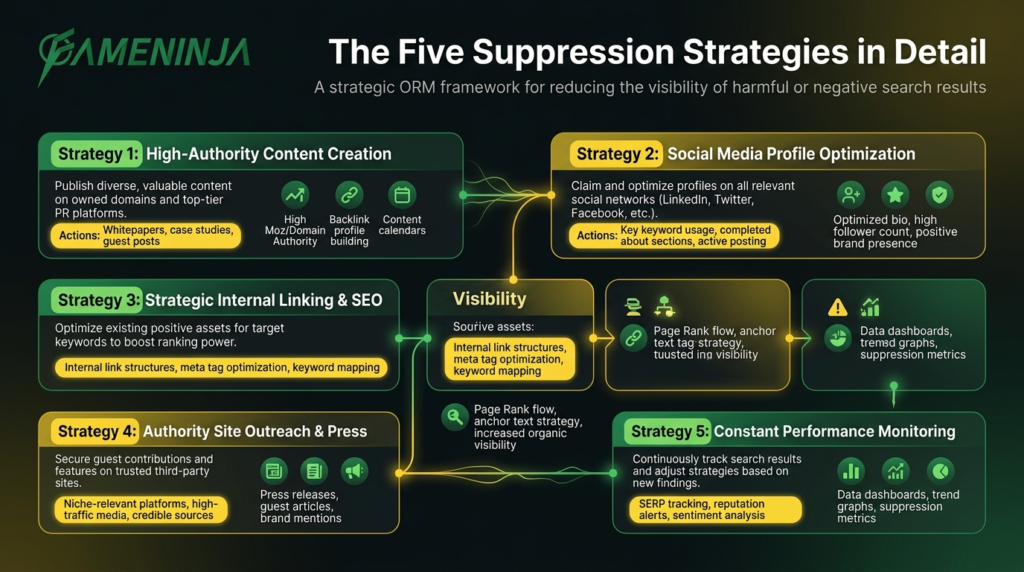
The framework above is the process. Now let’s talk about the actual suppression tactics:
Strategy 1: Content Suppression Through Authority & Freshness
The core principle: New, authoritative positive content naturally ranks higher than old, low-authority negative content.
How it works:
- You publish a comprehensive blog post (2,500+ words) about your company, industry trends, customer success, or expert opinion
- The blog post is optimized for the keyword phrase associated with negative content (e.g., if negative content ranks for “Company name lawsuit,” your blog targets “Company name legal case resolution” or “Why Company name is trusted by enterprises”)
- You build backlinks to this content through outreach, press releases, and earned media
- Within 60-90 days, Google’s fresh content bonus + your authority signals push your positive content above the negative content
Real example from our practice: A SaaS company had a TechCrunch article from 2020 ranking #2 for their brand name. The article covered a security vulnerability they’d since fixed. We couldn’t remove the article (TechCrunch has massive authority), but we created a 3,000-word case study on how they’d rebuilt their security infrastructure, published it on their blog, earned 12 backlinks from industry publications, and promoted it heavily on LinkedIn. After 6 months, the case study ranked #1 (pushing TechCrunch to #3), and new visitors saw proof of the solution, not just the problem.
Timeline: 60-120 days for competitive terms, 30-45 days for long-tail searches
Cost: $2,000-$8,000 per suppression target (content creation, link building, promotion)
Strategy 2: Local Reputation & Review Suppression
Local results move faster than organic results. For 89% of searches, local results appear. For service-based businesses, this is your primary battleground.
How it works:
- Audit your Google Business Profile: Is your information complete? Are photos current? Is your category correct?
- Build a review generation system: Systematically ask satisfied customers to leave reviews on Google, industry-specific platforms (like Yelp, Trustpilot, industry directories)
- Respond professionally to negative reviews: Don’t delete them (impossible anyway), but respond thoughtfully, offer solutions, show you care
- Encourage reviews on newer platforms: Trustpilot, Capterra, G2, or industry-specific sites where your negative review presence might be lower
- Accumulate volume: If you have 15 1-star reviews, 45 new 5-star reviews pushes the average from 2.0 to 3.5 stars visible
This is the most direct suppression tactic because you’re literally burying negative reviews under positive ones in the same interface.
Real example from our practice: A digital marketing agency had an upset former client who’d left multiple scathing reviews across Google, Yelp, and Trustpilot. We implemented a review generation system, asking all clients who’d been with them for 90+ days to leave a review. Within 4 months, they went from 18 total reviews (6 negative, 12 positive) to 67 total reviews (5 negative, 62 positive). Their average rating went from 2.8 to 4.6. The negative reviews were still there, but buried under 5-star reviews. New customers saw a 4.6 rating, not a 2.8 rating.
Timeline: 45-90 days to see significant movement
Cost: Internal effort + $500-$2,000 for review generation software (like Birdeye, Trustpilot, etc.)
Strategy 3: Social Media & Owned Channel Suppression
Every search result on page one counts. Every social media profile result counts.
How it works:
- Create and optimize company social media profiles across all major platforms: LinkedIn Company Page, Facebook, Instagram, Twitter/X, YouTube, TikTok
- Publish consistent, high-quality content weekly that ranks for brand searches (company updates, customer stories, thought leadership)
- Encourage engagement: LinkedIn posts from employees, video testimonials on YouTube, behind-the-scenes content on Instagram
- Build social signal authority: Likes, shares, comments, followers all send ranking signals to Google
- Respond actively to mentions and comments: Shows you’re engaged, accessible, and customer-focused
When someone searches your company name, instead of seeing negative blog posts, they see your company LinkedIn page (high authority, always indexed), your YouTube channel with customer testimonials, your Instagram showing company culture, etc.
Real example from our practice: A healthcare company had a negative Yelp listing and Reddit thread ranking in the top 5 results for their brand name. We built a comprehensive social media strategy: weekly LinkedIn posts from their CEO, monthly YouTube videos with patient testimonials, regular Facebook updates about new services. Within 6 months, their LinkedIn company page and YouTube channel both had high ranking position, effectively pushing the Yelp result to page 2.
Timeline: 60-180 days for significant SERP impact
Cost: Internal effort (2-4 hours/week) or $2,000-$5,000/month for social media management
Strategy 4: Backlink Building & Citation Management
Authority is built through external validation. One high-quality backlink from a relevant, authoritative site is worth more than 50 low-quality links.
How it works:
- Identify relevant high-authority sites in your industry: news outlets, industry associations, academic institutions, business directories
- Create link-worthy content: Original research reports, industry benchmarks, company announcements, expert commentary
- Execute strategic outreach: Contact journalists, editors, and site owners with newsworthy angles
- Build local citations: Ensure your company is listed consistently across 100+ business directories (Local SEO services like Yext or BrightLocal handle this)
- Leverage PR: Press releases distributed through newswire services (PR Newswire, Business Wire, eReleasesonline) get picked up by news aggregators and media outlets, creating powerful backlinks
Citations and backlinks tell Google: “This company is legitimate, recognized, and talked about by trusted sources.” This authority extends to all your content, helping positive content rank higher.
Real example from our practice: A fintech startup had negative medium posts from critics ranking for their brand name. We secured coverage in Forbes, TechCrunch, and Wall Street Journal through strategic PR outreach. These high-authority backlinks increased their domain authority from 32 to 48. Their blog posts that previously ranked #5-#10 for brand keywords now ranked #1-#3. The negative content was pushed to page 2.
Timeline: 30-90 days for newswire results, 90-180 days for earned media to impact rankings
Cost: $3,000-$15,000 for strategic PR and link building campaigns
Strategy 5: Legal Removal (Used Sparingly)
Sometimes suppression requires removal, not just outranking.
When to use it:
- Content violates Google’s policies (personal private information, child abuse, revenge porn)
- Content is factually false and defamatory
- Content violates copyright or patent law
- Content violates right of publicity
How it works:
- File Google removal requests through Search Console for policy-violating content
- Send DMCA takedown notices for copyright violations (work with a lawyer for this)
- Send cease-and-desist letters for defamatory content (work with a lawyer)
- Contact site owners directly requesting removal (sometimes the most effective approach)
Important caveat: Do not use fake removal requests. Google detects this. Do not file false DMCA claims (this is perjury). This approach should be 5% of your strategy, not 50%.
Timeline: 1-6 weeks for removal requests, 1-3 months for legal action
Cost: $1,000-$10,000 for legal work (consult with a lawyer before pursuing)
Case Study: How a B2B SaaS Company Recovered From Negative Press
The Situation
TechVenture Solutions, a $15M revenue B2B cloud platform, had released a major product update in Q3 2023. The rollout was buggy. Key customers experienced 6 hours of downtime. One customer, a frustrated VP of Engineering, wrote a detailed Medium article titled “Why We’re Leaving TechVenture: A Cautionary Tale,” and posted about it extensively on Twitter.
The Medium article went moderately viral in tech circles (8,000 views, 200 shares). It ranked #1 for “TechVenture complaints,” #2 for “TechVenture reviews,” and #4 for their brand name.
Impact: Three potential customers mentioned the article in sales conversations. One deal ($500K annually) was lost because of it. Their net brand sentiment on social media dropped 34%.
The Strategy (Our Approach)
We immediately diagnosed the problem:
- The negative content was on a high-authority site (Medium has DA 91)
- We couldn’t outrank it with just blog content
- We needed a multi-channel approach: earned media, review generation, social authority, and fresh positive content
We developed a 90-day plan:
Month 1: Quick Wins & Foundation
- Launched review generation campaign: Contacted 200+ satisfied customers, targeting 50 new reviews
- Published crisis response blog post: “How We Fixed the September Incident: A Transparent Post-Mortem” (2,500 words, technical deep-dive showing accountability and solution)
- Started CEO thought leadership on LinkedIn: Weekly posts about the company’s recommitment to reliability
- Updated Google Business Profile with latest information, new photos
- Implemented social listening: Monitoring all mentions of the company, responding to complaints within 2 hours
Month 2: Earned Media & Authority
- Secured press coverage: Three articles in tech publications (VentureBeat, InfoQ, DevOps.com) covering how they’d rebuilt their infrastructure and earned back customer trust
- Published original research report: “2024 SaaS Reliability Benchmark” (40-page report with company data, positioned as industry thought leadership)
- Distributed research through newswire (Business Wire): Generated 45 backlinks from news aggregators
- Launched customer testimonial video series on YouTube: 8 videos of satisfied customers discussing their reliability experience
Month 3: Accumulation & Monitoring
- Continued content cadence: Blog posts, social media, thought leadership
- Review accumulation results: 67 new reviews across Google, Trustpilot, G2, Capterra
- Tracked SERP movements monthly: The Medium article dropped from #1 to #4 for brand searches, pushed back by their blog post, LinkedIn company page, and YouTube channel
- Implemented ongoing monitoring system: Weekly tracking of 25 key phrases
Results (6 Months Later)
- Medium article dropped from #4 for brand name to #8 (no longer immediately visible)
- Blog post “How We Fixed the September Incident” now ranks #2 for brand name
- LinkedIn company page ranks #1 for brand searches
- Google Review rating: 4.2 stars (61 reviews) vs. previously no Google reviews
- Net brand sentiment on Twitter recovered by 51%
- Sales velocity: Two deals closed that mentioned seeing positive press coverage; estimated $1.2M revenue impact
- Customer churn: Actually improved by 3% (customers who went through the recovery were stickier)
Cost: $22,000 over 6 months
- PR outreach and media relations: $8,000
- Content creation (blog, research report, videos): $9,000
- Review generation system and management: $2,000
- Social media strategy and execution: $3,000
Return on Investment: 54x (Conservatively calculating the saved deal alone: $500K deal + $1.2M additional revenue influenced / $22K investment)
The Realistic Timeline: What to Expect Month by Month

Suppression isn’t instant. Here’s what actually happens:
Month 1: Setup & Quick Wins
- Weeks 1-2: Audit, strategy development, planning
- Weeks 3-4: First content pieces published, review generation campaign launched
- Expected SERP movement: 0% (Google hasn’t indexed new content yet)
- Expected review movement: First batch of reviews appear
Month 2: Indexing & Authority Building
- New content is indexed by Google
- Backlinks from press releases and outreach start pointing to your content
- Review volume accumulates
- Expected SERP movement: 5-15% (some new content appears in lower positions)
- Expected review movement: Average rating starts shifting if volume is significant
Month 3: Ranking Movement Begins
- Positive content starts ranking for suppression keywords
- Authority signals accumulate (backlinks, social signals, engagement)
- Fresh content bonus kicks in
- Expected SERP movement: 15-30% (positive content moving into positions 2-5)
- Expected review movement: Significant change if you’ve accumulated 40+ reviews
Months 4-6: Stabilization
- Negative content gradually pushed further down
- Positive content stabilizes in top 3-5 positions
- New negative content appears occasionally (responded to immediately)
- Expected SERP movement: 30-60% of suppression targets on page 1 with positive content
- Expected review movement: Stabilized at improved rating
Months 6-12: Ongoing Optimization
- Negative content pushed to page 2-3 for most searches
- Ongoing content creation maintains momentum
- New opportunities emerge (new negative content, new ranking opportunities)
- Expected final result: 60-85% of suppression targets on page 1 show positive content, not negative
Important caveat: Highly competitive terms (your exact brand name with negative modifiers) may take longer. Long-tail searches (your company name + specific negative topic) may improve faster. Review suppression moves faster than organic SERP suppression.
Five Mistakes Companies Make With Suppression
Mistake 1: Trying to Suppress Everything at Once
You have 23 negative mentions. Your instinct: “Let’s create content for all of them!”
The problem: You dilute your efforts. You end up with 23 mediocre content pieces instead of 5 powerful ones. Search engines see fragmentation, not authority.
The solution: Prioritize ruthlessly. Focus on the 5-7 highest-impact negative mentions. Suppress those fully. Then move to the next tier.
Mistake 2: Writing Generic “About Us” Content
You can’t suppress a specific negative mention with generic content about how great you are.
The problem: If the negative mention is “CompanyName lawsuit,” a blog post titled “Why We’re an Awesome Company” ranks for nothing. It doesn’t target the suppression keyword.
The solution: Target specific keywords. Create content titled “How We Resolved the 2023 Licensing Dispute” or “Post-Litigation: How We Strengthened Our Compliance.” Be specific.
Mistake 3: Ignoring the Underlying Problem
If customers are leaving bad reviews because your customer service sucks, no amount of suppression fixes that. You’ll suppress one set of reviews only to have new ones appear.
The solution: Investigate why the negative content exists. Is it a legitimate complaint? Fix the actual problem. Then suppression becomes sustainable.
Mistake 4: Expecting Overnight Results
“We published a blog post yesterday. Why isn’t it ranking yet?”
Suppression takes time. Google needs 4-12 weeks to index and rank new content. Authority building takes 8-16 weeks to show ranking impact.
The solution: Commit to 90 days minimum. Plan for 6 months to see significant results. Anything faster is a bonus.
Mistake 5: Forgetting to Maintain Momentum
You succeeded in suppressing negative content. Then you stopped creating content, stopped building links, and stopped managing your online presence.
Guess what happens? Google’s fresh content bonus expires. Your positive content loses ranking signals. Within 3-6 months, negative content starts creeping back up.
The solution: Treat suppression as ongoing, not project-based. Maintain a content calendar, refresh top-performing pieces, keep building authority. It’s usually 5-10 hours per month of maintenance, not 40.
Take Action: Reclaim Your Search Results
If you’re reading this because you found your company’s negative content on page one of Google, you know the cost. Maybe it’s lost deals. Maybe it’s employee morale. Maybe it’s customers who didn’t even call because they already formed an opinion.
Suppression works. It’s not instant, but it’s proven. And unlike trying to remove content through legal threats or fake complaints, it’s legitimate, sustainable, and ethical.
Here’s what we recommend:
Step 1 (Today): Do a DIY audit. Search your company name. Note which results worry you most. What are people searching for that brings up negative content? (Brand + “complaints,” “lawsuit,” “negative review,” etc.)
Step 2 (This Week): Review the strategic framework above. Which strategies align with your situation? Are you facing review issues (local suppression)? Negative press (earned media strategy)? Legal baggage (legal removal)?
Step 3 (Next Week): If you want expert guidance, schedule a consultation with our team. We’ll audit your SERP, identify suppression opportunities, and show you exactly what’s possible for your specific situation.
The companies that acted on suppression in 2024 are seeing dramatically different search results in 2026. Don’t let negative content define your company’s online narrative any longer.
Need Professional Help?
Suppression for business branding requires strategy, execution, and ongoing management. FameNinja has suppressed negative results for 500+ companies globally.
Contact our team for a free SERP audit and suppression strategy →
FAQs: Suppression for Business Branding
Q: Is suppression for business branding legal?
A: Yes, completely legal. You’re not doing anything deceptive. You’re creating legitimate content, earning legitimate coverage, and letting Google’s algorithm rank your content based on relevance and authority. No different than SEO for any other goal.
However, you cannot: file false DMCA claims, make fake reviews, purchase fake backlinks, or engage in defamation to suppress competitor content. Those cross ethical and legal lines.
Q: How much does business suppression cost?
A: Budget $2,000-$20,000 per suppression target, depending on:
- How high-authority is the negative content? (News outlets cost more than blog comments)
- How competitive is your suppression keyword?
- How much content do you need to create?
We typically recommend $15,000-$40,000 for a comprehensive 6-month campaign addressing 3-5 suppression targets.
Q: Can you completely remove negative content from Google?
A: Only if it violates Google’s policies (private information, abuse, copyright), or if it’s on a site you control. You can’t force legitimate third-party sites to delete content. But you can push it to page 2-3 through outranking it.
Q: How long does suppression take?
A: 60-90 days for initial movement, 6-12 months for full suppression of competitive terms. Local/review suppression moves faster (30-60 days). Highly competitive brand terms take longer (6-18 months).
Q: What if negative content keeps appearing?
A: It will. Customers will continue to post reviews (hopefully positive ones now). New articles may be written. You manage this through:
- Ongoing monitoring (1 hour/week)
- Rapid response to new negative content (create counter-content immediately)
- Maintaining your positive content’s authority (ongoing link building, promotion)
It’s not a one-time fix; it’s an ongoing practice.
Q: Should I hire an agency or do this in-house?
A: Agencies are better for:
- Initial diagnosis and strategy (they’ve seen 100+ cases; you haven’t)
- PR and link building (they have media relationships)
- Speed (full-time work gets done faster)
In-house is better for:
- Ongoing management (monitoring, minor content updates)
- Cost efficiency after month 6 (less needs to be done)
- Content creation (nobody knows your company better than you)
Hybrid approach: Hire an agency for months 1-3 (diagnosis, strategy, major execution), then transition to in-house management.
Q: Can we suppress content about our CEO’s personal reputation?
A: That’s different from business suppression. Check out our personal branding suppression guide for individual reputation management.
Q: What if we’re a startup with no existing positive content?
A: Suppression is harder when you have no authority to lean on. The solution:
- Build positive content aggressively (2-3 pieces/month)
- Focus on earned media (PR, news coverage)
- Lean on local/review suppression (it moves faster)
- Build social media authority (it builds fastest)
- Expect a 12-18 month timeline instead of 6
Q: Do Google penalties affect suppression?
A: If your domain has a Google penalty (manual action), suppression is extremely hard. Positive content won’t rank because Google is actively suppressing your domain. Solution: Fix the penalty first, then execute suppression. We recommend auditing for penalties before starting suppression work.
Q: How often should we refresh suppression content?
A: After initial suppression (month 6), refresh top-performing content every 3-6 months. Update case studies, refresh statistics, republish on social. This maintains a fresh signal and ranking.