

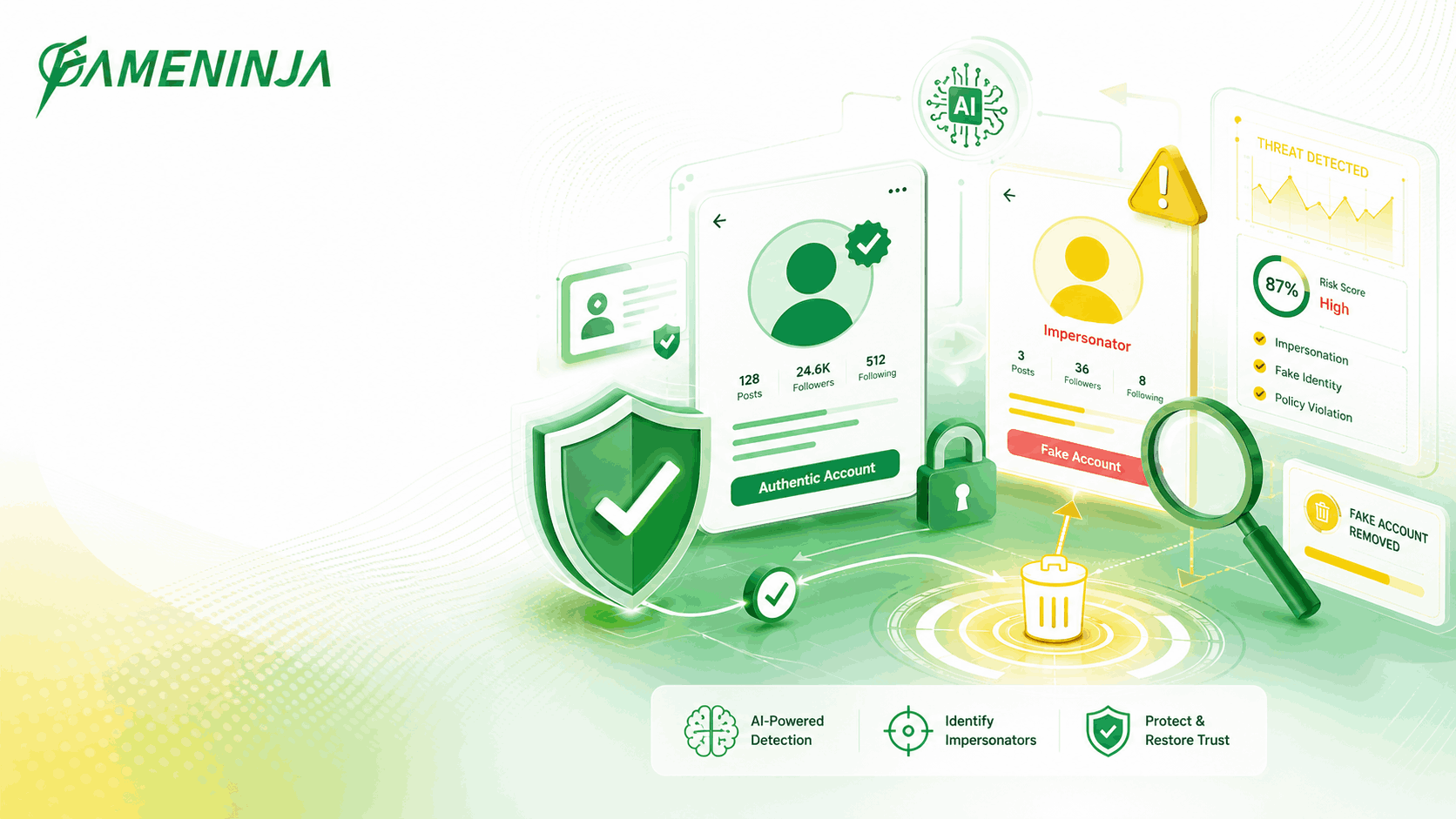
Someone is using your photos, your name, and your identity on a fake Instagram account. They might be scamming your followers, damaging your reputation, or harassing people while pretending to be you.
This happens more often in India than most people realize. And while Instagram has a built-in reporting process, it doesn’t always work. Reports get denied. Fake accounts get taken down and pop back up the next day with a slightly different username. The in-app process alone often isn’t enough.
This guide covers the complete removal strategy used in India: the Instagram in-app report, the cybercrime.gov.in portal filing, the legal routes under Section 66D of the IT Act, and the civil defamation options for persistent impersonation. Used together, these give you the highest chance of permanent removal.
Step 1: Report Through Instagram’s In-App Process
Always start here. This is the fastest route when it works, and it creates a record even when it doesn’t.
How to Report an Impersonation Account
If you have your own Instagram account:
- Go to the fake account’s profile
- Tap the three dots (…) in the top right corner
- Tap “Report”
- Select “It’s pretending to be someone else”
- Select “Me” (if the account is impersonating you)
- Confirm and submit
If you don’t have an Instagram account (or can’t access yours):
Use Instagram’s dedicated impersonation reporting form: help.instagram.com/contact/636276399721841
Fill in:
- Your full name
- Your email address
- The username of the fake account
- A government-issued ID to verify your identity (Aadhaar, PAN, Passport, Voter ID, or Driving License)
- A description of how the account is impersonating you
What Instagram Does With Your Report
Instagram’s moderation team reviews impersonation reports within 24-48 hours in most cases. They look for:
- Does the fake account use your name or a very similar name?
- Does it use your photos?
- Does it claim to be you?
- Is it misleading other users?
If Instagram agrees the account is impersonating you, they’ll disable it. You’ll receive an email confirming the action.
When Instagram’s Report Process Fails
Instagram denies impersonation reports more often than you’d expect. Common reasons:
The fake account uses a slightly different name. “Rahul.Sharma.Official” vs your real account “RahulSharma” may not be flagged as impersonation because the names don’t match exactly.
The fake account doesn’t claim to be you explicitly. If it uses your photos but a different name, Instagram may not classify it as impersonation.
The volume of reports is overwhelming. Instagram processes millions of reports globally. Some legitimate impersonation reports fall through the cracks.
The fake account is in a different language. If the bio is in Hindi or a regional language and the reviewer doesn’t understand the context, the impersonation may not be recognized.
If your report is denied, don’t give up. Move to Step 2.
Step 2: File a Complaint on cybercrime.gov.in
This is where the India-specific advantage kicks in. The National Cyber Crime Reporting Portal is a government resource that most impersonation victims don’t know about.
How to File
Go to: cybercrime.gov.in
Select: “Report Other Cyber Crime” (or “Report Cyber Crime Related to Women/Children” if the impersonation involves sexual content or harassment)
Category: “Social Media Related Crime”
Sub-category: “Fake Profile / Identity Theft”
Provide:
- Screenshots of the fake account (profile page, bio, posts)
- Screenshots of your real account or real photos being used
- Your government-issued ID proving you are the real person
- The fake account’s username and URL
- Any evidence of harm caused (scam messages, defamatory posts, harassment)
- A description of how the account is impersonating you
Save your complaint number. You’ll receive a unique complaint ID. This is essential for all follow-up and escalation.
Why the Cybercrime Complaint Matters
The cybercrime complaint does three things:
It creates a government record. This formal record strengthens any subsequent legal action and demonstrates to courts and platforms that the impersonation is genuine and documented.
It triggers law enforcement investigation. The cyber cell can trace the creator of the fake account through IP address tracking and platform cooperation. Meta is legally obligated to cooperate with Indian law enforcement requests.
It gives you additional weight with Instagram. When you follow up with Instagram (Step 3), referencing an active cybercrime complaint significantly increases the chance of action. Instagram’s India compliance team treats government-reported cases differently from standard user reports.
Step 3: Escalate Through Meta’s India Grievance Officer
After filing the cybercrime complaint, file a formal complaint with Meta’s India Grievance Officer. This triggers Meta’s legal compliance obligations under the IT (Intermediary Guidelines) Rules 2021.
Email: [email protected]
Your complaint should include:
- Subject line: “Impersonation Report and Removal Request under IT (Intermediary Guidelines) Rules, 2021”
- Your full legal name, contact information, and government ID
- The fake account’s username, URL, and screenshots
- Evidence that the account is impersonating you (your real photos, your real identity documents)
- Your cybercrime.gov.in complaint number from Step 2
- Reference to Section 66D of the IT Act 2000 (cheating by personation using computer resource)
- Reference to IT (Intermediary Guidelines and Digital Media Ethics Code) Rules, 2021
- A clear request for immediate removal of the fake account
Legal obligations: The Grievance Officer must acknowledge your complaint within 24 hours and resolve it within 15 days. For impersonation cases involving identity theft, the resolution timeline may be faster (72 hours for certain categories).
If not resolved: Escalate to the Grievance Appellate Committee at gac.gov.in within 30 days.
Step 4: Legal Action for Persistent Impersonation
If the fake account keeps coming back, or if the impersonation has caused significant harm, legal action is the permanent solution.
Section 66D of the IT Act 2000
This is the primary criminal provision for Instagram impersonation in India:
“Whoever, by means of any communication device or computer resource, cheats by personation, shall be punished with imprisonment of either description for a term which may extend to three years and shall also be liable to fine which may extend to one lakh rupees.”
How to invoke Section 66D:
File an FIR at your local police station or cyber cell. If the local police are reluctant (which sometimes happens with cybercrime), escalate through:
- The cybercrime.gov.in complaint (which can be forwarded to local police for FIR registration)
- The Superintendent of Police (SP) or Commissioner of Police
- A magistrate court complaint under Section 190 CrPC (now BNSS 2023)
BNS 2023 Provisions
Section 79 (Defamation): If the fake account posts defamatory content while pretending to be you, the impersonator can be prosecuted for defamation. Up to 2 years imprisonment.
Section 78 (Criminal Intimidation): If the fake account is used to threaten or intimidate others while using your identity.
Section 318 (Cheating by Personation): This is the BNS equivalent covering identity fraud.
Civil Remedies
Personality rights injunction: Indian courts have recognized personality rights, especially for public figures. The recent Delhi HC orders in celebrity deepfake and impersonation cases establish precedent for personality rights protection. You can seek an injunction restraining the impersonator from using your name, photos, or likeness.
Damages: If the impersonation caused financial harm (lost business, lost followers, scammed contacts), you can claim damages in a civil suit.
John Doe order: If you don’t know the impersonator’s identity, a John Doe order directs all platforms to remove accounts impersonating you, even future ones you haven’t discovered yet.
Understanding the Scale of Instagram Impersonation in India

Instagram impersonation in India isn’t a minor nuisance. It’s a growing problem with real financial and reputational consequences.
Indian professionals, especially doctors, lawyers, chartered accountants, and business owners, are frequently targeted by impersonators who use their credentials to run scams. A fake account using a doctor’s name and photo might sell fake medications. A fake account using a CA’s identity might offer fraudulent tax services.
For public figures and influencers, impersonation can redirect brand deals, confuse followers, and spread misinformation. We’ve seen cases where impersonators created fake accounts of Indian micro-influencers (5,000-50,000 followers) specifically to run cryptocurrency and forex scams, damaging the real person’s reputation when followers realized they’d been scammed.
The combination of Instagram’s massive user base in India (over 350 million users, making India Instagram’s largest market globally) and relatively weak automated detection for non-English impersonation creates fertile ground for this problem. Hindi-language impersonation, regional language accounts, and culturally specific scams often slip through Instagram’s moderation filters, which are primarily designed for English-language content.
This is precisely why the multi-channel approach (Instagram reporting + cybercrime.gov.in + Grievance Officer + legal action) is necessary. No single channel is sufficient on its own for the Indian context.
Special Situations
Business Account Impersonation
If someone creates a fake Instagram account impersonating your business:
File through Instagram’s business impersonation reporting (different from personal impersonation) Include your business registration documents (GST registration, incorporation certificate, trade name registration) Contact Meta Business Support at business.facebook.com/help Consider filing a trademark infringement complaint if your business name is registered as a trademark
Celebrity/Public Figure Impersonation
For verified accounts or public figures with significant followings:
Use Instagram’s verified account support channels for faster response Consider the MCN (Multi-Channel Network) route if you’re signed with a talent agency The recent Delhi HC personality rights orders provide strong legal precedent A John Doe order covering all platforms is often the most effective approach
Impersonation Used for Scams
If the fake account is actively scamming people (asking for money, selling fake products):
File a cybercrime complaint specifically categorizing it as “Online Financial Fraud” Notify your followers through your real account (or other platforms) about the fake account Report to the concerned bank if financial fraud is involved (the bank’s fraud team can freeze accounts) File under Section 420 IPC / Section 318 BNS 2023 (cheating and fraud)
Preventing Future Impersonation
After removing the fake account, protect yourself:
Get verified. Apply for Instagram’s verification badge. Verified accounts are harder to impersonate convincingly, and any impersonation of a verified account is taken more seriously by Instagram’s moderation team.
Watermark your photos. Adding subtle watermarks to Instagram photos makes it harder for impersonators to use them on fake accounts.
Set your profile to private if you don’t need public visibility. Private accounts can’t have their photos easily copied.
Monitor for impersonation regularly. Search your name on Instagram periodically. Use Google’s reverse image search on your profile photos to find copies.
Report immediately. The faster you report a fake account after it’s created, the fewer people it can harm and the easier it is to demonstrate to Instagram that it’s fake.
For a broader view of protecting your personal brand across all platforms, see our guide on personal online reputation management.
How FameNinja Handles Instagram Impersonation Cases
At FameNinja, we handle Instagram impersonation as part of our social media reputation management services:
We use all channels simultaneously. Instagram in-app report, cybercrime.gov.in filing, Grievance Officer complaint, and legal notice preparation all happen in parallel. This approach typically achieves removal within 48-72 hours for first-time impersonation cases.
We handle repeat offenders. For impersonators who create new accounts after the original is removed, we pursue court orders (John Doe orders) that cover future accounts. This prevents the whack-a-mole cycle.
We investigate the source. For targeted impersonation (especially for business clients and public figures), we work with cyber forensics to identify the impersonator, enabling criminal prosecution under Section 66D IT Act and BNS 2023.
We protect against future impersonation. We help clients set up monitoring systems, apply for verification, and build a strong authentic online presence that makes impersonation less effective. Our guide on personal branding creation covers the foundation-building side of this work.
FAQ
How long does it take Instagram to remove a fake account?
Through Instagram’s in-app reporting: typically 24-48 hours if the report is approved. Through the Grievance Officer route: legally mandated 15-day resolution (often faster for identity theft cases). With a cybercrime complaint as added pressure: often 3-7 days. Through a court order: 2-4 weeks for the order, immediate compliance after.
What if Instagram denies my impersonation report?
Re-file with stronger evidence (government ID, more screenshots, evidence of harm). Simultaneously file on cybercrime.gov.in and with Meta’s India Grievance Officer at [email protected], citing IT Rules 2021. The Grievance Officer route is independent of Instagram’s moderation system and triggers Meta’s legal compliance obligations.
Can I file a police FIR for Instagram impersonation?
Yes. Instagram impersonation falls under Section 66D of the IT Act (cheating by personation using computer resource), punishable by up to 3 years imprisonment and up to Rs. 1 lakh fine. File through cybercrime.gov.in first (which can be forwarded for FIR registration), or go directly to your local cyber cell or police station.
What evidence do I need to prove impersonation?
Screenshots of the fake account (profile, bio, posts), screenshots of your real account or real photos being used, a government-issued photo ID proving you are the real person, any evidence of harm caused by the fake account (scam messages, complaints from contacts), and your cybercrime complaint number if filed.
Does reporting a fake account reveal my identity to the impersonator?
No. Instagram does not share the identity of the person who reported an account with the account owner. Your identity is kept confidential during the standard reporting process. In legal proceedings (FIR, court cases), your identity may become part of the case record, but this is separate from the reporting process.
Can someone be jailed for creating a fake Instagram account in India?
Yes. Under Section 66D of the IT Act 2000, cheating by personation through a computer resource is punishable by imprisonment up to 3 years and a fine up to Rs. 1 lakh. If the fake account was used for fraud (Section 318 BNS), defamation (Section 79 BNS), or harassment, additional charges with higher penalties can apply.
What if the fake account has more followers than my real account?
File the same reports. Follower count doesn’t determine legitimacy. Instagram verifies identity through government-issued IDs, not follower counts. However, you may want to note in your report that the fake account’s follower count is being built through fraudulent impersonation, which adds to the urgency and harm of the situation.
How do I stop someone from creating new fake accounts after the old one is removed?
For repeat impersonation, a court order (John Doe order) is the most effective solution. This order directs Instagram (and other platforms) to remove any current and future accounts impersonating you. Without a court order, you’ll need to report each new account individually. Setting up monitoring with Google Alerts and regular Instagram searches helps you catch new fake accounts quickly.