

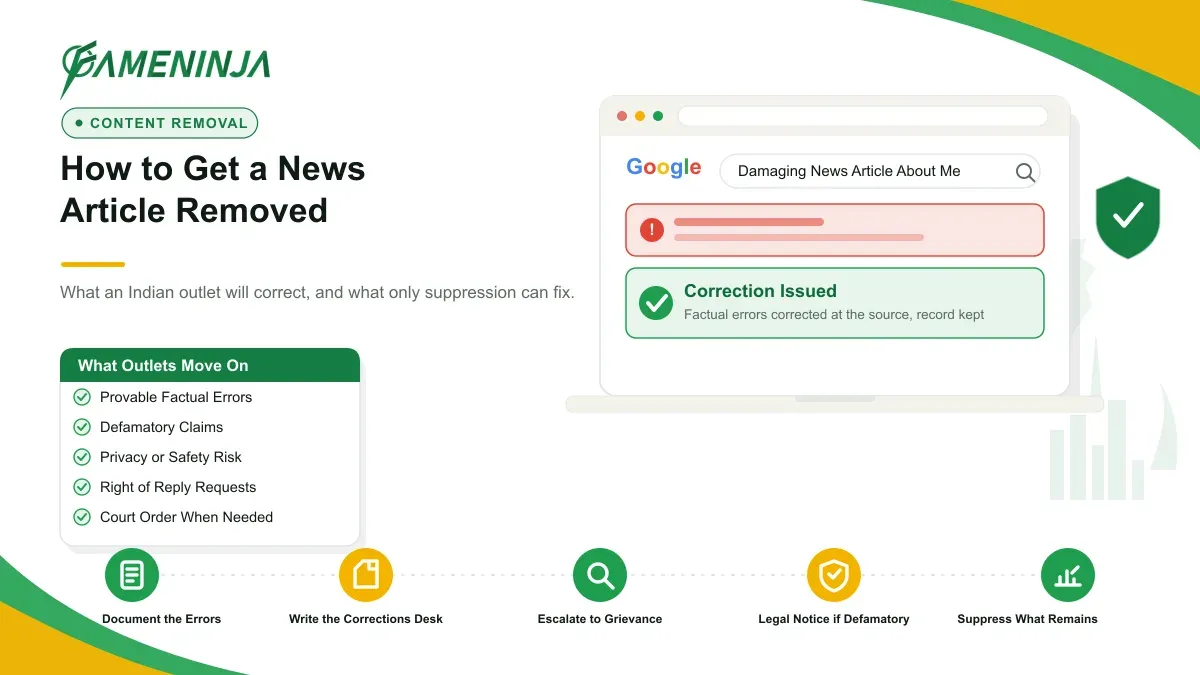
A damaging story runs on an Indian news site, and within days it is the first thing clients, investors, and family see when they search your name. The instinct is to get a news article removed as fast as possible, straight from the outlet that published it. That instinct is right, but the path is narrower than most people expect, and the outcome depends heavily on one thing: whether the story is true. If the outlet will not move, the search-side route is mapped out in our negative news article removal checklist.
This guide covers how to get a news article removed at the source, by dealing with the publisher directly rather than only chasing Google. It walks through contacting the editor, requesting a correction, using your right of reply, the grievance routes under Indian media rules, and a legal notice when the content is genuinely defamatory. It is also honest about the hard part: reputable outlets rarely unpublish accurate reporting, and de-indexing plus suppression is often the realistic result.
Quick answer: how to get a news article removed by an Indian outlet
To get a news article removed by an Indian outlet, write to the editor or corrections desk with a specific, documented correction or removal request. Factual errors are often corrected or unpublished. Accurate reporting rarely is. Escalate through the IT Rules 2021 grievance officer, the Press Council of India, or a legal notice for genuinely defamatory content.
This guide covers getting a news article removed or corrected at the source, by the outlet itself. To push a story out of Google when the publisher will not act, see our guides on deindexing negative news from Google and the negative news removal checklist.
Correction, unpublishing, or de-indexing: what you are actually asking for
Three different requests hide inside the phrase "remove the article," and the outlet treats each one very differently.
A correction changes the article. The outlet keeps the piece live but fixes a wrong fact, adds a clarification, or appends an editor's note. This is the most common and most achievable outcome.
Unpublishing removes the article from the outlet's website entirely. Serious outlets do this rarely, and usually only when the story is factually wrong, legally risky, or breaches their own ethics code.
De-indexing removes the article from Google's search results without touching the outlet's copy. That is a separate job, handled with Google and search suppression rather than with the editor. We cover it in the sibling guides linked below and will not repeat it here.
Knowing which one you actually need decides everything. If the story is accurate but old, you may not need it removed at all. You may need it pushed down. If it carries a clear factual error, a correction request to the desk is your strongest first move.
The single biggest factor is truth. A factual error gives you a real basis to ask for a correction or an unpublish. Unflattering but accurate reporting almost never comes down, because a credible outlet will not erase true journalism to protect a subject's image. Hold that distinction in mind through every step that follows.
Step 1: Contact the outlet's editor or corrections desk
Start with the people who can actually change the page. That means the editor, the corrections desk, or the specific reporter's editor, not a general feedback form.
Most Indian outlets publish a corrections or feedback email, an editor's contact, and, under Indian media rules, a grievance officer. The national dailies and their digital arms usually have formal corrections policies. Smaller portals may only list a generic address, so you may have to write to the reporter and copy the editor in.
Keep the first message calm and factual. Editors receive angry demands every week, and a threatening tone gets filed under nuisance. A short, specific, evidence-backed note gets read.
Send it in writing, by email, so there is a dated record. A phone call can help, but the written request is what starts a paper trail you may need later if you escalate to a grievance officer, the Press Council, or a court.
Step 2: Document the factual error and request a correction or removal
Your request is only as strong as the proof attached to it. Vague complaints go nowhere. Documented errors move.
Write a clear, point-by-point note that does four things:
- Identifies the article by exact headline, URL, author, and date.
- States precisely which sentence or claim is wrong.
- Provides evidence that it is wrong: a document, a court order, an official record, or a dated fact.
- Says clearly what you want: a correction, an added clarification, your response published, or the piece taken down.
Match the remedy to the harm. If one fact is wrong, ask for that fact to be corrected, not for the whole article deleted. An outlet is far more likely to fix a specific error than to unpublish an entire investigation. Asking for too much can get the whole request refused.
If the error is serious and central to the story, a removal or a substantial correction is reasonable to request. If the error is minor, a correction or an editor's note is the realistic ceiling.
Keep every version of the article. Screenshot the page with the URL and date visible before anything changes, because a corrected page loses the evidence of what it first said.
Step 3: Exercise your right of reply
The right of reply is one of the most underused tools available to the subject of a story. Indian journalistic ethics recognise that a person criticised in a report should get a fair chance to present their side.
If the outlet did not contact you before publishing, or carried your response inaccurately, say so plainly and provide a short, factual statement you want included. Many outlets will add it, either within the article or as an update, even when they will not remove the piece.
A published reply does not delete the story. It does change what a reader sees. Instead of a one-sided claim, the page now carries your documented rebuttal, which also gives future readers, and even AI systems, a truthful counter-signal to read.
This route works best when your reply is short, specific, and free of insult. Stick to facts you can back. A calm correction of the record reads as credible. A rant does not.
Step 4: Escalate under the IT Rules 2021 Digital Media Ethics Code and the Press Council of India
When the desk does not respond, India gives you two formal escalation routes.
The first is the grievance mechanism under the Information Technology (Intermediary Guidelines and Digital Media Ethics Code) Rules, 2021. These rules require publishers of digital news and current-affairs content to appoint a grievance officer and to decide a complaint within 15 days. The framework runs in three tiers: the publisher's own grievance officer first, then a self-regulating body of publishers, then an oversight mechanism under the government. The official rules are published by the Ministry of Electronics and IT at meity.gov.in.
The second route is the Press Council of India for print and its associated online editions. The Council is a statutory body that hears complaints about breaches of journalistic ethics and can inquire into them. You can file a complaint through presscouncil.nic.in.
Both routes have real limits, and this is the honest admission worth stating plainly. The Press Council can admonish, warn, or censure a publication, but it cannot fine an outlet or force it to take an article down. Parts of the 2021 Rules that apply to digital news publishers have faced court challenges, and enforcement is still settling. Treat these as pressure and record-building routes, not as a switch that deletes the page.
Step 5: Send a legal notice when the content is genuinely defamatory
If the article is not just unflattering but genuinely false and damaging, a lawyer's legal notice changes the conversation.
Defamation in India carries both civil and criminal dimensions. The Bharatiya Nyaya Sanhita, 2023, which replaced the Indian Penal Code, carries the criminal defamation provisions at Section 356. A civil defamation suit can seek damages and an injunction to take the content down. The route you choose depends on the facts, and it should be a lawyer's call, not a template downloaded online.
There is an important threshold. Truth, fair comment, and good-faith reporting on public matters are recognised defences to defamation. If the story is accurate, a defamation notice will not succeed and can backfire, sometimes drawing more attention to the very article you want buried. Send a legal notice only when the content is actually false and you can prove it.
For online-only outlets, the intermediary framework under the IT Act can also matter. Section 79 of the IT Act gives intermediaries safe harbour, which they can lose if they ignore a valid court order to remove unlawful content. That is why a court order, not just a notice, is usually what forces a stubborn host or platform to act. If the matter involves online criminal conduct such as harassment or extortion tied to the coverage, a complaint at cybercrime.gov.in can run in parallel.
Say plainly what this needs. For contested content that an outlet refuses to remove, a court order directing removal is often the only thing that compels it. A notice opens the conversation. A court order closes it.
This is general information, not legal advice. Defamation and takedown law is fact-specific, and a wrongly framed notice can be refused or can make things worse. Have a lawyer who does this regularly draft and review it.
Why reputable outlets rarely unpublish accurate news
Here is the judgment most people do not want to hear, and the one that saves the most wasted effort. A credible Indian outlet will almost never delete an accurate story because it embarrasses the subject.
Newsrooms treat unpublishing as an integrity question. Their archive is their record. Deleting true reporting on request would make every past story look negotiable, so serious editors refuse it as a matter of policy. They will correct errors quickly. They will add your reply. They will update a developing story. They will very rarely erase accurate news.
What most people get wrong is spending weeks pushing an outlet to delete a truthful piece, when that same energy would achieve far more aimed at de-indexing and suppression. If the facts are right and lawfully published, the realistic goal is not deletion at the source. It is to correct any errors, add your side, and then reduce the article's visibility.
Without naming anyone, the pattern we see often looks like this. A professional demands full removal of an accurate story, the outlet refuses, the exchange turns adversarial, and weeks pass with the article still ranking first. The cases that go better start with a narrow, documented correction request, secure a clarification or a published reply, and then move straight to search suppression. Method beats outrage. A precise ask to the right desk does more than a loud demand to the wrong one.
Suppression versus deletion: the honest fallback
When the source will not remove an accurate article, the realistic plan shifts from deletion to suppression. These are two different outcomes, and confusing them is what leads to disappointment.
Deletion means the article is gone from the outlet's site. It is achievable when the piece is factually wrong, unlawful, or breaches the outlet's own code, and when the editor, a grievance body, or a court agrees.
Suppression means the article still exists, but it no longer dominates what people find. You strengthen accurate, positive, and authoritative content about you so it outranks the negative piece and pushes it off the first page of search results. Most people never look past the first page, so a story ranked well down carries far less weight.
An honest plan for an accurate news article usually mixes both. You correct what is wrong at the source, add your reply, and then de-index where eligible and suppress the rest. Anyone promising to permanently erase a live, accurate news story from a national outlet on a fixed date is not being straight with you.
This is the point to hand off to the search-side work, which we cover in depth elsewhere rather than repeat here. Our guide on de-indexing negative news from Google organically explains the search route, the negative news article removal checklist gives you a step-by-step audit, and a broader online reputation management plan ties source correction and suppression together.
How news articles about you surface in AI search
Search is no longer only a list of blue links. When someone asks ChatGPT, Perplexity, or Google's AI answers about you or your company, the assistant writes a short summary from whatever it finds across the web. A prominent negative article can shape that summary, even after you have added a correction.
This changes the removal job. Getting a factual error fixed at the source protects the search results and the AI answer at the same time, because the model reads the corrected page, not the original claim. That is one more reason a correction at the outlet is worth more than it looks.
Where the article stays live and accurate, the AI-search fix mirrors the suppression fix. You publish clear, factual, well-structured content about yourself on sources these systems trust, so the model has a truthful, current version to summarise. Consistent details across your profiles, credible third-party coverage, and an up-to-date account of the facts give an AI engine something accurate to cite. Fixing the article's ranking while ignoring the AI answer leaves half the problem in place.
If a story about you is live right now
A damaging article can feel like it owns your name in search. It does not have to. The honest path is to fix what is wrong at the source, add your side, and then reduce the visibility of what stays.
If you would rather have an experienced team handle the outlet correspondence, the grievance escalation, and the search cleanup discreetly, we can help. You can request a Free ORM Report for a quiet, honest assessment and we will tell you plainly what can be corrected, what needs a court order, and what only suppression can fix. For more India-specific guidance, our blog covers court records, de-indexing, and reputation repair.