

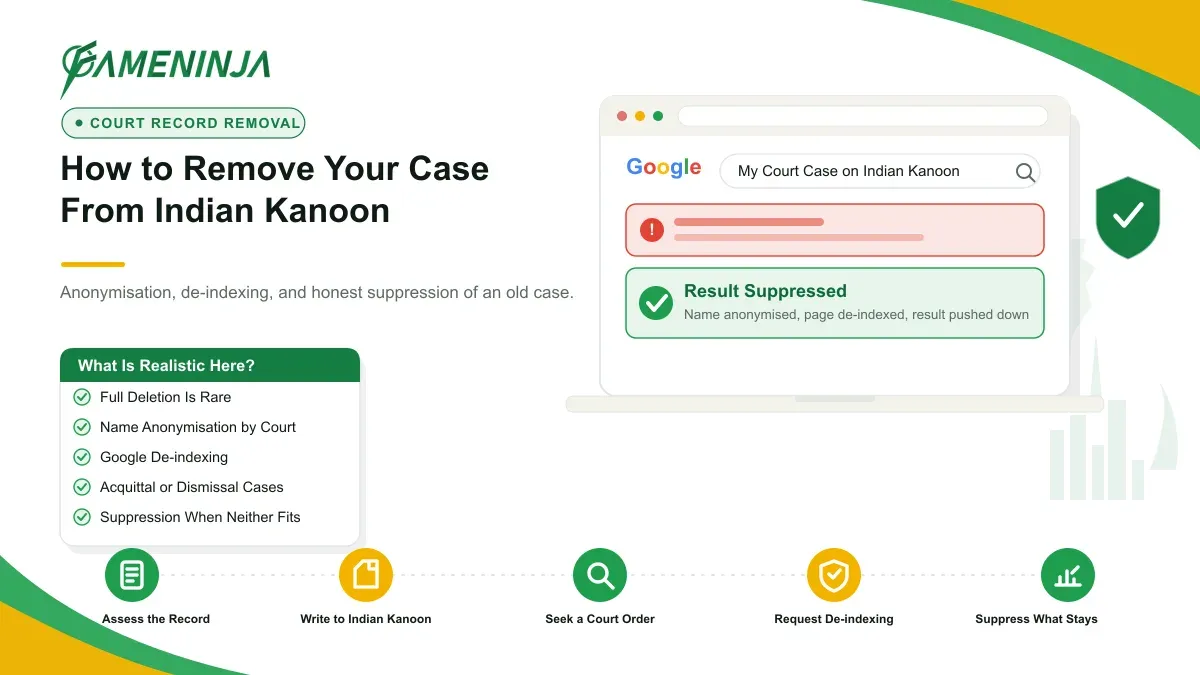
Your name, a case number, and the text of an old judgment are sitting on a public website and ranking on Google for anyone who searches you. If you are trying to remove a case from Indian Kanoon, this guide sets out what is realistic. A recruiter, a client, or a prospective in-law types your name, and Indian Kanoon returns a years-old FIR, a bail order, or a civil dispute you had long moved past. The matter may be settled. It may even be an acquittal. On the page, it still reads like a live accusation. Before you start, it helps to read our comparison of court case removal versus suppression.
This guide explains how to remove a case from Indian Kanoon. When full removal is not possible, it shows how to get your name anonymised, the page de-indexed from Google, and the result honestly suppressed. It is written for professionals and business owners who did nothing wrong, and for people who resolved a matter long ago and want the record to reflect that. We will be straight about one thing throughout. Judgments are public records, so deletion is the exception, not the default.
Quick answer: how to remove a case from Indian Kanoon
To remove a case from Indian Kanoon, first write to Indian Kanoon requesting removal or name anonymisation, and explain the harm. Because judgments are public records, full deletion is rare. The realistic routes are a court order to anonymise your name, de-indexing the page from Google, and honest suppression when neither is available.
What Indian Kanoon is, and why your judgment or FIR appears there
Indian Kanoon is a free legal search engine that publishes judgments, orders, and statutes from Indian courts and tribunals. It carries decisions from the Supreme Court, the High Courts, district courts, and various tribunals. Its purpose is to make the law searchable for lawyers, students, litigants, and researchers. That public-interest purpose is exactly why it is hard to argue for deletion.
Your name appears because courts deliver judgments and orders in open court, and those documents are public. Indian Kanoon collects, indexes, and republishes them, including your name wherever the original judgment names you. The site is well built and heavily indexed, so its pages often sit on the first page of Google for a person's name. A minor matter can carry outsized weight online. A cheque-bounce complaint, a quashed FIR, a bail application, or a clean acquittal can all surface as if they were the headline of your life.
Two facts follow from this. Indian Kanoon is republishing a record it did not create, so it will point you back to the court and to the public nature of the document. And the page ranks well, which is why it hurts. You can see the platform and its holdings at indiankanoon.org.
For the wider picture across legal databases, our hub on the de-indexing of court cases sets out the full landscape.
How to remove a case from Indian Kanoon, step by step
Structure beats emotion on these requests. Work through the steps in order, and be clear from the start about which outcome you are actually chasing.
- Preserve and document the page. Save the exact Indian Kanoon URL, the case title, the court, and the date. Take a full-page screenshot. You will need this for every route that follows, and for any court petition.
- Decide what you are asking for. Full removal, name anonymisation, and de-indexing from Google are three different requests with three different odds. Naming the right one early saves weeks.
- Write to Indian Kanoon. Use the contact route on the site and send a factual request for removal or noindexing. State the harm, the URL, and any court order you already hold. A calm, specific note lands better than a threat.
- Pursue a court order for anonymisation where the matter qualifies. If the platform declines and your case fits a recognised category, a lawyer can move the appropriate court to anonymise or redact your name. This is the route with real force.
- Submit a separate Google request. Once a page is anonymised or noindexed, or where Google's personal-information policies apply, ask Google to drop or refresh the result. This is a distinct job from the source removal.
- Suppress in parallel. Whatever the legal route decides, build and strengthen accurate content about you so the record sinks below the results people actually read.
This is general information, not legal advice. The right remedy depends on the facts of your case, and a lawyer should shape any court petition.
Requesting removal or name anonymisation directly from Indian Kanoon
Start with the platform, but keep your expectations honest. Indian Kanoon has generally treated court judgments as public records, so a plain request to delete a decision is often declined. The site will usually point out that it is republishing a public document produced by a court.
Two outcomes are more realistic than deletion. The first is noindexing, where Indian Kanoon blocks a page from search engines so it stops appearing on Google while the document stays reachable on the site itself. The second is a discretionary removal or masking, which the platform is far more likely to grant when you produce a court order directing anonymisation. Requests reported to succeed tend to be the ones backed by a legal direction, not the ones that rely on urgency or anger.
Understand the limits of even a good result here. Noindexing on Indian Kanoon does not remove the judgment from the court's own records, and it may not touch other legal databases that carry the same decision. Here is the honest limit worth stating plainly. No service, ours included, can promise that Indian Kanoon will delete a published judgment, and there is no fixed timeline for a reply. Send a clean, documented request, keep a copy, and treat the platform route as one lever among several rather than the whole answer.
The court route: anonymising or redacting your name in the judgment
For a published judgment, the route with real weight is a court order. You, through a lawyer, ask the court with jurisdiction, often a High Court, to order anonymisation or redaction of your name, or to direct online databases to take the page down. Several High Courts have recognised a limited right to be forgotten and have, in appropriate cases, directed the masking of names or the removal of judgments from online platforms.
The court does not grant this automatically. It weighs your privacy against open justice and the public's interest in access to court records. Certain categories tend to carry a stronger case. Acquittals and quashed FIRs, where continued publication paints an innocent person as accused, are one. Matrimonial and family disputes are another. In sexual-offence matters, anonymisation of the victim is often already required by law. Where an old, resolved matter causes harm out of all proportion to any public interest, the argument for anonymisation is stronger.
Once a court orders anonymisation, Indian Kanoon and other databases are expected to comply, which is why this route matters. The cost and effort vary with the court and the complexity, and our honest breakdown of the cost to remove a court case from Google sets realistic expectations.
If your matter is an acquittal or a dismissal, the specifics in our guide on how to remove an acquittal or dismissed case from Google search in India will apply directly. A lawyer should draft and file the petition, because an overbroad or wrongly framed request can be refused.
Right to Be Forgotten in India, and where it fits
India has no single statute that guarantees a right to be forgotten for court records. The right is recognised through court rulings, and it is limited rather than absolute. The Supreme Court's 2017 privacy judgment, widely known as the Puttaswamy case, recognised privacy as a fundamental right. Building on that, several High Court decisions have applied a limited right to be forgotten to online judgments, allowing anonymisation in suitable cases.
The balance is the whole point. Courts weigh an individual's privacy and dignity against open justice and the public's right to access the record of what courts decided. A recent, serious matter of genuine public interest is unlikely to be erased. An old, resolved, or minor matter that keeps surfacing for a private person is where the argument gains traction.
The data-protection angle is developing but narrow for court records. The Digital Personal Data Protection Act, 2023 gives individuals a right to correction and erasure of personal data. The framework is administered by the Ministry of Electronics and Information Technology at meity.gov.in.
Its erasure right does not straightforwardly reach a published court judgment, because processing tied to legal proceedings and public records sits outside the everyday erasure obligations. So the practical takeaway is simple. The right to be forgotten exists in India in a limited, case-by-case form, and our deeper explainer on the right to be forgotten in India covers how it is being applied.
De-indexing the Indian Kanoon page from Google
De-indexing is a separate step from removal, and confusing the two costs people time. Removal takes the page off Indian Kanoon. De-indexing stops the page from appearing in Google results for your name, even if the page still exists on the site. Most people who search you use Google, so clearing the search result solves much of the visible harm.
There are two practical paths. The first is at the source. If Indian Kanoon adds a noindex tag or blocks the URL, Google drops the page from its index over time. Once that happens, Google's Refresh Outdated Content tool can speed up the update so the stale listing clears faster. You can read Google's own guidance through its Search help resources. The second path is Google's own removal process. Where a court has ordered anonymisation, you can send that order to Google, and Google also operates removal tools for certain kinds of personal information.
Keep two limits in mind. De-indexing from Google does not delete the underlying record, so the page can remain on Indian Kanoon and in the court's files. And a de-index on Google may not clear Bing or other search engines, which need their own requests. De-indexing is a strong, realistic win. It is not the same as the record ceasing to exist.
Suppression versus deletion when the record cannot be removed
The mistake most people make is treating Indian Kanoon like a social media post with a delete button. A judgment is a public record produced by a court, so the default is that it stays. Once you accept that, the real work becomes clear.
Deletion means the page or your name is gone from the source. It is realistic when a court orders anonymisation, when the matter sits in a sensitive category, or when the platform exercises discretion in your favour. For a routine published judgment, though, deletion is the exception. Suppression means the record still exists, but you push it below the results people actually read by strengthening accurate, credible content about you. You suppress when deletion is not on the table, or while a court petition is still pending.
An honest reading of most Indian Kanoon cases mixes all of it. You send a documented platform request, you file for anonymisation where the matter qualifies, you de-index from Google what you can, and you suppress what stays. Anyone promising to make a published judgment disappear on a fixed date is not being straight with you. Even a court order to anonymise may not reach every mirror or cached copy on the first pass, and older copies can linger on secondary sites. The realistic objective is to anonymise or remove where the law allows, de-index the URL from Google, and rebuild your first page so a searcher meets the real you first.
How your Indian Kanoon record feeds AI answers about you
Search is no longer only ten blue links. When someone asks ChatGPT, Perplexity, or Google's AI answers about you or your business, the assistant writes a short summary from whatever it finds across the web. Indian Kanoon pages are well-structured, rich in names and dates, and heavily indexed, which makes them exactly the kind of source these systems read and repeat.
The risk is that an old case surfaces in an AI answer as a flat statement about you, stripped of the context that it was dismissed, quashed, or decades old. The model may not know the matter ended in your favour, because the page itself often reads like an open accusation. Removing or anonymising the source helps the search results, but the AI layer needs a second step. Accurate, well-structured content on sources these systems trust gives the model a truthful version to cite. Consistent details across your profiles and credible third-party coverage do the same. Fix Google and ignore the AI answer, and you have solved only half the problem.
One pattern we see with Indian Kanoon requests
Without naming anyone, the request that goes wrong usually looks the same. A professional finds an old Indian Kanoon page for a matter that was settled or dismissed, fires off an angry email demanding immediate deletion, receives a refusal citing public records, and stops there. Weeks pass, the page keeps ranking, and the frustration hardens into the belief that nothing can be done.
The cases that actually move are the patient, structured ones. The category is assessed first, so effort goes where the law is likely to help. Where the matter qualifies, a lawyer applies for anonymisation. Any court order is then sent to both Indian Kanoon and Google. Suppression runs alongside from day one, so the record sinks while the legal route plays out at its own pace. Method beats outrage here, every time. The page did not appear overnight, and clearing it is a campaign, not a single email.
If you are dealing with an Indian Kanoon listing
An old case on Indian Kanoon can feel like a permanent verdict on your name. It usually is not the whole story, and you have more routes than a single angry email. Get the category assessed, pursue anonymisation where it qualifies, de-index the page from Google, and suppress what stays.
If you would rather have an experienced team assess the page, handle the anonymisation route with a lawyer, and manage the search cleanup discreetly, we can help. You can chat with us on WhatsApp for a quiet, honest read on your options, or request a Free ORM Report and we will tell you plainly what is removable, what needs a court order, and what only suppression can fix.
For more India-specific guidance, our blog covers court records, de-indexing, and reputation repair.