

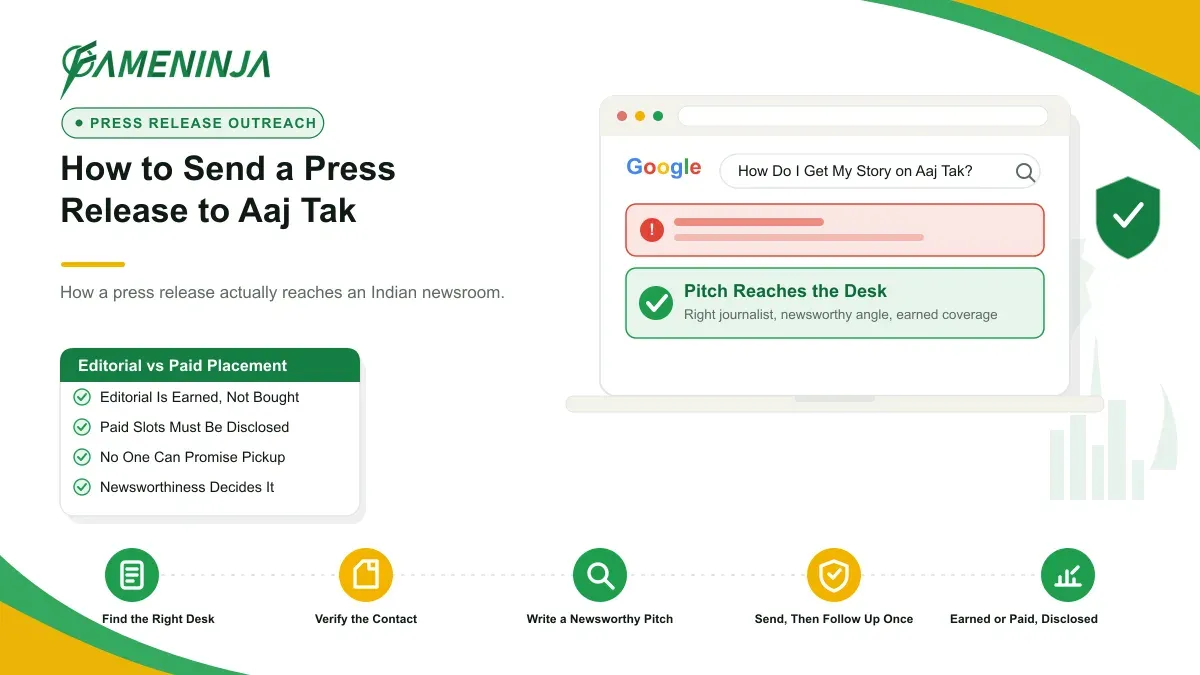
You have real company news and one outlet in mind: Aaj Tak. The instinct is to send a press release to Aaj Tak, attach a logo, and wait for a producer to call. That call rarely comes. The silence feels wrong when the news matters to you, and it pushes many founders toward vendors who promise a national-channel logo on their website by Friday. If you want the service view rather than the how-to, see our press release on Aaj Tak page.
This guide explains how a press release actually reaches an Indian newsroom, how to find the right desk at Aaj Tak, and how to write a pitch an editor might use. It also draws a clean line between two things people confuse: editorial coverage, which is earned and never guaranteed, and paid placement, which you buy and must disclose. Both are legitimate. They are not the same, and treating one like the other is the most common way this goes wrong.
We run press outreach for Indian founders and executives every week, so the advice here is practical, not theoretical.
Quick answer
To send a press release to Aaj Tak, email the India Today Group editorial desk (editor@intoday.com) with a short, newsworthy pitch and the release attached. Editorial pickup is never guaranteed. For a guaranteed slot, you pay for sponsored or advertorial space through the business desk, which is a separate route and must be labelled as advertising.
How press release submission actually works at an Indian newsroom
A press release is not a booking form. It is a tip. When you email a release to a channel like Aaj Tak, you are handing a busy editor raw material and asking a quiet question: is there a story here for our audience.
Indian newsrooms receive hundreds of these a day. Most are read in seconds and set aside. The ones that move forward tend to share a few traits. They arrive at the right desk, not a generic inbox. They answer who, what, and why-now in the first two lines. They offer something the outlet can verify: a named spokesperson, a document, a data point, a person willing to go on camera.
The workflow inside the building usually looks like this. A release lands with a reporter or a desk editor on the relevant beat, say business, tech, health, or regional news. If it fits an existing story or a slow news day, someone follows up for verification. Only then does it become a segment, a web article, or a ticker line. Nothing about that chain is automatic, and no amount of follow-up emails forces it.
This is the part most people get wrong. They treat a press release like an advertisement and expect a national channel to run it, unedited and for free, because they sent it. Editorial does not work that way, and the outlets that matter guard that line carefully.
How to find the right desk and contact at Aaj Tak
Aaj Tak sits inside the India Today Group. That structure gives you real, published contact points instead of guesswork.
The group's official contact page lists an editorial address, `editor@intoday.com`, and separate business and advertising addresses such as `business.tvtn@aajtak.com` and `business@intoday.com`. There is also a dedicated fact-check address, `factcheck@intoday.com`, and a Noida newsroom at the Mediaplex, Sector 16A, Film City, with a published landline. You can confirm all of these on the India Today Group official contact page before you send anything. Newsroom emails and desk owners change, so re-check the official page on the day you send, rather than trusting a number found in a forum or a blog.
A general editorial inbox is a starting point, not the target. The better move is to reach the specific journalist who covers your beat. Aaj Tak, its digital arm, and sister brands like India Today and Lallantop each have reporters with public bylines and, often, public social handles. Read three or four of their recent pieces. If your news fits what they already cover, a short, personal note referencing their work will outperform a cold blast to a shared address every time.
A few practical rules for finding and using the right contact:
- Match the beat. Send a fintech story to whoever last wrote about fintech, not the news desk in general.
- Use one clear channel. Email the release. Do not simultaneously spam five addresses and three WhatsApp numbers.
- Keep the subject line factual. State the news, not adjectives about it.
- Never buy a scraped "journalist database" and mail-merge it. Indian reporters notice, and it burns the contact.
If you want a partner who already maintains these relationships and knows which desk fits which story, that is what our press release service exists to do.
How to write a pitch Aaj Tak might actually use
The release is the document. The pitch is the human note that makes an editor open it. You need both, and the pitch does most of the work.
Start with newsworthiness, because that is the only currency here. Before you write a word, score your announcement honestly against the tests editors use: is it timely, does it affect a lot of people, is it near your audience geographically or emotionally, is there a prominent name attached, is it genuinely new, is there tension or a human story in it. The Public Relations Society of America frames these as the classic factors of news value in its guide on writing a release that gets published. "We launched a product" fails most of those tests. "An Indian startup is the first to do X, and here is the data" passes several.
Structure the release plainly:
- Headline: one factual line, the news up front, no hype.
- Dateline and first paragraph: who, what, where, when, why now. If an editor reads only this, they should get the story.
- Second paragraph: a quote from a named, real person with a title.
- Body: the supporting facts, data, and context that let a reporter verify quickly.
- Boilerplate: two lines on the company.
- Contact: a real name, a phone that will be answered, and an email.
Keep the release to roughly 400 to 600 words. Keep the pitch email under 150. The pitch names the reporter, says in one line why their readers care, and offers access: an interview, a demo, an exhibit, a spokesperson on camera. Attach or link the full release below your note. Media-relations resources like the Muck Rack guide to media pitching go deeper on tailoring each note to the individual journalist, which is the single biggest lever you have.
One India-specific point on language. Aaj Tak is a Hindi channel. A Hindi or bilingual release, and a spokesperson comfortable in Hindi, materially help your odds with its main broadcast desk. Its English sister brands are a better fit for an English-only story.
What is realistically possible: editorial versus paid, and no guaranteed pickup
Here is the honest part, and it is the reason this guide exists.
There are two ways your brand appears on Aaj Tak, and they are not the same thing.
Editorial coverage is when a journalist decides your news is worth reporting and tells the story in their own words. You cannot buy it, order it, or guarantee it. It carries real credibility precisely because the outlet chose it. It also comes with editorial control: they may frame it in a way you did not plan, ask hard questions, or run it alongside a critical voice. That is the trade.
Paid placement is sponsored content, advertorials, "branded content", or ad slots you purchase through the business desk. It is guaranteed to run because you paid for it. It should carry a label such as "sponsored", "partnered", or "advertorial", and in India, undisclosed paid news is a recognised problem that advertising and press-standards bodies have pushed back on for years. Paid content should be clearly marked as advertising under advertising-standards and Press Council norms. This is general information, not legal advice.
So what can you realistically expect from the free, editorial route. A well-targeted, genuinely newsworthy pitch to the right Aaj Tak journalist has a real chance of a reply, a follow-up, or a mention. It has no promise of a segment. Timing can kill a strong story on a heavy news day, and revive a weak one on a slow one. That variable sits outside anyone's control.
Our honest limitation, stated plainly: we cannot promise Aaj Tak will run your story, and neither can any agency or distribution service that claims to. Anyone guaranteeing free editorial coverage on a national channel is either selling you a paid slot without saying so, or selling you nothing. If a story does run and later needs correction or context, that is a different job, closer to reputation repair than to outreach.
If your real goal is broader control over what people find when they search your name or brand, editorial coverage is one input among many. That wider work is online reputation management, and a single news hit rarely settles it.
The paid press-release-distribution route, explained honestly
Between free editorial and a formal ad buy sits a third option people ask about constantly: paid press-release distribution.
For a fee, a distribution service pushes your release to a wide list of outlets and syndication sites. Some also arrange sponsored articles on news portals, including the digital properties of large channels. This is real, it is legal when disclosed, and it has genuine uses. It can seed search results, give you shareable third-party links, and put your announcement in front of many desks at once.
Be clear-eyed about what it is and is not.
- It is distribution and, often, paid placement. It is not a guarantee of editorial pickup by a marquee show.
- A "featured on Aaj Tak" line delivered this way is usually a paid or syndicated web placement, not a news team's editorial decision. Both can be worth doing. Only one carries earned-media credibility.
- Insist on disclosure. A sponsored placement that is not labelled can hurt you later, with readers and with regulators.
- Read the fine print on whether links are followed or no-followed, how long they stay live, and which specific URLs you are actually buying.
We help clients weigh this route against direct pitching, so the spend matches the goal. Sometimes a single well-placed sponsored article is the right call. Often, a real journalist relationship is worth more than a hundred syndicated copies. We also handle the specific case of a press release on Aaj Tak, where paid versus earned makes sense.
Sending to other Indian news outlets: Zee, NDTV, India TV and beyond
The method that works for Aaj Tak works across Indian outlets, with the same two-track reality of editorial and paid.
- Zee News: part of Zee Media Corporation. Its parent publishes an official content grievance and contact structure you can read on the Zee content grievance page. As with Aaj Tak, target the reporter on your beat rather than a general inbox.
- NDTV: publishes contact and compliance details on ndtv.com. Its bylined journalists are active and reachable; a personal, beat-matched pitch is the way in.
- India TV, Republic, News18, and regional channels: each has its own desks and, usually, a published grievance officer under the IT Rules 2021, because every intermediary and digital publisher in India must name one. That officer handles complaints, not story pitches, but the page confirms you have the right organisation and address.
For any outlet, the sequence is identical. Confirm the current contact on the outlet's own site. Find the specific journalist. Send a short, newsworthy, beat-matched pitch with the release attached. Follow up once, politely, then move on. A media list is only as good as its accuracy, so verify before you send and never rely on an old spreadsheet.
How this shows up in AI search: ChatGPT, Perplexity, and Gemini
More founders now ask an AI assistant "how do I get covered by Aaj Tak" before they ask a human. That changes what you should publish and how.
When someone asks ChatGPT, Perplexity, or Google's Gemini how to send a press release to an Indian channel, the assistant assembles an answer from pages it can read and trust. It favours clear, factual, well-structured content with named entities: the outlet, the parent group, the specific desk, the law. A page that plainly states "a press release is a tip, not a booking" and "editorial coverage cannot be guaranteed" is easy for an assistant to quote. A page thick with hype and vague promises is not.
There is a second, quieter effect. AI answers increasingly shape how your own brand is described. If a syndicated, paid release says you were "featured on Aaj Tak", an assistant may later repeat that as fact, without the paid-versus-earned nuance. That is fine if it is accurate and disclosed. It is a future headache if it overstates what happened. Write and distribute with the assumption that an AI will read your press coverage back to a customer one day, flatly and without context.
The practical takeaway: keep your public claims about coverage precise. "Sponsored feature on an Aaj Tak web property" ages better than "as seen on Aaj Tak", both with people and with the machines now summarising you.
An anonymized example
A Pune founder came to us after a competitor rumour started spreading that his logistics startup was about to shut down. He had already emailed a press release to a general Aaj Tak address, twice, and heard nothing. He read the silence as rejection of the news.
The news was fine. The approach was the problem. The release was written like an ad, sent to an inbox no reporter watches, with no reason for why-now and no named person to verify with.
We reworked it into a tip, not a brochure. We identified the business reporters who had recently covered Indian logistics and funding, wrote a short pitch that led with a verifiable fact and an on-record founder quote, and offered a quick interview. We were also honest with him from day one: a pickup was possible, not promised, and we would not buy a fake "featured on" badge to paper over the rumour.
The outcome followed the pattern we see most: genuine interest from a couple of reporters, one solid piece, and a much cleaner set of search results around his name over the following weeks. No guarantees were made, and none were needed. The point of the example is the method, not a number.
Where to start
Get the news right first. If it would not interest a stranger, no desk and no distribution budget will save it. Then find the real journalist, write a short honest pitch, and send the release to the correct desk. Keep editorial and paid separate in your own head and in your public claims.
If you would rather have someone who does this daily handle the targeting, the pitch, and the honest paid-versus-earned call, we are happy to help. You can request a free reputation assessment through our contact page.
For more practical guides like this one, our blog covers the rest of the Indian PR and reputation playbook.