

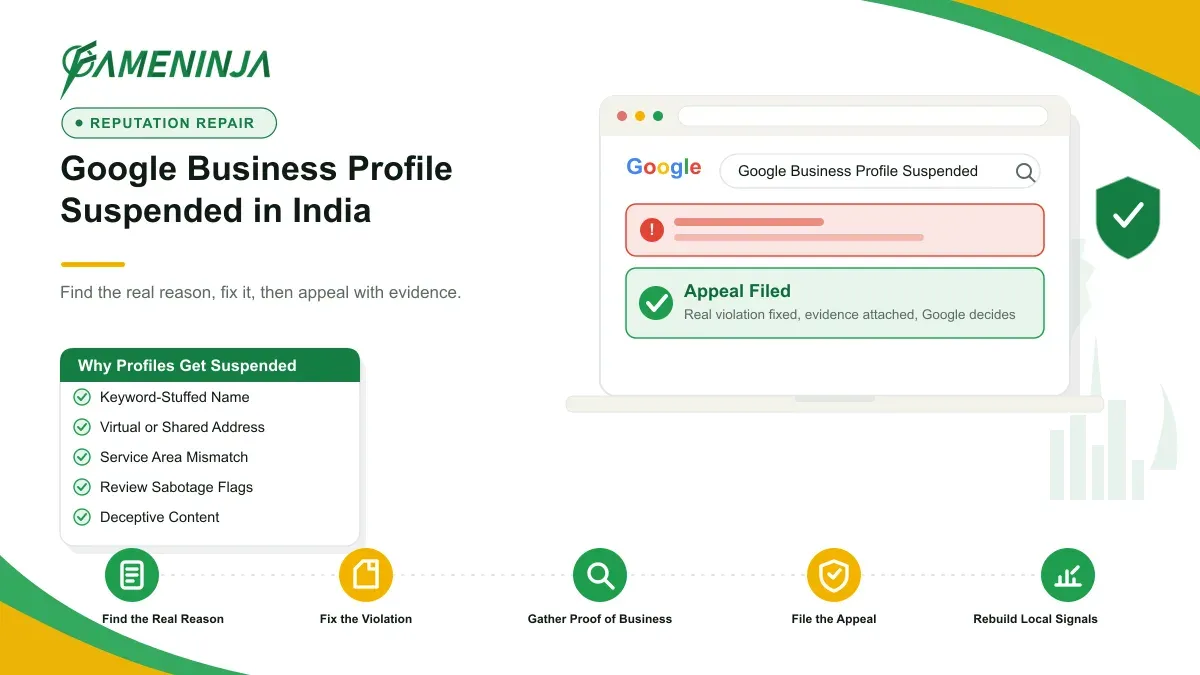
Your listing was there yesterday. This morning the phone stopped ringing, the Maps pin is gone, and the local pack that used to send you walk-ins now shows a competitor. For a clinic in Mumbai, a boutique firm in Delhi, or a home-services business in Bangalore, a suspended Google Business Profile is not a marketing problem. It is a revenue problem that started the moment the listing vanished. This guide walks the reinstatement path that actually works in India, and where the damage runs wider than the suspension itself, our reputation repair work picks up from there.
If you searched your own name and got nothing, or you opened the dashboard and saw the word "suspended", you are in the right place. This guide explains why a Google Business Profile gets suspended in India, how a competitor's review-sabotage or a "deceptive content" flag can trigger it, and the exact reinstatement steps that give you the best shot at getting the listing back. We will also be honest about the part most agencies skip: reinstatement is not guaranteed, and the outcome depends on the violation.
This is general information, not legal advice.
Quick answer: what to do when your GBP is suspended in India
A suspended Google Business Profile is Google removing your listing from Search and Maps for a suspected guideline violation. To reinstate it, identify the suspension reason, fix any real violation, then file an appeal through the Google Business Profile appeals tool and attach evidence. Reviews can take up to five business days. Recovery is not guaranteed.
Why Google suspends a Business Profile (and what "deceptive content" means)
A Google Business Profile suspension happens when Google decides a listing does not follow its guidelines, so it hides or disables the profile. Google's own help page is blunt about it: the platform may suspend or disable Business Profiles that break the rules, and it does not publish an exhaustive public list of triggers. You are often left guessing.
In practice, the common reasons cluster into a few buckets. Keyword stuffing in the business name. An address that does not match a real, staffed location, or a virtual office used as a storefront. Frequent edits to the name, category, or address in a short window. Two profiles for the same business. A category that does not fit what you actually do. And the label that scared thousands of Indian owners in 2026: "deceptive content".
"Deceptive content" is Google's way of saying it believes something on the profile misleads users. That can mean a name, a photo, a description, or a website that does not line up with the real business. The frustrating part is that the flag can fire even when nothing is wrong.
The 2026 suspension waves
2026 was a rough year for local listings. Starting around late April 2026, waves of Google Business Profiles disappeared from Maps overnight, many of them carrying the same "deceptive content" reason. A large share were fully verified profiles that had been live for years with genuine review histories. Home-services businesses and contractors were hit hard.
What most owners get wrong is treating a suspension as a punishment they earned. Several of these 2026 sweeps were pattern-based enforcement, where Google's systems judged whole groups of listings by shared signals like industry, region, and behaviour, then acted on the group rather than the individual. Video verification proved the business existed. It did not make the profile immune to a later algorithmic suspension. Good standing is ongoing, not a one-time badge.
That distinction matters for your appeal. If you were swept up by a pattern, your job is to prove you are a legitimate, staffed, real-world business, not to confess to a violation you did not commit.
When a competitor's review-sabotage triggers your suspension
Here is the angle a generic local-SEO shop rarely covers, and the reason reputation and suspension are the same conversation. Your profile does not exist in a vacuum. Competitors, disgruntled parties, or paid attackers can push it toward suspension on purpose.
The most common form is a coordinated fake-review attack. A sudden flood of reviews, often from accounts posting in the same pattern or from a narrow range of IPs, does not just drag your rating down. It trips Google's spam systems. Under Google's Fake Engagement policy, the response can escalate from removing the fake reviews, to pausing new reviews on your profile, to showing a public warning banner to searchers, and in repeated or severe cases, to restricting the profile itself. Fake reviews on Google Maps have been climbing year over year, which is exactly why the enforcement is now so aggressive.
Sabotage also comes through the edit and report tools. Anyone can "suggest an edit" to your listing. A competitor can quietly change your hours, your category, or your address, or file repeated reports claiming your business is closed or fake. Enough hostile signals in a short window can look, to an algorithm, like the kind of instability that precedes a suspension.
None of this is your fault. It still lands on your listing. When it happens, the work splits into two tracks: getting the profile reinstated, and cleaning up the attack that caused it. Flagging and disputing the fake reviews through Google's own channels is part of the reinstatement story, not a separate errand.
If the attack is organised and defamatory, or tied to extortion, it can cross into criminal territory in India. Coordinated defamation can attract action under the Bharatiya Nyaya Sanhita, and you can file a complaint on the National Cyber Crime Reporting Portal at cybercrime.gov.in. Preserve everything first: screenshots of every fake review with dates and reviewer profiles, and a log of the edits. Whether a specific attack meets the threshold for a criminal complaint depends on the facts, so confirm with a lawyer. This is general information, not legal advice.
How to reinstate a suspended Google Business Profile in India: step by step
Reinstatement is a process, not a button. Rushing it, or filing three appeals in a panic, tends to make things worse. Work through these steps in order.
Step 1: Read the suspension notice and identify the reason. Sign in to the Google account tied to the profile. The dashboard or the appeals tool will show the moderation reason and the policy Google says you violated. That reason shapes everything else. A name-stuffing flag and a "deceptive content" flag need different responses.
Step 2: Fix any genuine violation before you appeal. If your business name has extra keywords, trim it to the real-world name. If the address points to a virtual office and you have no staffed presence there, correct it. If you have duplicate listings, sort them out. Appealing while the violation is still live is the fastest route to a rejection. If you were swept up by a pattern and there is no real violation, skip the fixing and go straight to gathering proof.
Step 3: Gather your evidence. Collect documents that prove the business is real and located where you say it is. Google accepts things like business registration, a business licence, tax certificates, and utility bills such as electricity, phone, or internet. Get at least two. The name and address on every document must match the profile exactly. Add current photos of your signage or storefront if you have them.
Step 4: File the appeal through the appeals tool. Open the Google Business Profile appeals tool, sign in, select the suspended profile, review the stated reason, and click Submit Appeal. Write a short, calm explanation of why the profile is legitimate. No threats, no essays.
Step 5: Attach your evidence. In 2026 Google let owners attach supporting documents inside the appeal flow. Once you open the evidence form, you have 60 minutes to submit it, so have your files ready and named before you start. Missing that window means the evidence does not attach to your appeal.
Step 6: Wait, then escalate if needed. Google reviews appeals and emails a decision, and its stated window is up to five business days. Do not file a second appeal on top of a pending one, and do not create a new profile for the same business while the appeal is under review. Both can dig the hole deeper. If the appeal is rejected, you can request another review and add stronger documents. Persistent, well-documented cases sometimes go through the Google Business Profile support channels or the community forum for a human escalation.
For the full official checklist, Google's Fix suspended or disabled profiles page is the source of record, and it updates as the process changes.
Timelines and what the 2026 evidence change means
Owners want one thing: a date. Google does not give a firm one, and neither will we. The only hard number in the process is the 60-minute window to submit the evidence form once you open it. For the decision itself, Google says up to five business days, which in real cases can be faster or can stretch longer, especially during a mass-suspension wave when appeal queues are backed up.
The meaningful 2026 change is the evidence upload. Earlier, the appeal and the evidence lived in awkwardly separate steps, and many owners never realised they could send proof at all. Being able to attach registration and utility documents inside the appeal has made clean, well-documented appeals more likely to succeed on the first pass. It rewards preparation. A vague appeal with no attachments, filed in frustration, is the one that tends to bounce.
Treat any timeline you read online as an estimate, not a promise. A local-SEO source like Sterling Sky tracks how enforcement shifts month to month, which is a reminder that the goalposts move.
What is realistically possible: reinstatement is not guaranteed
This is the honest part, and it is the reason to read this section twice.
Reinstatement is not guaranteed, and how likely it is depends entirely on the violation. A profile suspended by a pattern-based sweep, with no real breach and solid documents, has a genuine path back. A profile with a real, repeated violation, a fake address, or a history of manipulation is a much harder case, and some do not come back at all. Anyone promising a certain outcome or a fixed number of days is selling confidence they do not have.
There is a suppression-versus-deletion parallel here worth naming. Getting a listing reinstated is about restoring what Google removed. Cleaning up the attack that caused it is different work: some fake reviews can be flagged and taken down through Google's process, while others survive review, and the practical answer is to bury them under a steady flow of genuine customer reviews. Removal and suppression are two different promises, and an honest plan tells you which one applies to your case.
If a profile is genuinely lost, that is not the end of your local presence. The rebuild runs through your website, your other listings, your genuine reviews, and a slow, clean re-verification. It is slower and less satisfying than a reinstatement, and sometimes it is the realistic road. Our view, after handling these cases, is that the businesses that recover fastest are the ones that documented everything early and resisted the urge to spam appeals.
If you would rather not do this alone, our reputation repair and online reputation management teams handle suspensions, review attacks, and the rebuild. Ask us for a Free ORM Report and we will tell you honestly whether the case looks reinstatable or whether the smarter money is on rebuilding.
How this shows up in AI search (ChatGPT, Perplexity, Gemini)
Suspension has a second, quieter cost that most owners miss. When a potential customer asks an AI assistant to recommend a dentist in Pune or a builder in Chennai, tools like ChatGPT, Perplexity, and Google's AI Overviews draw heavily on the same local data your Business Profile feeds. A suspended profile does not just drop out of Maps. It drops out of the pool of information the AI reaches for, so you can quietly disappear from AI recommendations too.
It cuts the other way when an owner is the one asking. If you type "why is my Google Business Profile suspended in India" into an AI tool, it stitches together Google's help pages and local-SEO commentary into an answer. That answer is only as accurate as the sources behind it, and much of the web still carries outdated "just fill the reinstatement form" advice from before the 2026 evidence change. Verify anything an AI tells you about the current process against Google's live help pages before you act on it.
The reputation lesson is the same one we teach for content on Google: the goal is to be found, quoted, and recommended accurately across Search, Maps, and AI answers at once. A restored, accurate, well-reviewed profile is what feeds all three.
An anonymized example from our desk
A multi-location dental practice in Delhi came to us after every one of its Google Business Profiles was suspended in the same week, all flagged for "deceptive content". Nothing had changed on the listings. The practice was fully registered, staffed, and years old.
Two things had happened close together. The clinic had recently edited its categories across all locations on the same day, and a burst of oddly similar one-star reviews had appeared just before the suspensions. That combination, mass edits plus a review spike, is the kind of shared signal that pattern-based enforcement reacts to.
The work was unglamorous. We reverted the category churn, documented each suspicious review with screenshots and posting patterns, gathered registration and utility documents for every location so the names and addresses matched exactly, and filed clean appeals with evidence attached inside the 60-minute window. Some locations came back on the first review. Others needed a second, better-documented pass. We are not going to quote a success rate or a timeline, because the real answer varied by location and depended on what Google saw. The pattern held: careful documentation beat panic. You can read more case-style breakdowns on the FameNinja blog.
A calmer next step
A suspended listing feels like an emergency, and for your revenue it is. The response that works is not a faster panic. It is a clean, documented appeal, an honest read of whether the case is reinstatable, and a plan for the review attack or the rebuild underneath it.
If you want a second set of eyes before you file, send us the suspension reason and a few screenshots, and request a Free ORM Report. We will tell you what we would do, and whether it is worth doing, without the guaranteed-recovery sales pitch.