

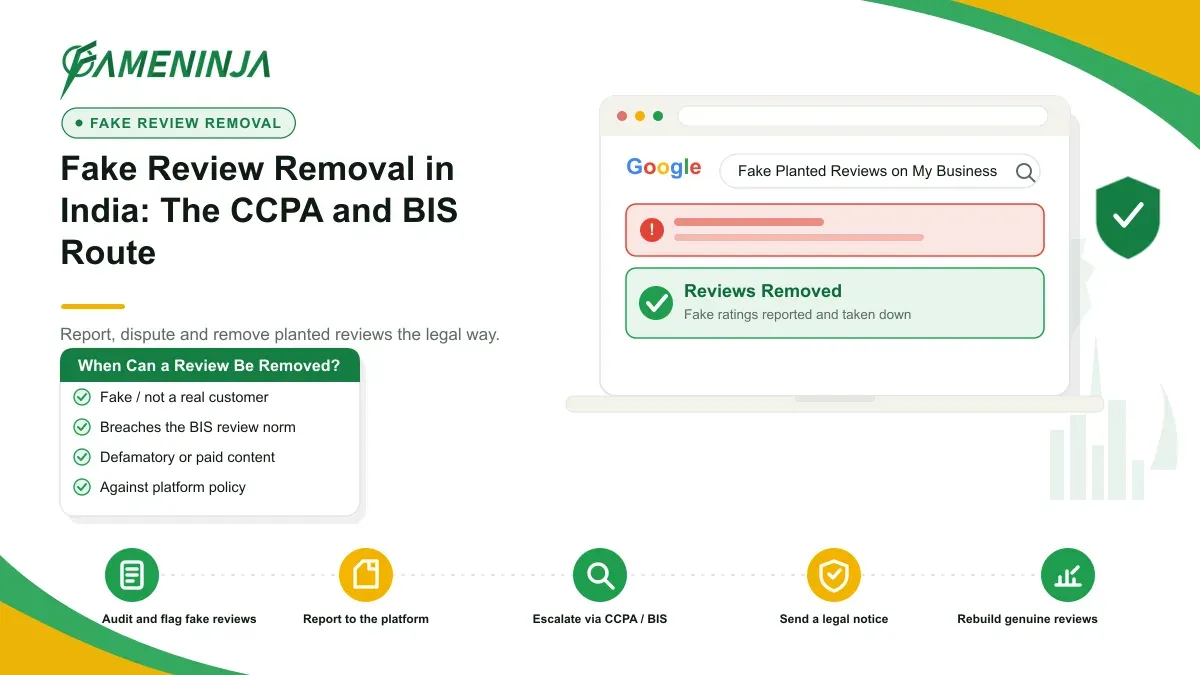
A cluster of one-star reviews lands overnight. The wording repeats. The names look invented. None of the reviewers ever bought from you. If that describes your Google Business Profile, your Practo page, or your marketplace listing, you have a fake or planted review problem, and you want to know your options under fake review removal India law. Here is the honest starting point. India now treats fake and paid reviews as a consumer-protection matter, not a grey area. The Central Consumer Protection Authority (CCPA) and the Bureau of Indian Standards (BIS) have both drawn lines. Google tightened its own review rules again in 2026. That gives a genuine business real grounds to act. It does not mean every bad review can come down. This guide explains what the rules actually say, which reviews qualify, and the two routes that get fake reviews removed. It is written for the business owner, not the lawyer, though a lawyer should confirm anything you rely on.
Quick answer: Fake and paid reviews are treated as unfair trade practices in India under the Consumer Protection Act, 2019, the CCPA dark patterns guidelines of 2023, and the BIS IS 19000:2022 review standard. To remove one, report it to the platform on policy grounds, and where it is defamatory or clearly planted, escalate with a legal notice. Genuine negative reviews stay.
This is general information, not legal advice.
This guide focuses on the legal route to removing fake reviews in India, the CCPA and BIS angle. For platform-by-platform removal steps on JustDial, Trustpilot and Sulekha, see our cross-platform fake review removal guide.
What counts as a fake review under Indian law
A fake review is a review that misrepresents a real customer experience. In practice, the term covers a few distinct things, and the difference matters when you go to remove one.
A fake review is written by someone who never used your product or service. That includes bot-generated reviews, review-farm reviews bought in bulk, and reviews posted from invented accounts.
A paid review is written in exchange for money or benefit and presented as an ordinary customer opinion. The payment is hidden from the reader.
A planted review is posted by a competitor, a disgruntled former employee, or someone acting for them, to damage a rival rather than to describe a real transaction.
An incentivised review sits in a grey zone. It is a real customer nudged into leaving a positive rating with a discount or a gift, without disclosure.
Indian consumer law does not use all of these words, but it targets the behaviour behind them. The BIS standard defines the problem precisely: a review is not a genuine consumer review if it has been "purchased and/or written by individuals employed for that purpose by the supplier or third party concerned." That single line captures most fake and paid reviews, whether they attack you or flatter you.
What most people get wrong is assuming the law is only about the reviews *against* them. It is not. The same rules apply to any positive reviews you may have bought in the past. If you are cleaning up an attack, clean up your own house first, because a platform or a regulator that looks closely will see both.
The CCPA route: dark patterns, misleading practices, and penalties
The Central Consumer Protection Authority is the regulator set up under the Consumer Protection Act, 2019. It sits under the Department of Consumer Affairs and can act against unfair trade practices and misleading advertisements. You can read about its mandate on the Department of Consumer Affairs site.
In November 2023, the CCPA notified the Guidelines for Prevention and Regulation of Dark Patterns, 2023. These name thirteen specific dark patterns, deceptive design choices that push consumers into actions they did not intend. The official summary is on the government press release.
Fake reviews are not listed as a standalone dark pattern by name. The relevant hook is different. A paid review dressed up as an organic customer opinion sits close to the guideline on a "disguised advertisement," and the wider Consumer Protection Act, 2019 already treats a false or misleading representation about goods or services as an unfair trade practice and a misleading advertisement. So the legal grounding for acting against fake reviews comes from the Act itself, with the dark patterns guidelines and the BIS standard giving it shape.
On penalties, be careful and precise. Under the Consumer Protection Act, 2019, the CCPA can impose penalties for misleading advertisements, reported in commentary at up to Rs 10 lakh, and up to Rs 50 lakh for repeat offences. In its dark patterns enforcement, the CCPA has issued penalties against digital platforms; press coverage described a total of around Rs 20 lakh across several platforms. Treat these figures as context on what the regulator can and has done, not as a promise about your specific case. The penalty falls on the offender, and it does not by itself pull a review off your listing. That still runs through the platform or a court.
For an Indian business, the practical value of the CCPA framing is added weight in a legal notice and a credible complaint channel. If a competitor is running a review campaign against you, the conduct is arguably an unfair trade practice, and that is a stronger footing than simply flagging a rude comment. Our reputation repair work often starts exactly here: mapping which reviews are policy violations and which are lawful opinion.
The BIS route: IS 19000:2022 and what platforms are measured against
The Bureau of Indian Standards published IS 19000:2022, "Online Consumer Reviews: Principles and Requirements for their Collection, Moderation and Publication," in late 2022. You can confirm the standard through the Bureau of Indian Standards. It applies to any organisation that publishes consumer reviews online, whether the seller collects reviews itself, hires a third party to do it, or runs an independent review platform.
The standard sets guiding principles that a review system should meet: integrity, accuracy, privacy, security, transparency, accessibility, and responsiveness. It places duties on two parties. The review author must have had a genuine experience and must not be paid to post. The review administrator, the platform, must verify, moderate, and take down reviews that break these principles.
Two points matter for your removal case.
First, IS 19000 is currently a voluntary standard. The government has said it may make the framework mandatory if fake reviews keep spreading, but as things stand a platform is not legally bound to follow it in the way it is bound by a statute. That is an honest limitation you should hold in mind. The standard is a benchmark and a persuasion tool, not an automatic takedown lever.
Second, because it is the recognised national benchmark, IS 19000 is useful language. When you report a review or send a notice, framing the review as a breach of the BIS principles of integrity and accuracy, backed by the Consumer Protection Act, reads as informed and serious. Platforms respond better to that than to "this review is unfair."
The policy work behind these frameworks sits partly with the Ministry of Electronics and Information Technology, which oversees the intermediary rules that govern how platforms handle user content. Reviews are user content, so those rules are part of the same picture.
Google's 2026 review policy and AI-generated reviews
Most Indian businesses feel this problem first on Google. Google runs its own content rules for reviews, separate from Indian law, and it updated its enforcement again through 2025 and into 2026.
Google's review content policy prohibits fake engagement, content from people with a conflict of interest, and, since 2025, AI-generated review text. A review written by ChatGPT or a similar tool breaks the policy even if the underlying visit was real. Google's Gemini-based moderation now screens many reviews before they publish and removes patterns it flags as machine-written or spammy. You can read the current rules on Google's own contribution and review content policy page.
For you, this means the strongest report to Google is one that maps a review to a named policy line. "Off-topic," "spam," "conflict of interest," "impersonation," and "not based on a real experience" are the grounds Google acts on. A report that says "this is defamatory under Indian law" is often weaker to Google than one that says "this account posted the same text on five competitors in one hour, which is fake engagement." Match the review to the platform's own words.
Google removing a review is a policy decision, not a legal one. It is fast when it works and silent when it does not. That is why the second route, the legal notice, exists. If you want to understand how Google removals fit the bigger picture of search cleanup, our guide to removing content from Google covers the wider terrain, including results that are not reviews at all.
Two removal paths: the platform report and the legal notice
There are two honest routes to remove a fake review in India, and serious cases use both.
Path one: the platform report. Every major platform has a flagging flow and a stated content policy. Google, Practo, JustDial, Glassdoor, AmbitionBox, and the marketplaces each run their own process. Under India's intermediary rules, larger platforms must also have a grievance officer you can escalate to if the first flag is ignored. The method is the same everywhere:
- Identify the exact policy the review breaks. Fake engagement, conflict of interest, off-topic, impersonation, or a genuine experience that never happened.
- Gather evidence. Screenshots with visible dates, the reviewer's other activity, any pattern of repeated wording, and proof the person was never a customer.
- Flag the review through the in-product option, then escalate to the grievance officer in writing if nothing moves within the platform's stated window.
- Keep a record of every reference number. Persistence and paperwork win these cases more often than a single dramatic complaint.
Path two: the legal notice. Where a review is defamatory, or clearly planted by a competitor, a lawyer's notice raises the stakes. It can go to the reviewer if identifiable, and to the platform as the intermediary hosting the content. The grounds usually cited are defamation, now under the Bharatiya Nyaya Sanhita rather than the old penal code, and unfair trade practice under the Consumer Protection Act, 2019. Where a platform will not act voluntarily and the content is unlawful, a court order is the instrument that compels removal. That is the honest ceiling: the strongest reviews for removal are the ones a court would call unlawful, and getting there takes time and a lawyer.
These two paths are the heart of fake review removal India law in practice. Most of what we do on the remove negative reviews service is deciding, review by review, which path fits, and running the paperwork so it actually lands.
What is realistically possible
This is the section to read twice, because it is where honest expectations live.
Only two kinds of review realistically qualify for removal. The first is a fake or policy-violating review: a bot, a bought review, a competitor plant, an off-topic rant, impersonation, or content that breaks the platform's stated rules. The second is a defamatory review that states a damaging falsehood as fact, which a legal notice or court order can address.
Everything else stays. A genuine negative review from a real customer who had a bad experience is protected opinion, and no law in India requires a platform to delete it because you dislike it. If a real patient found your clinic's waiting time long, or a real buyer received a late delivery, that review is lawful. Trying to strip it out is both futile and, if you fake counter-reviews to bury it, a violation in its own right.
So set the expectation clearly. There is no guaranteed removal, no fixed timeline, and no button that clears a listing. What works is a sorted, evidenced, review-by-review effort: remove what qualifies, and out-earn the rest with a steady flow of real, satisfied customer reviews. Suppression and deletion are different promises. Deletion takes down the specific fake review. Suppression, through genuine new reviews and stronger listings, lowers the weight of the negatives that lawfully remain. Most real cases need both, and our wider online reputation management approach is built around that split rather than a single takedown.
If someone promises to erase every one-star rating you have, walk away. That is the tell of a vendor who will either fake reviews or waste your money.
How your reviews show up in AI search
Reviews no longer live only on the platform. When a customer asks ChatGPT, Perplexity, or Google's AI Overviews "is this clinic any good" or "should I buy from this brand," the AI answer is stitched together from your ratings, your review text, and third-party mentions. A cluster of planted one-star reviews can therefore poison an AI summary, not just a Google listing.
This matters because AI engines quote and paraphrase rather than link. A defamatory or fake review that a person might scroll past becomes a sentence the AI states as background fact. Removing the fake review at the source is what changes the AI answer, because these systems read from the same public reviews you are cleaning.
Two things help. Keep your genuine review base current and specific, because AI engines weight recent, detailed, verifiable reviews over old or generic ones. And make sure your own site and profiles state the facts clearly, in plain sentences an AI can lift, so the model has an accurate source to prefer. This is the reputation-repair layer that sits beneath the removal work, and it is why we treat AI-search visibility as part of the same job rather than a separate service.
An anonymized example
A mid-sized services firm in a Tier-1 city came to us after a burst of one-star reviews appeared on its Google profile inside a single weekend. The reviews shared near-identical phrasing, several accounts had no other activity, and a few named a "service" the firm did not even offer.
The work was unglamorous and it followed the two paths above. We sorted the reviews into three buckets: clear policy violations, arguably defamatory statements, and a couple of genuine older complaints that had nothing to do with the attack. For the policy-violation bucket, we filed platform reports that matched each review to a specific Google policy line, with dated screenshots and the pattern of repeated wording as evidence. For the defamatory statements, the firm's lawyer issued a notice framed on unfair trade practice and defamation grounds.
Not everything came down, and we told the client that at the start. The two genuine complaints stayed, because they were lawful opinion, and the firm answered them properly instead. The honest outcome was a cleaner listing, a documented trail if the attack repeated, and a plan to build real reviews so a future burst would carry less weight. No numbers are quoted here because every case moves differently, and anyone who quotes you a fixed success rate is guessing.
A calmer way to handle a review attack
A wave of fake reviews feels personal, and it is meant to. The steady response beats the panicked one. Sort the reviews, match each to a policy line or a legal ground, document everything, and act on the ones that genuinely qualify while building real reviews to carry the rest. That is the whole method, and it is honest work rather than a magic button.
If you are staring at a listing that does not reflect your business, we are happy to look at it with you and tell you plainly what is removable and what is not. Request a free ORM report, and browse more India-specific guides on the FameNinja blog. No hard sell, just an honest read on your options.