

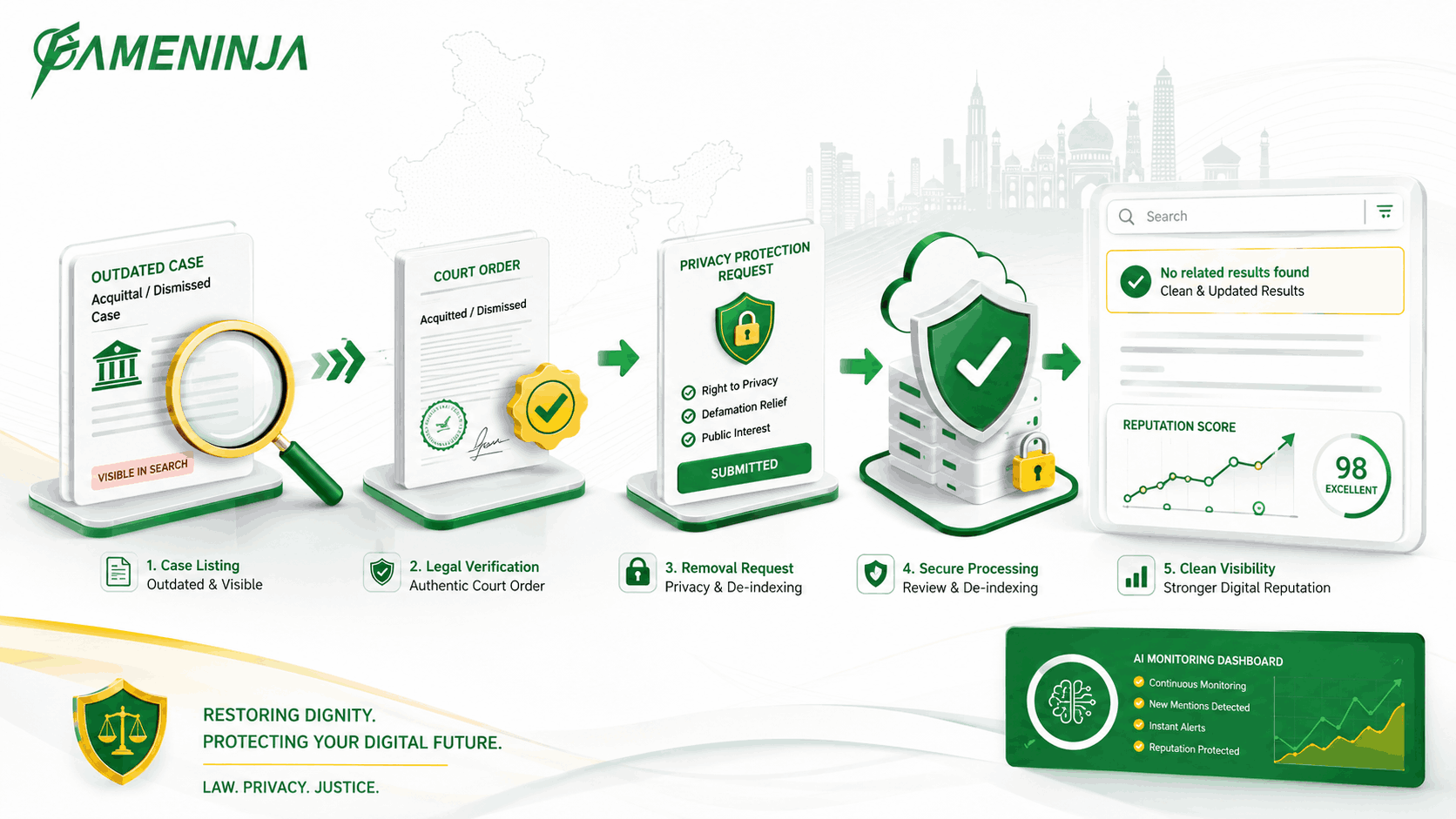
The court cleared you. The charge was dropped, the FIR quashed, the case dismissed, or you were honourably acquitted after years. On paper you are innocent. Yet type your name into Google and the old case is still sitting there, frozen at the moment of accusation, telling everyone who searches a story that the court already rejected.
This is one of the cruellest gaps in online reputation. The legal system moved on; the internet did not. The good news is that a cleared case is the strongest possible position from which to ask for removal, and a 2026 Delhi High Court ruling has made that argument stronger than ever. This guide walks through exactly how to get an acquittal or dismissed case taken out of Google search in India, what outcome to realistically expect, and where the limits are.
If you want the broader playbook first, read our pillar guide on deindexing court cases from Google. This article focuses on the cleared-case scenario, which follows its own rules.
Quick answer
If you were acquitted, discharged, or your case was quashed or settled, you can ask Indian Kanoon, Casemine, and Google to de-index your name from the record, usually by sending the certified court order. If they refuse, a writ petition in the High Court for a masking order is the next step. Courts in India typically order redaction of your name rather than deletion of the judgment, so the case stays public for its legal value but stops surfacing when someone searches your name.
Why a cleared case still ranks (and why that feels so unfair)
Search engines index court records because they are public documents. A dismissal or acquittal does not automatically erase the earlier filing from the databases that scraped it. Indian Kanoon, Casemine, and Google Scholar host the judgment, and Google ranks it because legal databases carry high authority and your name is the most specific query attached to it.
Here is the part that stings. The acquittal order is itself a document, but it often ranks below the original case, or never gets indexed against your name at all. So the accusation is loud and the vindication is quiet. Reversing that imbalance is the whole job.
The opinion worth stating plainly: an acquittal is not a footnote, it is the verdict. Anyone treating a cleared case as if it were still an open allegation is misreading the record, and Indian courts have started to agree.
What the 2026 Delhi High Court ruling means for you
This is the most important development for cleared individuals. In a landmark order, the Delhi High Court directed Google and Indian Kanoon to disable name-based searches for certain judgments, orders, and news articles. The order applies mainly to cases ending in acquittal, discharge, quashing, or settlement, and to matters of a purely private nature.
In an earlier matter, the Delhi High Court directed Google and Indian Kanoon to block a judgment involving a person acquitted in an NDPS case. The reasoning in these orders is exactly the argument a cleared person makes: once the matter ends in your favour and serves no continuing public interest, your privacy outweighs the case’s searchability.
Two honest cautions. First, the relief is de-indexing of your name, not deletion of the judgment. The record stays reachable by case number, citation, court, and date. Second, the higher courts have not settled this fully. The Supreme Court has stayed at least one direction asking Indian Kanoon to pull down a judgment and is still deliberating the scope of the right, a point Internet Freedom Foundation has tracked closely. So you are arguing from a strong, recent, but not final position. We cover the wider debate in our guide to the right to be forgotten in India.
De-indexing versus deletion: set your expectations now
This distinction decides whether you walk away satisfied or disappointed, so understand it before you start.
De-indexing your name stops the record from appearing when someone searches your name on Google. The judgment still exists; it just no longer answers to your name. Redaction is the version courts most often order on legal databases, where the judgment stays online for its legal reasoning while your identifying details are masked. Deletion, the complete removal of a judgment from the internet, is rare. Indian courts are cautious about rewriting the legal record, and they protect the public’s access to judgments as precedent.
So the realistic, honest outcome for most cleared individuals is this: your name stops pulling up the case, while the case itself survives in anonymised form. That is a win. It is not the same as the case never having existed, and any service promising the latter is overpromising.
Step by step: getting a cleared case off Google
Step 1: Gather your clearing documents
Get certified copies of the order that cleared you, whether it is the acquittal judgment, the discharge order, the FIR-quashing order, or the settlement. This certified document is your single most powerful asset. Without it, every request is just an opinion. With it, you are presenting a court’s own conclusion.
Step 2: Map where the case appears
Search your name with “court,” “case,” “FIR,” and the case number. List every URL, the platform hosting it (Indian Kanoon, Casemine, Google Scholar, news sites), and where each ranks. Screenshot with dates. This map tells you how many separate requests you will need to send, because each platform is removed separately.
Step 3: Approach Indian Kanoon with the certified order
Indian Kanoon is usually the most visible source. Email their team with the certified clearing order and a clear, calm explanation that the matter concluded in your favour and is private in nature. When the order is genuine and the case ended in acquittal or quashing, they generally consider redacting your name. Without a court order they are far less likely to act on reputation grounds alone. The same approach works for Casemine, which tends to be a little more responsive. Our detailed walkthrough for the legal-database scenario sits in our guide to removing an FIR or court case from Indian Kanoon.
Step 4: File the Google removal request
Submit Google’s content removal request for the specific URLs, attaching the certified order and explaining that the matter is concluded and private. Google is more willing to de-index where there is a clear legal basis and the content is no longer of public interest. Keep your URLs exact; a precise request is acted on faster than a broad one.
Step 5: If refused, escalate to a writ petition
If the platforms or Google refuse, the next step is a writ petition in the High Court under Article 226, seeking a right-to-be-forgotten or masking order naming the exact URLs. After the 2026 rulings, counsel has strong, recent precedent for cleared cases. These petitions usually take a few months, with interim relief possible in urgent matters.
Step 6: Lift the acquittal so it ranks
Removal is only half the repair. Even after de-indexing, you want the truth to be the thing people find. Publish and rank accurate content, your professional profile, your work, your achievements, so a name search leads with who you are now, not an accusation the court rejected. This is where our reputation repair work comes in, and it protects you if a stray copy of the case resurfaces later.
How this plays out in AI search (ChatGPT, Perplexity, Gemini)
In 2026 you have to think past Google. When someone asks an AI assistant “was [your name] involved in a criminal case,” ChatGPT, Perplexity, or Gemini may answer from older training data or by retrieving a news page that still describes the accusation, even after Google has de-indexed it. The AI does not automatically know you were cleared unless the clearing is visible in the sources it reads.
This is why removal alone is incomplete. The fuller fix is to make sure the acquittal is itself well-documented and indexed, so that any system summarising your name has the verdict in front of it, not just the charge. Building that accurate, citable footprint is part of modern reputation work, and it is the difference between an AI answer that clears you and one that quietly repeats an old allegation.
FameNinja example: a professional cleared after a long case
A professional we supported had been acquitted after a prolonged proceeding. The matter was over, but the original case still ranked on a legal database for his name, and a hospital empanelment process had flagged it. He had the acquittal order but had not sent it anywhere, assuming the internet would catch up on its own. It does not.
We assembled his certified acquittal, sent structured requests to the legal databases and to Google, and prepared the ground for a masking petition in case of refusal. Alongside that, because removal takes time and is never certain, we built accurate professional content so his name led with his credentials. The pattern is the lesson here, with no invented timelines: a certified clearing document plus patient, parallel suppression is what turns a cleared case from a liability back into a closed chapter.
Frequently asked questions
I was acquitted. Can I get the case removed from Google?
You are in the strongest position to ask. Send the certified acquittal order to Indian Kanoon, Casemine, and Google requesting de-indexing of your name. If refused, a writ petition for a masking order is the next step, and 2026 rulings favour cleared cases. Expect redaction of your name rather than deletion of the judgment.
What is the difference between redaction and deletion?
Redaction masks your identifying details while the judgment stays online for its legal reasoning. Deletion removes the judgment entirely and is rare in India. Courts prefer redaction because it protects both your privacy and public access to legal precedent.
Do I need a court order, or is the acquittal order enough?
Often the certified acquittal order alone persuades platforms to redact your name. If they refuse, you then seek a separate court order, a masking direction through a writ petition, to compel de-indexing.
How long does removal take after acquittal?
Platform requests can resolve in a few weeks when the documentation is strong. A writ petition, if needed, usually takes a few months. Suppression of any remaining copies runs alongside and takes additional time.
Will the case disappear from my actual record?
No. De-indexing changes what Google shows; it does not alter court records or your legal history. The acquittal already governs your legal status. This work is about what the public sees in search, not the file at the registry. [LEGAL REVIEW]
What if there are news articles about the original case?
News articles are handled separately from legal databases. Some publishers will update or append the acquittal; others require a different approach. We cover this in our guide to deindexing negative news from Google.
Can someone else’s cleared case be removed by me?
Generally no. The person who was cleared, or their authorised representative, must make the request. You cannot remove a third party’s record on their behalf without authority.
Is the right to be forgotten guaranteed for acquitted people in India?
It is strong but not absolute or fully settled. The 2026 Delhi High Court orders favour acquittal, discharge, quashing, and settlement cases, but the Supreme Court is still deliberating, and a public-interest exception remains for figures like public officials. [LEGAL REVIEW]
The bottom line
Being cleared is the best ground there is for getting a case off Google, and Indian law in 2026 is leaning your way for acquittals, discharges, quashings, and settlements. The realistic outcome is de-indexing or redaction of your name, not deletion of the judgment, and the right is strong but not yet finally settled at the Supreme Court. Send the certified clearing order first, escalate to a masking petition if refused, and build accurate content so your name leads with the truth.
You should not have to keep answering for something the court already closed. If you want a clear, confidential read on your options, chat with us on WhatsApp or request a free consultation. We will tell you honestly what is achievable in your case, and what is not.