

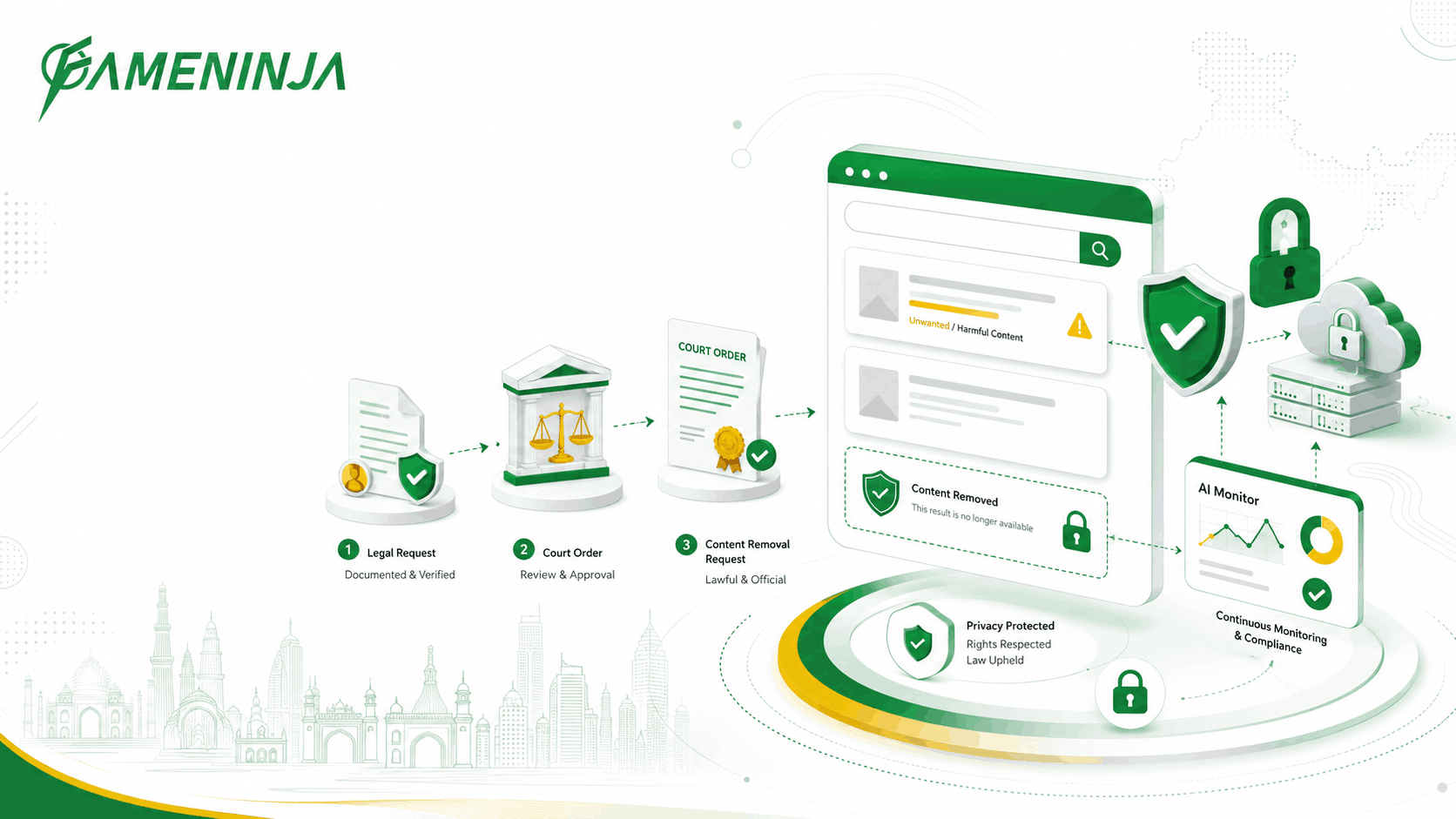
You have already asked Indian Kanoon to redact your name. You have filled in Google’s removal form. Maybe both said no, or simply never replied. The case is still the first thing a client, an investor, or a prospective in-law sees when they search your name. At this point, the polite requests are over, and the real question is the legal one: how do you get a court order that forces Google to take the link down?
This guide explains exactly that. Which court you approach, what you ask for, the two main legal routes in India, what a 2026 Delhi High Court ruling changed for people who were acquitted or discharged, and the honest limits of what any order can achieve. This is the route most people reach for last, and it is the one that actually moves search engines.
For the wider picture of removing legal records, start with our pillar guide on deindexing court cases from Google. This article goes deep into the court-order route specifically.
Quick answer
In India, you usually get content removed from Google with a court order in one of two ways: a writ petition in a High Court under Article 226 seeking a “right to be forgotten” or masking order, or a complaint to the Data Protection Board under the DPDP Act 2023. Google generally acts on a specific, certified order that names the exact URLs. Courts more often order redaction or de-indexing of your name than full deletion of a judgment.
When you actually need a court order
Not every removal needs a judge. Before you spend months in litigation, it is worth knowing where the line sits.
You probably do not need a court order if the content is a fake review, a defamatory blog post on a small site, a news article the publisher is willing to update, or a page that already violates Google’s own policies (doxxing, non-consensual intimate images, certain financial or medical data). Those have direct request routes, and we cover them in our guide to removing negative articles and content.
You usually do need a court order when the content is a genuine court judgment or FIR hosted on a legal database, when Indian Kanoon or a news outlet has refused a voluntary request, or when Google has told you it needs a legal basis to de-index a lawful page. Search engines will not remove a truthful, lawfully published record on request alone. They want a court speaking, not you.
The opinion most lawyers will not say out loud: many people rush to court when a well-argued representation to the platform, backed by the right documents, would have worked. Litigation is a heavy tool. Reach for it when the lighter ones have genuinely failed, not before.
The two legal routes in India
India does not yet have a single, settled “right to be forgotten” statute. What it has is a patchwork of constitutional privacy rulings and a new data-protection law. Two practical routes come out of that.
Route one: write a petition in the High Court
This is the established path. You file a writ petition under Article 226 of the Constitution before the High Court with jurisdiction, naming the search engine, the hosting platform (often Indian Kanoon or a news publisher), and sometimes the Union of India. You ask the court to recognise your right to privacy under the Puttaswamy line of judgments and to direct the respondents to mask your name or de-index the specific URLs.
Realistic timeline: a writ petition for this kind of relief usually takes two to six months, depending on the court’s backlog and whether the respondents contest it. Some petitioners get interim relief much faster. A civil court at Tis Hazari, in an April 2026 matter, granted interim relief directing platforms to de-index and remove links within 36 hours and to restrain further publication until the case was decided. That speed is the exception, not the rule, but it shows interim orders are possible. [[LEGAL REVIEW] confirm current status before citing the 36-hour figure to a client.]
Route two: the DPDP Act and the Data Protection Board
The Digital Personal Data Protection Act 2023 gives you the right to correction and erasure of your personal data held by a data fiduciary. In principle, you can file a complaint with the Data Protection Board of India, which can issue binding directions and impose penalties on companies that ignore them. For many people, this is a cheaper and faster alternative to a writ.
Be careful here, and this is the honest part. The Delhi High Court itself has observed that the DPDP Act does not, in plain terms, recognise a standalone right to be forgotten for judicial records. The erasure right is real for ordinary personal data, but its reach over published court judgments is still being worked out. Treat the DPDP route as promising and improving, not as a guaranteed switch. [LEGAL REVIEW]
What the 2026 Delhi High Court ruling changed
This is the development that matters most right now. In a landmark order, the Delhi High Court upheld the right to be forgotten and directed Google, other search engines, and Indian Kanoon to disable name-based searches for certain judgments, orders, and news articles.
The order matters because of who it helps. It applies mainly to cases ending in acquittal, discharge, quashing, or settlement, and to matters of a purely private nature. In other words, if a court cleared you, the reasoning of this ruling is squarely in your favour. We go deeper into that scenario in our guide on removing an acquittal or dismissed case from Google.
Two cautions sit beside the good news. First, the relief is usually de-indexing of your name, not deletion of the judgment. The case stays reachable by case number, citation, court, and date; it just stops surfacing when someone types your name. Second, the law is genuinely unsettled at the top. The Supreme Court has stayed at least one High Court direction asking Indian Kanoon to pull down a judgment, and is still deliberating on the exact scope of the right. So the precedent is strong but not final. Source your hopes accordingly.
Step by step: getting a de-indexing or masking order
Here is the sequence we follow for clients, simplified.
First, document everything. Run searches for your name plus “court,” your name plus the case type, and the bare case number. Record every URL, which platform hosts it, and where it ranks. Screenshot the results with dates. This evidence pack is what your counsel builds the petition on, and it is what Google later needs to act precisely.
Second, exhaust the representation stage. Send a written request to Indian Kanoon, Casemine, or the publisher, and to Google, with your certified court documents (the acquittal order, the quashing order, the settlement). Many requests succeed here, and even those that fail create a record that you tried, which strengthens a later petition.
Third, brief a lawyer who has done right-to-be-forgotten matters specifically. This is a niche. A general litigator will take longer and charge more to learn it. Your counsel decides between the writ route and the DPDP complaint based on your facts.
Fourth, file and seek interim relief. The petition asks for de-indexing or masking of named URLs. Where the harm is ongoing and serious, counsel can press for an interim order so you are not waiting months for first relief.
Fifth, serve the final order correctly. An order only helps if it reaches the right desk in the right form. Google acts on certified orders that identify the exact URLs. A vague order, or one that names a person but not the links, slows everything down.
What a court order can and cannot do
This is the section competitors skip, and it is the one that protects you from disappointment.
A court order can direct Google to de-index specific URLs so they stop appearing for name searches. It can direct Indian Kanoon to mask your name within a judgment. It can restrain a publisher from republishing. Those are real, enforceable outcomes.
A court order usually cannot erase a judgment from the legal record. Indian courts are cautious about rewriting history. They far more often order redaction, where the judgment stays online for its legal principles while your identifying details are masked, than complete deletion. A court order also cannot touch your actual case file at the registry; de-indexing changes what Google shows, not what the court holds. And it cannot beat the public-interest exception: the right to be forgotten is not absolute, and courts will refuse removal where the information serves an overwhelming public interest, such as the criminal record of a serving public official or a politician.
So the honest promise is this. With the right order, you can very often stop your name from pulling up the record on Google. You cannot reliably make the record cease to exist. Anyone promising the second thing is selling you something they cannot deliver. If full removal is impossible, the realistic path is suppression, and our content suppression service is built for exactly that gap.
How this shows up in AI search (ChatGPT, Perplexity, Gemini)
A point most people miss in 2026. Even after you de-index a page from Google, an AI assistant may still surface the underlying facts. When someone asks ChatGPT, Perplexity, or Gemini “is there any legal case against [your name],” these tools answer from a mix of their training data and live retrieval. A judgment that has been masked on Google can still sit inside an older crawl, or be summarised from a news article that was never removed.
That means a court order is necessary but not always sufficient for full reputation repair. The complete job includes getting the source pages updated or removed so the AI models have nothing to retrieve, and building accurate, authoritative content about you that these systems can cite instead. We treat search engines and AI answers as two fronts of the same problem, which is why our work increasingly pairs legal removal with reputation repair and AI-visibility work.
FameNinja example: a founder cleared, but still haunted
A founder we worked with had been named in a commercial dispute that ended in his favour. The matter was settled and the suit withdrawn. Yet the old order sat on a legal database, ranking second for his name, and two investors had quietly raised it during due diligence.
We assembled the evidence pack, sent certified copies of the settlement to the database and to Google, and were refused at the platform stage. We then supported his counsel through a right-to-be-forgotten petition arguing the matter was private and concluded. In parallel, because litigation takes time, we built accurate content about his company and his work so the dispute stopped dominating the first page. By the time the de-indexing direction came through, his name search already led with his business, not the old suit. No invented timelines here; the point is the pattern. Removal and suppression run together, because each covers the other’s gap.
Frequently asked questions
Which court do I approach to remove content from Google in India?
For a right-to-be-forgotten or masking order, you typically file a writ petition under Article 226 in the High Court that has jurisdiction over you or the respondents. The DPDP Act offers an alternative through a complaint to the Data Protection Board. Your lawyer chooses based on your facts. [LEGAL REVIEW]
How long does it take to get a court order to de-index a URL?
A writ petition for this relief usually takes two to six months, depending on the court’s backlog and whether respondents contest it. Interim relief can come faster in urgent matters, sometimes within days, but that is not guaranteed.
Will the court delete the judgment entirely?
Rarely. Indian courts lean towards redaction and de-indexing of your name rather than deleting a judgment. The record usually stays reachable by case number and citation; it just stops surfacing for name searches.
Does the DPDP Act give me a right to be forgotten?
The DPDP Act 2023 gives a right to correction and erasure of personal data, and the Data Protection Board can issue binding directions. Its application to published court judgments is still being settled, and the Delhi High Court has noted the Act does not expressly recognise a standalone right to be forgotten. Treat it as a strong but evolving route. [LEGAL REVIEW]
Can Google refuse a court order?
Google acts on valid, specific orders that identify the exact URLs. Problems usually come from orders that are vague, name a person but not the links, or are not properly certified. A precisely drafted order, correctly served, is what gets acted on.
What if the case is in the public interest?
The right to be forgotten is not absolute. Courts will refuse removal where the information serves an overwhelming public interest, such as the record of a serving public official or politician. Private disputes and cleared matters are treated very differently from these.
Can I do this without a lawyer?
You can file a representation to platforms and Google yourself, and many people succeed at that stage. The court route, writ or DPDP complaint, is best handled by counsel who has done these matters. It is a narrow specialism, and getting the drafting right saves months.
The bottom line
A court order is the strongest tool for removing lawful content from Google in India, and after the 2026 Delhi High Court ruling, the ground is more favourable than it has been, especially for people who were acquitted, discharged, or who settled. Two routes are open: a writ petition under Article 226, or a complaint under the DPDP Act. Both more often deliver de-indexing of your name than deletion of the record, and both bend to the public-interest exception.
Get the evidence right, exhaust the polite requests first, brief a lawyer who has done this before, and pair the legal route with suppression so your name search improves while the case moves. If you want a calm, honest assessment of which route fits your situation, chat with us on WhatsApp or book a free, confidential consultation. We have handled court-record removals across India and the UAE, and we will tell you plainly what is and is not possible in your case.