

Someone uploaded obscene content involving you online. Or an intimate video was leaked without your consent. Or you’re being harassed with sexually explicit material. You know something can be done about it, but you don’t know exactly which legal provision to use or how to actually start the removal process.
Section 67 of the Information Technology Act, 2000 is the primary weapon available to Indian victims of online obscene content. It criminalizes the publishing, transmission, or distribution of obscene material in electronic form, with penalties ranging from 3 to 7 years imprisonment and fines up to Rs. 10 lakhs.
But here’s what most legal explainers on Section 67 miss: the section isn’t just about punishing offenders. It’s also your tool for getting content removed. When you file a complaint under Section 67, you activate the intermediary liability provisions of the IT Act, which obligate platforms to remove the content. The criminal prosecution and the content removal are two parallel tracks, and most victims need both.
This guide is the victim-side playbook. Not a legal textbook. Not an academic analysis. A practical, step-by-step process for using Section 67 (and its sister sections 67A, 67B, and 66E) to get harmful content off the internet and hold offenders accountable.
Understanding Section 67 and Its Sister Sections
Section 67: Publishing Obscene Material in Electronic Form
This is the base provision. It covers any material that is “lascivious” or “appeals to prurient interest” or whose effect tends to “deprave and corrupt” people.
Penalties:
- First conviction: up to 3 years imprisonment and up to Rs. 5 lakhs fine
- Subsequent conviction: up to 5 years imprisonment and up to Rs. 10 lakhs fine
What it covers: Photos, videos, text, audio, and any other electronic material that meets the legal definition of “obscene.” The definition comes from the Supreme Court’s test in Ranjit D. Udeshi v. State of Maharashtra: whether the material, taken as a whole, tends to deprave and corrupt those whose minds are open to such immoral influences.
Section 67A: Publishing Sexually Explicit Material
This is the stronger version, specifically targeting sexually explicit content (as opposed to merely “obscene” content).
Penalties:
- First conviction: up to 5 years imprisonment and up to Rs. 10 lakhs fine
- Subsequent conviction: up to 7 years imprisonment and up to Rs. 10 lakhs fine
The difference from Section 67: Section 67A covers content that is “sexually explicit” in nature, which is a broader and more explicit category than “obscene.” In practice, leaked intimate videos and MMS recordings almost always fall under 67A rather than 67.
Section 67B: Child Sexual Abuse Material (CSAM)
If the obscene or sexually explicit content involves a minor (under 18), Section 67B applies with severe penalties.
Penalties:
- First conviction: up to 5 years imprisonment and up to Rs. 10 lakhs fine
- Subsequent conviction: up to 7 years imprisonment and up to Rs. 10 lakhs fine
Important note: This section applies not just to creating and distributing CSAM, but also to facilitating abuse of children online, such as grooming or soliciting minors through electronic means.
Section 66E: Violation of Privacy
This section specifically addresses the capture, publication, or transmission of images of a private area of any person without their consent.
Penalties: Up to 3 years imprisonment or up to Rs. 2 lakhs fine, or both.
Key feature: Unlike Sections 67/67A, Section 66E doesn’t require the content to be “obscene” or “sexually explicit.” It covers any private-area imagery captured or shared without consent. This makes it useful for cases where the content might not meet the legal threshold of “obscenity” but still violates privacy.
Important Court Rulings You Should Know
These rulings affect how Section 67 is applied in practice:
Allahabad High Court (2024): “Liking” Doesn’t Constitute an Offense
The Allahabad High Court ruled that merely “liking” an obscene post on social media does not constitute publishing or transmitting obscene material under Section 67. This means passive engagement (likes, reactions) is not covered. The person who actually publishes, forwards, or transmits the content is liable, not people who merely view or like it.
J&K High Court: Mere Possession of Device Not Sufficient
The J&K High Court ruled that merely possessing a device containing obscene material is not sufficient for conviction under Section 67. The prosecution must prove actual publication, transmission, or causing to be published or transmitted. This distinction matters because it focuses liability on the act of sharing, not just possession.
The “Electronic Form” Requirement
Section 67 specifically covers electronic transmission. This means the content must have been published or transmitted through electronic means (internet, messaging apps, email, social media, etc.). Physical distribution of obscene material is covered by other laws (BNS 2023/IPC), not the IT Act.
Step-by-Step: Using Section 67 to Remove Content
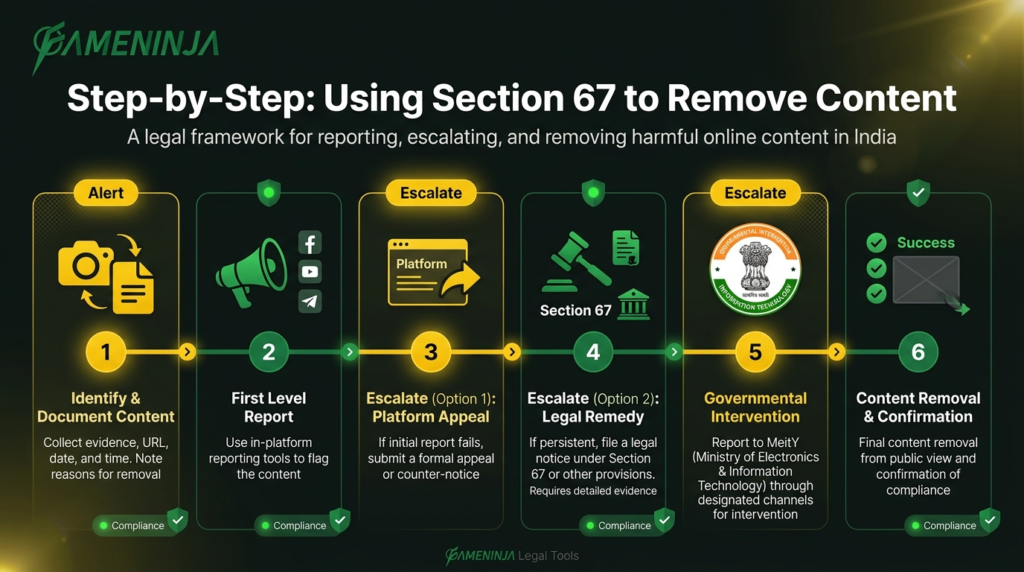
Step 1: Document the Content
Before anything else, preserve evidence. This is more important than you might think, because content can be deleted by the offender at any time, and without evidence, your case weakens significantly.
How to document:
Take screenshots of every instance of the content. Each screenshot should clearly show the URL, the posting account or sender, the date/time, and the content itself.
If it’s a video, record your screen while viewing it. Note the duration, the platform, and the URL.
Save the content offline if possible. Download it to a secure device. This isn’t comfortable when the content involves you, but it preserves the evidence.
Record the time you first discovered the content.
If the content was sent via WhatsApp, Telegram, or other messaging apps, screenshot the message, the sender’s number/username, and the group/channel details.
Evidence preservation for legal proceedings: Have a notary or cyber forensics expert certify the screenshots/recordings. Certified evidence carries more weight in court. If budget allows, get a forensic hash of the digital evidence (MD5/SHA-256) to prove it hasn’t been tampered with.
Step 2: File a Complaint on cybercrime.gov.in
Go to: cybercrime.gov.in
Select the appropriate category:
For sexually explicit content: “Report Cyber Crime Related to Women/Children” For other obscene content: “Report Other Cyber Crime” > “Social Media Related Crime” or “Data Theft”
Provide:
- Your details (name, contact, address)
- Platform/website where the content appeared
- URLs and screenshots
- Details of the accused (if known)
- Description of how the content violates Section 67/67A/67B/66E
Save your complaint number. This is essential for all follow-up.
Step 3: File an FIR at the Cyber Cell
While the cybercrime.gov.in complaint is important, filing an FIR (First Information Report) directly with the police adds a higher level of urgency.
Where to file:
Approach the Cyber Cell of your city’s police department. Major cities (Mumbai, Delhi, Bengaluru, Hyderabad, Chennai, Kolkata, Pune) all have dedicated cyber cells.
If your city doesn’t have a dedicated cyber cell, file at your local police station. Under Section 154 of CrPC (now BNSS 2023), the police are obligated to register an FIR for cognizable offenses, and offenses under Section 67 are cognizable.
What if the police refuse to register the FIR?
This unfortunately happens. If the police refuse:
Send a written complaint to the Superintendent of Police (SP) or Commissioner of Police File a complaint with the magistrate under Section 190 CrPC/BNSS Approach the National/State Human Rights Commission if the refusal involves a failure to protect privacy rights
Step 4: Send a Takedown Notice to the Platform
Under Section 79 of the IT Act (intermediary liability), platforms lose their “safe harbor” protection if they fail to remove content after receiving “actual knowledge” of its illegal nature. Your takedown notice provides that “actual knowledge.”
Your notice should include:
- Your name and contact information
- A statement that you are the person depicted/affected by the content
- The specific URLs of the offending content
- A statement that the content violates Sections 67/67A/66E of the IT Act 2000
- Your FIR or cybercrime complaint number
- A demand for immediate removal
- A warning that failure to remove will result in the platform losing safe harbor under Section 79
Where to send:
For Instagram/Facebook: [email protected] / [email protected] For YouTube: Legal removal request form + email to [email protected] For X (Twitter): [email protected] + in-app report For Telegram: [email protected] For websites: Look for a “Legal” or “DMCA/Takedown” contact. If none exists, use the domain’s WHOIS contact or hosting provider’s abuse email.
Timeline: Under IT Rules 2021, platforms must respond within 72 hours for privacy-related complaints and 15 days for other complaints.
Step 5: Google Deindexing
Even after the content is removed from the original platform, it may appear in Google search results (cached versions, thumbnails, etc.).
File a Google removal request using:
The Google personal information removal tool for non-consensual intimate images The Google legal removal form for content violating Indian law Reference your FIR/cybercrime complaint number
Google has specific processes for non-consensual intimate images and has been responsive to Indian legal removal requests.
For detailed strategies on deindexing, see our guides on removing negative images from Google and deindexing negative news.
Step 6: Court Orders (For Persistent Cases)
If the content keeps reappearing or if platforms are slow to respond, a court order provides definitive removal authority.
Interim injunction: You can petition the High Court for an immediate order directing all intermediaries to remove the content. Courts have been granting these orders with increasing speed for privacy violation cases.
John Doe order: If you don’t know the identity of the person who uploaded the content, a John Doe order directs all platforms and ISPs to remove the content, regardless of who uploaded it.
Compensation: Under the IT Act and through civil courts, you can seek compensation for damages caused by the unauthorized publication.
The Intermediary Timeline: What to Expect
Here’s a realistic timeline for content removal through different channels:
Platform-direct report (in-app): 24-72 hours Grievance Officer complaint: 72 hours (privacy) / 15 days (standard) cybercrime.gov.in: 2-4 weeks for investigation to begin FIR registration: Immediate to 1 week (depending on police cooperation) Google deindexing: 7-14 days after request Court interim order: 2-4 weeks Grievance Appellate Committee: 30 days
Filing through multiple channels simultaneously gives you the fastest overall resolution. Don’t wait for one channel to fail before trying the next.
Protecting Yourself and Preventing Future Incidents

Secure your devices and accounts. Enable 2FA on all accounts. Use strong, unique passwords. Be cautious about sharing intimate content digitally, as once shared, you lose control over copies.
Know your privacy settings. Review privacy settings on all social media platforms. Limit who can see your posts, photos, and stories.
Document agreements. If you’re sharing intimate content with a partner, be aware of the legal protections available under Section 66E and 67A. Non-consensual sharing of consensually captured intimate content is a crime in India.
Seek emotional support. Being a victim of online obscene content publication or MMS leaks is traumatic. Don’t hesitate to reach out to counseling services or support organizations. ICALL (9152987821), Vandrevala Foundation (1860-2662-345), and iCall (022-25521111) provide free and confidential support.
How FameNinja Approaches These Cases
At FameNinja, we handle content removal under Section 67 as part of our personal reputation management services, with specific sensitivity protocols:
We minimize exposure. Our team minimizes the number of people who see the content during the removal process. Only the necessary team members are involved, and all evidence is handled with strict confidentiality protocols.
We pursue parallel removal and legal tracks. Platform removal, Google deindexing, and legal action happen simultaneously, not sequentially. For intimate content especially, every hour matters.
We coordinate with legal counsel. For criminal prosecution under Section 67/67A, we work alongside the client’s criminal lawyer to ensure that evidence collected during removal supports the criminal case.
We monitor for re-uploads. After initial removal, we set up monitoring to catch any re-uploads or copies on other platforms. Automated monitoring combined with periodic manual checks catches most re-appearances within 24 hours.
For related strategies on managing the digital aftermath, see our guides on removing negative images from Google and court case deindexing.
FAQ
What is Section 67 of the IT Act?
Section 67 of the Information Technology Act, 2000 criminalizes the publishing or transmission of obscene material in electronic form. It covers any material that is “lascivious,” “appeals to prurient interest,” or tends to “deprave and corrupt.” Penalties include up to 3 years imprisonment and up to Rs. 5 lakhs fine for a first conviction, increasing to 5 years and Rs. 10 lakhs for subsequent convictions.
What is the difference between Section 67 and Section 67A?
Section 67 covers “obscene” material (a broader, somewhat subjective category based on community standards). Section 67A specifically covers “sexually explicit” material, which is a more defined and typically more explicit category. Section 67A carries higher penalties (up to 5 years and Rs. 10 lakhs for first conviction vs. 3 years and Rs. 5 lakhs under Section 67). Most MMS leak and intimate content cases fall under Section 67A.
Can someone be arrested for sharing an obscene video on WhatsApp?
Yes. Forwarding or sharing obscene or sexually explicit content through WhatsApp, Telegram, or any electronic messaging platform constitutes “transmission” under Sections 67/67A. The person who forwards the content is liable even if they didn’t create it originally. However, merely receiving or viewing the content (without forwarding) is not an offense under current court interpretations.
Does merely “liking” an obscene post constitute an offense under Section 67?
No. The Allahabad High Court ruled in 2024 that merely “liking” an obscene post does not constitute publishing or transmitting obscene material. Liability under Section 67 requires active publishing, transmission, or causing the content to be published or transmitted. Passive engagement such as viewing, liking, or reacting is not covered.
How do I file a complaint under Section 67?
File on cybercrime.gov.in (National Cyber Crime Reporting Portal) and simultaneously file an FIR at your local cyber cell or police station. Provide screenshots, URLs, and any evidence identifying the person who published the content. Include references to Section 67/67A/67B/66E as applicable. The cybercrime portal complaint can also be forwarded to the relevant police station for FIR registration.
Can I get obscene content removed without filing a criminal case?
Yes. You can request content removal through the platform’s in-app reporting process, through the platform’s Grievance Officer under IT Rules 2021, and through Google’s removal tools without filing a criminal case. However, filing a criminal complaint (cybercrime.gov.in or FIR) significantly strengthens your removal request because platforms take government-reported cases more seriously.
What if the content is on a website hosted outside India?
Indian law still applies to content accessible in India. You can file complaints under Section 67 regardless of where the hosting server is located. For removal, approach the hosting provider with a takedown notice citing Indian law and your FIR number. Google deindexing can remove the content from Indian search results. For persistent cases, an Indian court order can direct ISPs to block access to the specific URL.
Is revenge porn specifically covered under Indian law?
While India doesn’t have a standalone “revenge porn” law, sharing intimate content without consent is covered by Section 66E IT Act (privacy violation, up to 3 years), Section 67A IT Act (sexually explicit material, up to 5 years), Section 77 BNS 2023 (voyeurism, up to 3-7 years), and the DPDP Act 2023 (processing personal data without consent). Together, these provisions provide strong legal protection for revenge porn victims in India.